Kubernetes Gateway API Migration Guide for Modern Platform Engineering
Learn how Kubernetes Gateway API replaces legacy Ingress with scalable role-based traffic management for modern platform engineering and cloud-native infrastructure.
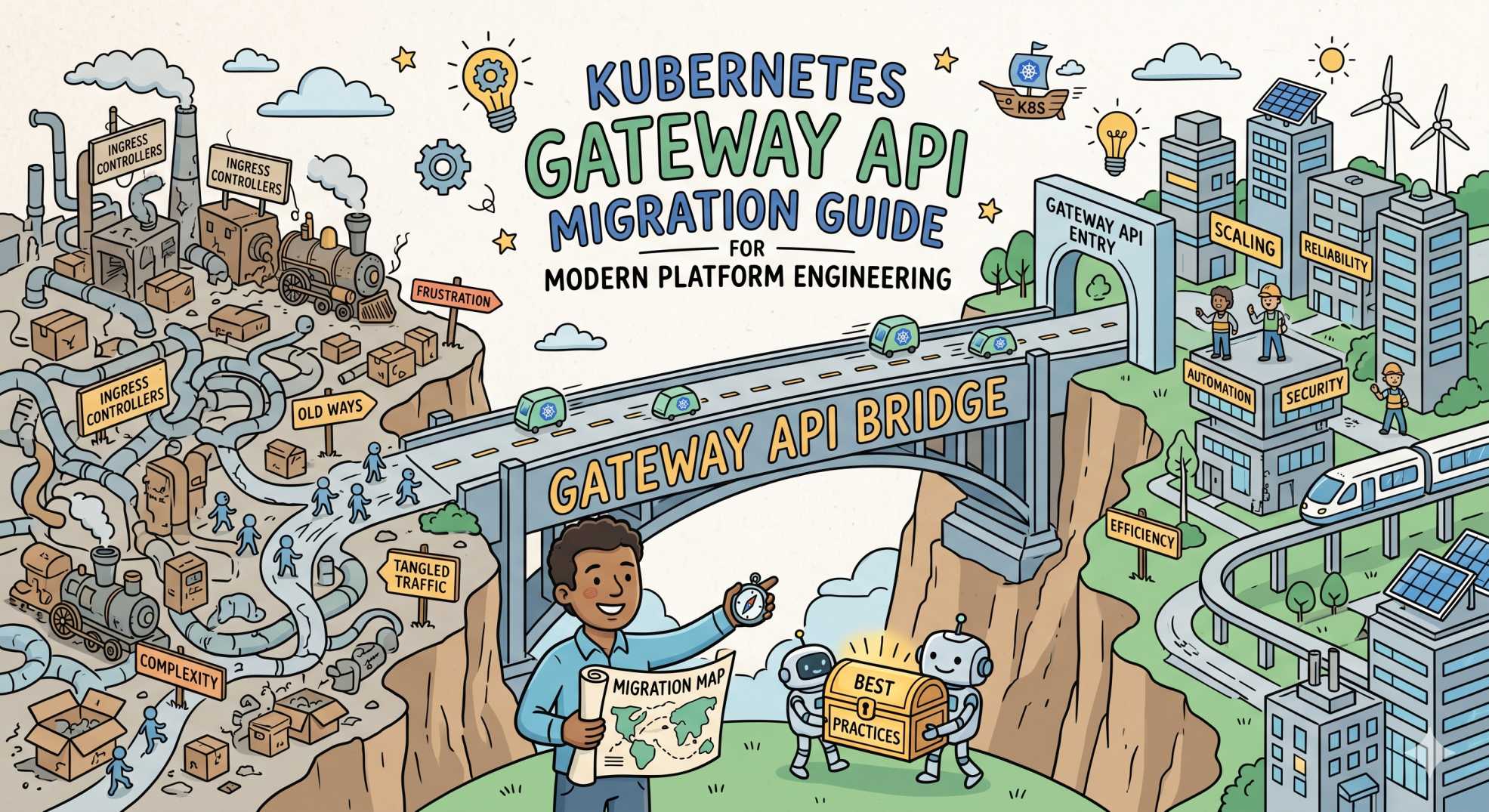
For years, Kubernetes Ingress worked well enough for basic traffic routing. But if you manage production clusters today, your Git repositories are probably overloaded with fragile NGINX annotations, vendor-specific routing hacks, and deeply coupled ingress configurations that are becoming harder to maintain at scale.
A simple timeout adjustment or path rewrite often requires engineers to inject long metadata annotations into shared manifests. One small syntax error can break routing for multiple applications across the cluster.
The problem is no longer an operational inconvenience. The traditional Kubernetes Ingress API is now effectively frozen, and the cloud-native ecosystem is rapidly moving toward the Kubernetes Gateway API standard for scalable, role-oriented traffic management.
Modern platform engineering teams are replacing annotation-heavy ingress architectures with structured Gateway APIs that separate infrastructure ownership from application routing logic.
Why Legacy Kubernetes Ingress Became Technical Debt
The original Ingress API was designed during the early Kubernetes era when clusters were smaller, and networking requirements were relatively simple.
Everything lived inside one monolithic object:
- TLS configuration
- Host routing
- Path rewrites
- Proxy behavior
- Security settings
- Vendor-specific annotations
As clusters scaled, this architecture became increasingly brittle.
Application developers frequently need access to shared ingress resources just to modify a routing path. Infrastructure teams had to review risky configuration changes for minor application deployments. Different ingress controllers introduced incompatible annotations, locking organizations into specific vendors.
For example:
- NGINX used one annotation format
- Traefik used another
- HAProxy implemented entirely different semantics
This created massive operational fragmentation across enterprise environments.
Kubernetes Gateway API vs Ingress
The Kubernetes Gateway API introduces a fully decoupled architecture built specifically for modern multi-tenant platform engineering.
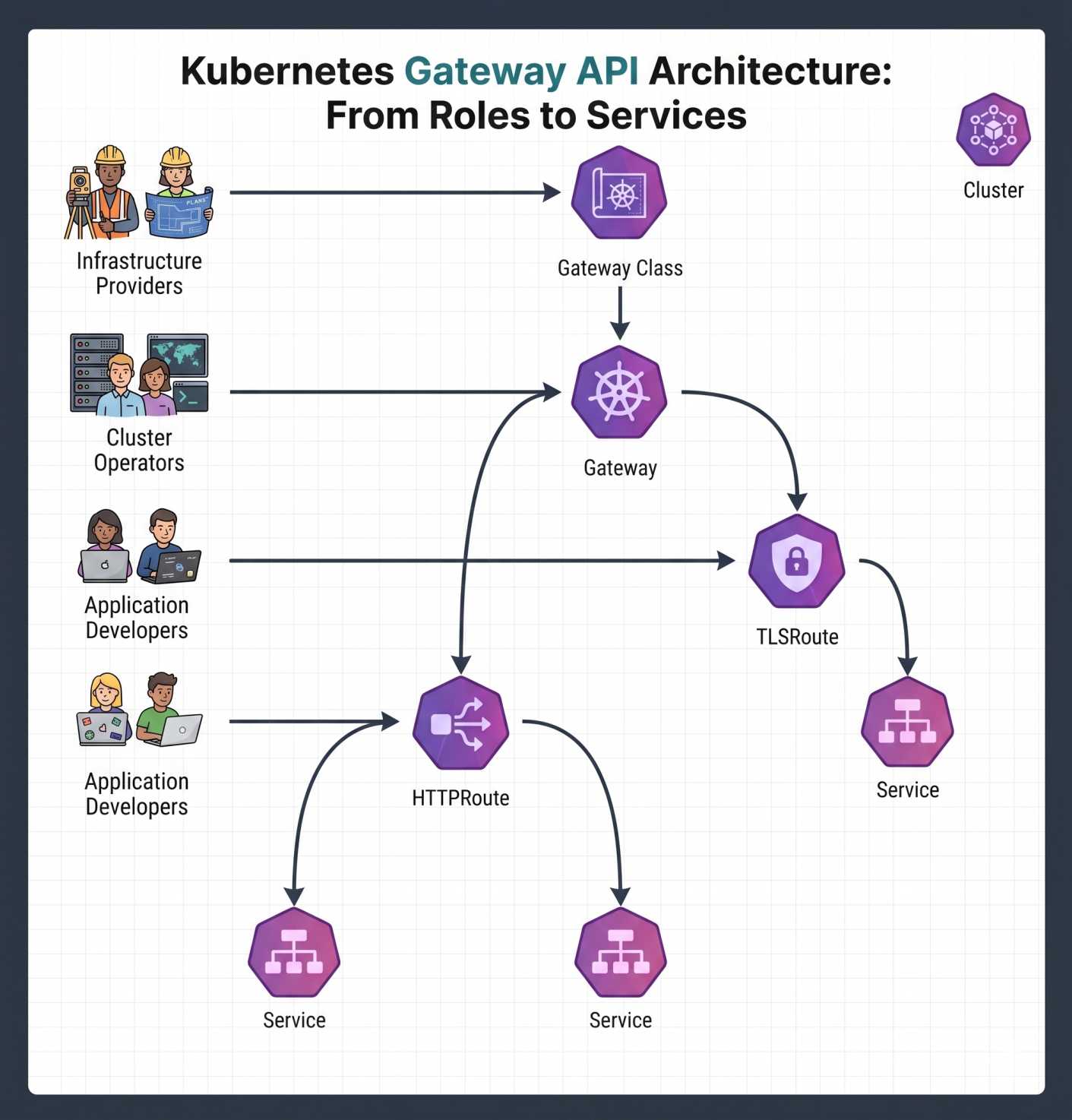
Instead of stuffing every routing behavior into a single resource, the Gateway API splits responsibilities into specialized components.
GatewayClass
Managed by infrastructure providers.
Defines the underlying networking implementation, such as:
- Envoy proxies
- Cloud load balancers
- Internal service mesh integrations
This works similarly to how StorageClass abstracts storage infrastructure.
Gateway
Managed by cluster operators.
Defines:
- Entry points
- Listener ports
- TLS certificates
- Shared network boundaries
This becomes the centralized cluster ingress layer.
HTTPRoute
Managed by application developers.
Contains only application-specific routing intent:
- URI matching
- Header rewrites
- Backend service targeting
- Traffic splitting
This separation eliminates the dangerous overlap between infrastructure administration and application delivery.
Application teams can safely modify their routing logic without touching shared cluster security controls.
Why Platform Engineering Teams Prefer Gateway API
The Gateway API solves several long-standing Kubernetes networking problems:
| Traditional Ingress | Kubernetes Gateway API |
|---|---|
| Annotation-heavy configs | Structured native resources |
| Vendor lock-in | Standardized APIs |
| Shared monolithic manifests | Role-based ownership |
| Difficult multi-team scaling | Namespace isolation |
| Hard-to-maintain rewrites | Native traffic policies |
| Weak extensibility | Modular policy attachments |
For enterprise platform teams, this dramatically improves governance, scalability, and operational safety.
Choosing a Modern Gateway Engine
Most organizations adopting the Gateway API standardize around Envoy-powered implementations.
Envoy Gateway
Best for:
- Standard cloud-native workloads
- CNCF-native environments
- Lightweight Gateway API deployments
Provides a streamlined implementation focused on standard Gateway API behavior.
Kgateway
Best for:
- Enterprise-scale traffic management
- Advanced routing architectures
- Multi-cluster platform environments
Offers stronger extensibility and large-scale operational capabilities.
The major advantage is that both solutions consume the same Gateway API resources.
Your manifests remain portable across implementations.
Ingress NGINX Migration Guide
Migrating from legacy Ingress controllers no longer requires manual rewrites.
The Kubernetes SIG-Network project provides an open-source migration utility called ingress2gateway.
Step 1: Install ingress2gateway
brew install ingress2gateway
Step 2: Install Gateway API CRDs
kubectl apply -f https://github.com/kubernetes-sigs/gateway-api/releases/download/v1.5.1/standard-install.yaml
Step 3: Convert Existing Ingress Resources
ingress2gateway print \
  --input-file legacy-ingress.yaml \
  --providers=ingress-nginx \
  > modern-gateway.yaml
This automatically converts existing NGINX ingress resources into Gateway API manifests.
GatewayClass Example
Instead of vendor-specific ingress annotations, infrastructure teams define clean GatewayClasses.
apiVersion: gateway.networking.k8s.io/v1
kind: GatewayClass

metadata:
  name: enterprise-envoy

spec:
  controllerName: gateway.envoyproxy.io/controller
This establishes the cluster-wide networking foundation.
HTTPRoute Example
Application developers can now manage routing independently using structured HTTPRoute resources.
apiVersion: gateway.networking.k8s.io/v1
kind: HTTPRoute

metadata:
  name: order-routing
  namespace: e-commerce

spec:
  parentRefs:
  - name: internal-gateway
    namespace: gateway-system

  rules:
  - matches:
    - path:
        type: PathPrefix
        value: /v2/orders

    filters:
    - type: URLRewrite
      urlRewrite:
        path:
          type: ReplacePrefixMatch
          value: /api/orders

    backendRefs:
    - name: order-service
      port: 8080
This is significantly cleaner than managing dozens of fragile ingress annotations.
The application team simply declares:
- which traffic to match
- how requests should be rewritten
- where traffic should be routed
without touching infrastructure-level networking policies.
Why Gateway API Improves Enterprise Kubernetes Security
Gateway API introduces safer operational boundaries.
Infrastructure teams retain ownership of:
- TLS policies
- Public exposure
- Shared ingress listeners
- Compliance enforcement
Application teams control only:
- routing behavior
- application paths
- backend services
This reduces the blast radius of configuration mistakes and prevents accidental infrastructure-level changes during normal deployments.
Future of Kubernetes Traffic Management
The Kubernetes Gateway API is rapidly becoming the new standard for modern ingress architecture.
As clusters continue scaling across:
- multi-team environments
- platform engineering organizations
- internal developer platforms
- service mesh ecosystems
The old annotation-heavy ingress model becomes increasingly difficult to maintain safely.
Organizations modernizing today are gaining:
- cleaner routing architecture
- safer multi-tenant operations
- vendor portability
- structured traffic policies
- better scalability for platform engineering teams
The shift away from legacy Ingress is no longer experimental.
It is becoming the default direction for enterprise Kubernetes networking.
Frequently Asked Questions
Is Kubernetes Ingress deprecated?
The Ingress API is not officially deprecated, but it is considered feature-frozen. Most new Kubernetes networking innovation is now happening inside the Gateway API ecosystem.
What is the main advantage of the Gateway API over Ingress?
Gateway API separates infrastructure ownership from application routing, allowing safer multi-team operations and cleaner traffic management.
Can Gateway API replace NGINX Ingress?
Yes. Gateway API works with modern gateway implementations like Envoy Gateway and Kgateway that replace traditional ingress controller architectures.
Does Gateway API support advanced routing?
Yes. Gateway API supports:
- traffic splitting
- URL rewrites
- header manipulation
- advanced policies
- multi-listener routing
- role-based delegation
Is Gateway API production-ready?
Yes. Many enterprise Kubernetes platforms are actively deploying the Gateway API in production environments today.
“Modern clusters need modern traffic control.”