AI and Cognitive Infrastructure Reshaping SRE and DevOps
Discover how AI agents, OpenTelemetry, and cognitive infrastructure are transforming SRE, DevOps, and incident response with real-time observability and guardrails.
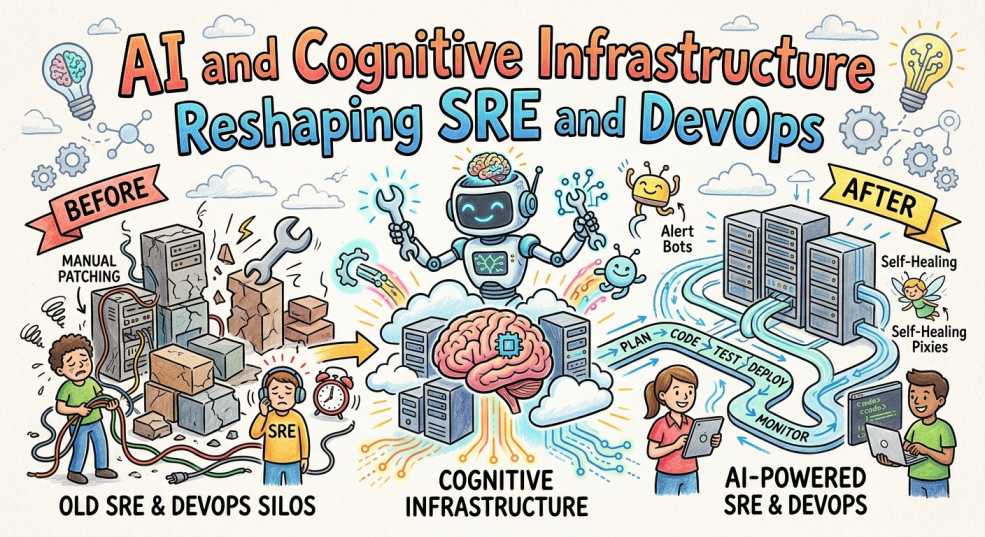
Welcome to DevOps Inside, where the coffee’s strong and the automation is stronger ☕🤖. Today we’re diving into how AI, AI agents, and cognitive infrastructure are flipping the script for SRE, DevOps, and Platform Engineering. This is not sci-fi. It’s practical, fast-moving, and already reshaping our on-call nights (for the better... most of the time).
What is "Cognitive Infrastructure" and Why It Matters
For this article, cognitive infrastructure means combining telemetry, organizational knowledge graphs, and agentic AI models to make infrastructure systems that don’t just respond; they reason and act. Imagine an observability stack that summarizes incidents, correlates root causes across distributed microservices, suggests or executes verified mitigations under strict policy guardrails, and learns from every postmortem. Cool? Yes. Useful? Hugely.
For SRE/DevOps teams, this matters because it moves you from reactive firefighting to proactive reliability engineering. Instead of hunting needles in haystacks, you get context-aware alerts, prioritized actions, and faster mean time to resolution (MTTR).
And this is becoming much more practical now. AI agents are increasingly able to interact with operational tools, query infrastructure data, call APIs, and execute multi-step workflows. That also creates a new problem: the infrastructure has to be observable enough for both engineers and agents to understand what is actually happening.
A quick analogy
Think of traditional tooling as a toolbox and cognitive infrastructure as an expert SRE co-pilot who hands you the exact wrench you need, explains what went wrong across the stack, drafts the fix, and writes the postmortem note afterward. Handy and slightly smug.
The important part is that the co-pilot still needs access to the right context. An AI model looking at incomplete telemetry or outdated runbooks is not going to magically understand your infrastructure.
How AI is Reshaping SRE and DevOps
Observability & Telemetry: From Data Dumps to Signal
- AI-driven anomaly detection and deep eBPF telemetry reduce alert noise by learning normal system behavior and surfacing true incidents.
- Dynamic baselining adapts to traffic patterns so you’re not woken at 3 AM by seasonal spikes or routine batch jobs.
- Root cause correlation connects logs, traces, metrics, and recent deployments into a coherent story, fast.
There is another layer becoming important here:
observability of the AI systems themselves.
When an AI agent investigates an incident, we need to know which model it used, which tools it called, how long those calls took, how many tokens were consumed, what failed, and what actions it actually performed.
OpenTelemetry is actively developing its GenAI observability conventions. They provide a way to capture information such as model calls, token usage, latency, and tool calls, giving engineers visibility into what happens inside an AI workflow. Current OpenTelemetry examples show GenAI operations as traces with model calls and tool execution, making it possible to follow an AI workflow through a familiar distributed tracing model.
So the observability problem is becoming two-sided:
Observe the infrastructure so the AI can reason about it.
Observe the AI so the engineers can trust what it is doing.
Incident Response & Runbooks: Smarter Playbooks & Autonomous Agents
- Automated triage classifies incidents, queries context via agentic workflows, and suggests next steps with confidence scores.
- AI-assisted runbooks generate executable checklists, run diagnostics, and propose rollback or remediation criteria.
- ChatOps & AI Co-pilots bring recommended actions directly into Slack/MS Teams with policy guardrails and one-click or automated execution.
This is where the difference between an AI assistant and an AI agent becomes important.
An assistant might tell you:
"The deployment appears to be causing elevated 5xx errors."
An agent can potentially investigate the deployment, check recent changes, inspect logs and metrics, compare the affected pods, and prepare a rollback.
The second approach is obviously more powerful, but it also means the blast radius of a mistake is much larger.
That is why permissions, approval workflows, audit trails, and clear boundaries become part of the infrastructure design itself.
CI/CD & Change Management: Predictive Safety Nets
- Canary and progressive delivery analysis becomes automatic. AI spots subtle latency, memory, or error-budget regressions earlier.
- Test prioritization focuses pipeline runs on likely-failing code paths, making CI/CD faster and more effective.
- Change risk scoring predicts the blast radius of a pull request or deployment so humans can approve faster.
The interesting part is that AI can now look at more than the code change itself.
A useful change-risk system could combine the pull request, service ownership, historical incidents, dependency relationships, recent deployments, production telemetry, and previous rollback history.
That gives engineers something much more useful than a simple "high-risk" or "low-risk" label.
Capacity Planning & Cost Optimization
- Demand forecasting predicts system load and suggests autoscaling policies ahead of traffic peaks.
- Right-sizing recommendations reduce cloud waste and bills without manual guesswork or risking performance throttling.
AI can also help connect capacity decisions with actual business patterns.
For example, instead of simply seeing that CPU usage normally increases every Monday morning, the system can connect that pattern with a scheduled business process and recommend capacity changes before the load arrives.
Security & Compliance
- IaC scanning and automated drift remediation spot security misconfigurations early in the development lifecycle.
- Real-time anomaly detection flags suspicious access patterns, IAM privilege escalation, and potential breaches.
This is another area where agentic workflows need strong boundaries.
An AI system might be allowed to identify a suspicious IAM change, collect evidence, and open an incident automatically. Automatically changing production permissions is a very different level of authority.
The more powerful the agent becomes, the more important it is to separate detection, recommendation, approval, and execution.
Key Components of a Cognitive Infrastructure
- Observability pipeline (OpenTelemetry, eBPF) that collects, enriches, and structures metrics, logs, and traces.
- Knowledge graph/runbook corpus storing past incidents, fixes, architecture diagrams, and organizational context.
- Vector stores, Agentic frameworks, & LLMs/SLMs using integration interfaces such as Model Context Protocol for real-time retrieval, reasoning, and tool execution.
- Real-time event processors & evaluation engines to apply models, policy controls, and automation rules.
- Human-in-the-loop controls & policy guardrails to keep safety, security, and human judgment central.
- AI observability and evaluation to track agent actions, model calls, tool usage, latency, token consumption, failures, and the quality of the decisions being made.
This is especially important because an agent can fail even when the underlying infrastructure is perfectly healthy.
A slow tool call, an incorrect tool selection, a bad retrieval result, a retry loop, or a poor model response can become the incident.
The July 28, 2026 Model Context Protocol specification also shows how quickly the integration layer around AI agents is evolving. The latest specification introduced a stateless protocol core, Multi Round-Trip Requests, header-based routing, improved authorization, Tasks as an extension, and a formal extensions framework.
For DevOps teams, protocols like MCP matter because agents need a consistent way to interact with the systems we already operate.
Practical Steps to Adopt AI & Cognitive Infrastructure
Ready to get started? Here’s a pragmatic roadmap that won’t require building a research lab in your basement:
- Pick a high-impact use case: e.g., reduce noisy alerts, speed MTTR, or automate postmortem drafting.
- Improve telemetry: better signal beats smarter models every time. Instrument with OpenTelemetry, label, and enrich data.
- Build a knowledge base: collect runbooks, past incident reports, postmortems, and architecture docs for the models to ground their reasoning.
- Start with augmentation: AI should assist, not replace engineers. Suggest actions, run diagnostics, but don't execute high-risk mutations without approval.
- Measure impact: track MTTD, MTTR, change failure rate, and error budget consumption.
- Iterate and harden: add guardrails, provenance tracking, and observability for the AI agents themselves.
- Give agents only the access they need: start with read-only access, then gradually introduce controlled write operations where the risk is understood.
- Test the agent like production software: deliberately give it incomplete information, conflicting signals, failed tools, and unusual incidents before allowing it to operate in production.
The last two steps are becoming much more important as teams move from AI that only recommends actions toward AI that can actually execute them.
Challenges & Risks: What to Watch Out For
Because we’re engineers, we can’t help but be skeptical. And rightfully so. Here are the main pitfalls and how to avoid them:
- Data quality: garbage in, garbage out. Invest in consistent, structured telemetry and clean documentation.
- Hallucinations & Runaway Loops: language models can invent facts or get stuck in execution loops; always bound agent permissions and validate commands before execution.
- Over-automation: automate low-risk diagnostic tasks first. Keep humans in critical decision loops for production mutations.
- Bias & blind spots: models reflect their training data and historical context; diversify incident corpora and regularly evaluate model edge cases.
- Cost & complexity: not every org needs a massive self-hosted model stack. Aim for measurable ROI and incremental rollouts using managed tools.
- Explainability & audit trails: maintain audit logs of AI agent decisions, prompt context, and execution steps to allow fast rollbacks or manual overrides.
- Tool and permission failures: an agent can make a technically valid request to the wrong system. Treat tool access and authorization as part of the reliability model.
- Context drift: runbooks, architecture diagrams, service ownership, and infrastructure change constantly. An agent working from six-month-old documentation can make a very confident mistake.
- Agent observability: monitor the agent itself. Model latency, token consumption, tool failures, retry loops, and unexpected actions should be visible alongside normal infrastructure telemetry.
This last point is easy to overlook.
We spent years teaching engineers to monitor applications because applications can fail in unexpected ways.
Now we have to do the same thing for the systems that are making operational decisions.
Real-world Quick Wins
Want to try something practical without turning your infrastructure into an AI experiment? Try these:
- Anomaly detection for creeping memory leaks: catch trends before they cause OOM kills and cascading failures.
- Auto-remediation for disk pressure: automated cleanup scripts executed under strict policy approval.
- Automated postmortem drafts: LLMs summarize incident timelines and extract action items directly from Slack channels and telemetry logs.
- Predictive scaling before major sales events: pre-warm and scale cluster workloads automatically before traffic spikes.
- Incident investigation assistant: give an AI agent read-only access to logs, metrics, traces, deployment history, and runbooks and ask it to build an incident timeline before an engineer starts debugging.
- Kubernetes troubleshooting assistant: allow an agent to inspect cluster state and explain why a Pod is Pending, why a rollout is stuck, or why a node is under pressure without giving it permission to modify anything.
That last approach is a good starting point for teams that are interested in agentic operations but are not ready to give an AI system production write access.
Read-only first.
Automation later.
The Future: SRE 2.0: More Strategy, Less Triage
Expect the role of SRE/DevOps to tilt heavily toward design, governance, platform safety, and reliability strategy. Cognitive systems will handle repetitive triage and surface actionable insights, while engineers will focus on:
- Designing resilient architectures, blast-radius boundaries, and policy guardrails.
- Defining business-aligned SLOs, error budgets, and policy controls.
- Training, evaluating, and maintaining the AI agents, knowledge bases, and context pipelines.
- Auditing compliance, security posture, and ethical governance of automation in production.
- Designing the permissions and boundaries that determine what an AI agent can actually do.
- Building reliable feedback loops between infrastructure telemetry, incident outcomes, and future decisions.
The role is not simply becoming an engineer who uses AI.
It is becoming something closer to an engineer who designs the environment in which AI can safely operate.
That distinction matters.
An AI agent can investigate an incident in seconds, but it still needs accurate telemetry, useful context, correct permissions, reliable tools, and clearly defined boundaries.
In short, the job becomes more interesting and more impactful: fewer midnight scrambles, more high-leverage system design.
Final Thoughts: Embrace the Co-pilot
AI and cognitive infrastructure aren’t magic wands, but they are incredibly powerful co-pilots. When implemented carefully, they reduce toil, accelerate incident resolution, and surface smarter insights so platform teams can focus on building resilient systems. Start small, instrument well, keep humans in the loop, and enforce strong guardrails. You’ll get massive reliability wins without handing control over to a black box. 🧠
The biggest change is not that AI can now write commands or explain an alert.
The bigger change is that AI is starting to become another participant in the operational loop.
It can observe.
It can investigate.
It can reason over context.
It can call tools.
And in some environments, it can act.
That means observability, permissions, policy, and reliability engineering are no longer separate concerns. They become the foundation that allows these systems to operate safely.
The teams that get this right will not be the teams that automate everything first.
They will be the teams that know what should be automated, what should remain controlled, and how to prove that the automation is behaving correctly.
If you liked this, follow DevOps Inside for more practical guides, platform strategies, and weird-but-true incident war tales. Got a use case you’re wrestling with in your stack? Drop a comment below. I’d love to hear how you’re using AI in your infrastructure! 💬