CNCF Score Simplifies Kubernetes Developer Experience for Platform Engineering
CNCF Score simplifies Kubernetes developer experience by separating workload definitions from infrastructure configuration, helping platform engineering teams reduce YAML complexity, improve self-service workflows, and streamline cloud-native deployments.
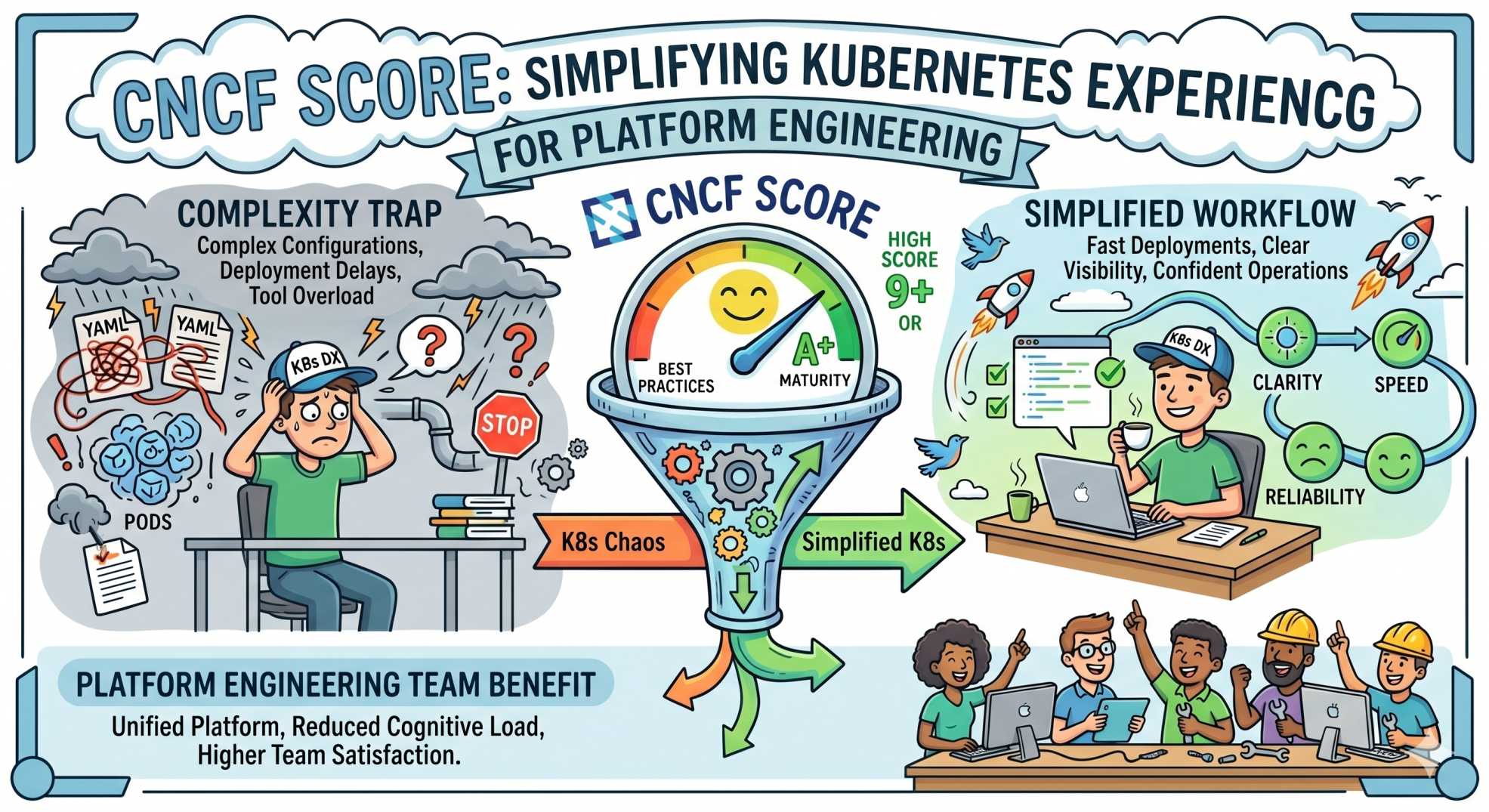
Remember when being a developer meant writing application code? Somewhere along the line, the script flipped. Now, shipping a simple microservice feels like preparing a tax audit. You change three lines of application code, and suddenly you are staring down a multi-hundred-line Kubernetes manifest, wrestling with structural indentation, and trying to figure out why your Helm values are not injecting properly.
This is not development. It is YAML gymnastics, and it is driving developer experience straight into the ground. ⚙️
As platform engineering teams look for ways to build effective developer experience tooling, they face a massive challenge: how do you stop engineers from needing a deep understanding of cloud-native infrastructure just to run a health check on their services?
Enter Score.
This open-source project has gained serious traction within the CNCF Sandbox ecosystem because it takes a completely fresh approach to workload management and Kubernetes deployment workflows.
Why YAML Fatigue Is Hurting Developer Experience
When the industry shifted, security and operations left, and application developers inherited far more than deployment access. They also inherited the burden of managing:
- ingress rules
- persistent volume claims
- environment-specific Helm values
- cluster networking
- Kubernetes deployment management
The result is a massive increase in developer cognitive load. Engineers spend hours copy-pasting configuration blocks they barely understand, leading to severe configuration drift between local environments, staging clusters, and production systems.
What a software engineer actually wants to declare is simple:
“My application needs a container image, port 8080, and a Postgres database.”
What they are forced to manage instead is hundreds of lines of infrastructure-specific deployment files spread across multiple repositories.
That is where Score changes the game.
What Is the CNCF Score Specification? 🧠
Score fixes this disconnect by separating workload intent from environment configuration.
Instead of writing target-specific manifests, developers create a single readable file called score.yaml.
Think of it as a declare-and-forget contract. The developer defines exactly what the application requires to run successfully, while the platform team provides a runner that automatically translates the specification into the correct infrastructure configuration for the target environment.
As shown in the architecture workflow, developers interact only with the score.yaml specification. From there, the platform automation layer takes over.
- Running locally?
score-composegenerates a cleandocker-compose.yaml. - Deploying to Kubernetes?
score-helmgenerates the required Helm values automatically. - Moving across environments? The workload definition stays consistent.
The developer never needs to rewrite infrastructure logic for each deployment target.
How Score Simplifies Kubernetes Deployments
Here is what a clean workload definition looks like under the CNCF Score specification:
apiVersion: score.dev/v1b1

metadata:
  name: payment-service

containers:
  web:
    image: release-registry.internal/payment:v2.1.0

    variables:
      DB_CONN: "${resources.db.connection}"

    ports:
      - target: 8080

resources:
  db:
    type: postgres
Look closely at the structure.
There are:
- no cloud-specific provider configurations
- no replica management logic
- no infrastructure-level scheduling rules
- no complex Kubernetes abstractions
It is pure application intent. 🔥
The real magic happens inside:
${resources.db.connection}The developer simply declares they need a Postgres database.
When the workload runs locally, the Score runner provisions a local container automatically. When the same workload moves into staging or production, the platform layer injects the correct managed database connection securely without changing the application definition.
This dramatically simplifies the cloud-native developer workflow.
Why Platform Teams Are Adopting CNCF Score
For platform engineering teams building internal developer platforms, Score acts as a powerful decoupling layer.
In a traditional enterprise setup, a new compliance requirement might force platform engineers to modify:
- dozens of Helm charts
- Kubernetes templates
- environment repositories
- security context definitions
That often means opening pull requests across fifty different services just to apply a single operational change.
With Score, platform teams maintain centralized governance through runners and templates while developers continue using the same lightweight workload specification.
This creates a true internal developer portal experience:
- developers keep self-service flexibility
- platform teams maintain operational control
- security policies remain standardized
- infrastructure changes become globally manageable
The result is dramatically lower operational friction across engineering organizations.
The Real Payoff of Developer Self-Service 🚀
Adopting a centralized workload specification helps platform teams deliver guardrailed self-service without sacrificing governance.
Developers regain autonomy because they can provision services using familiar application-level definitions rather than wrestling with infrastructure complexity. At the same time, platform architects retain complete control over how workloads are executed across production environments.
If your engineering teams are currently buried under:
- copy-pasted Helm charts
- broken YAML indentation
- inconsistent Kubernetes manifests
- deployment configuration drift
Then it may be time to move toward a decoupled platform engineering architecture.
The future of cloud-native development is not forcing every developer to become a Kubernetes infrastructure expert. The future is building systems where developers describe intent, and the platform handles the operational complexity automatically.
Stay tuned for our next DevOps Inside deep dive, where we break down why platform engineering teams are moving beyond Terraform and turning Kubernetes into a universal cloud control plane with Crossplane, continuous infrastructure reconciliation, and custom XRD-powered self-service APIs for modern cloud-native platforms. 🚀
“The best platform is the one your developers barely notice because everything simply works.”