How Cluster API Simplifies Multi Cluster Kubernetes Operations
Learn how Cluster API (CAPI) enables declarative multi cluster Kubernetes management, fleet automation, self healing infrastructure, and GitOps driven platform operations at scale.
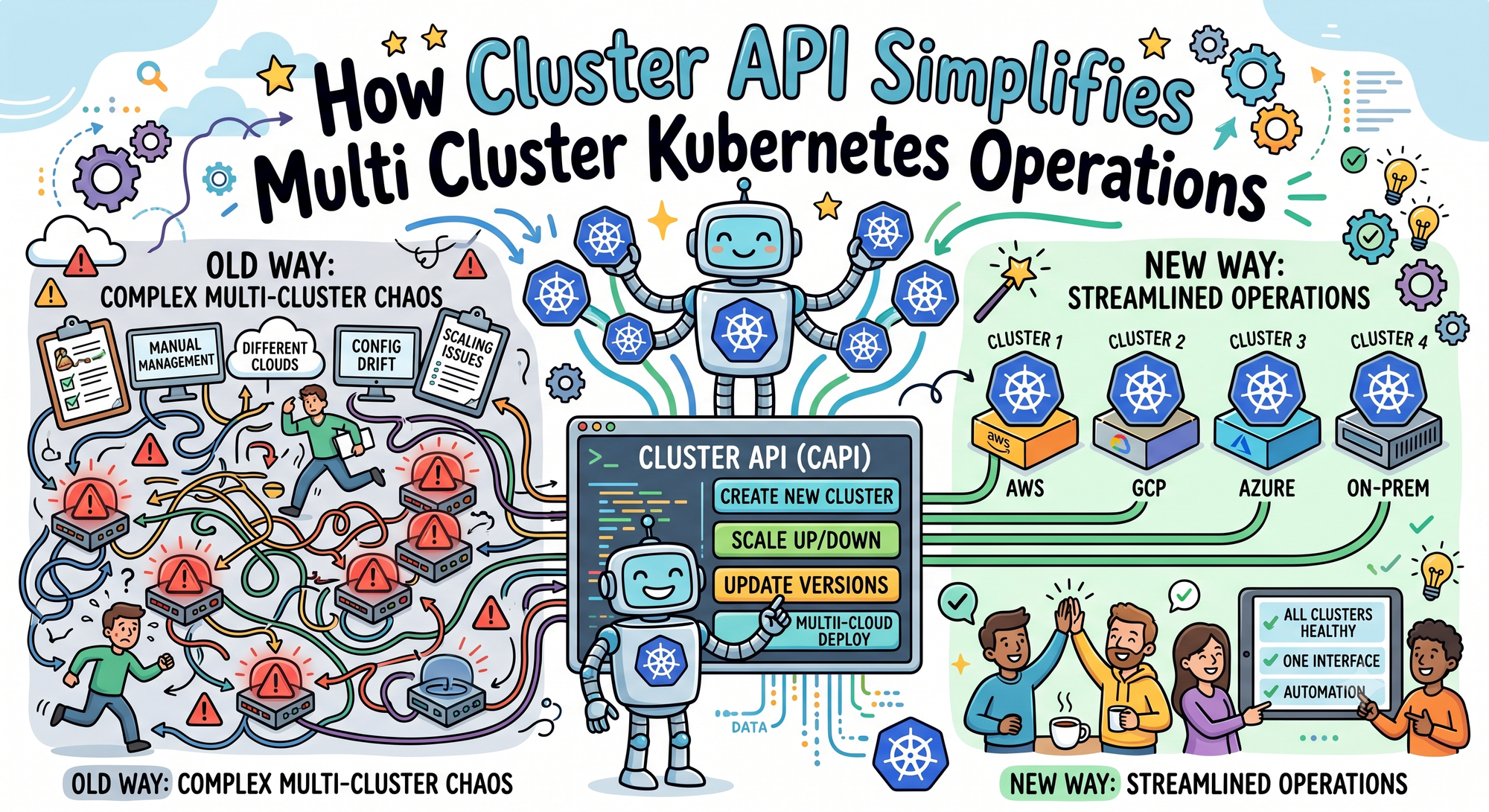
Fleet Control: Why Cluster API (CAPI) is the Missing Parent Layer for Multi-Cluster GitOps
In our popular series “100 Reasons Your Kubernetes Cluster is Crying,” we spent a lot of time troubleshooting individual control plane anomalies, node pressure leaks, and rogue ingress controllers inside a single cluster boundary. That's a great exercise when you are operating a small footprint.
But what happens when you scale to a fleet level?
When your platform engineering team suddenly assumes responsibility for 50+ Kubernetes clusters scattered across three different public clouds and multiple bare-metal edge regions, debugging clusters one by one stops being feasible. You’ve probably deployed pull-based GitOps tools like ArgoCD or Flux inside every single environment, syncing your application manifests nicely. But you're still left with a glaring, systematic question: Who manages the clusters themselves?
If you are still spinning up, patching, and scaling your raw cluster boundaries using separate push-based automation loops, you are running headfirst into the multi-cluster sprawl apocalypse. To maintain absolute control across extensive footprints, modern enterprise architecture is shifting toward declarative kubernetes cluster management using the upstream CNCF project: Cluster API (CAPI).
The GitOps Paradox: The Multi-Cluster Drift Problem
We love GitOps because it promises that Git is the absolute source of truth. If a developer manually scales an application deployment or modifies a service port inside the live cluster, the GitOps controller immediately steps in, catches the deviation, and enforces the declared state.
But standard GitOps tools have a severe blind spot: they require a functional, pre-configured Kubernetes API server to sit inside. They cannot easily manage the underlying infrastructure lifecycle of the cluster they inhabit.
This is exactly where managing multi-cluster GitOps drift gets messy. If an engineer triggers a manual out-of-band upgrade to a node pool via a cloud provider console, or if an automated cloud update changes an underlying machine image subnet topology, your application-level GitOps tools remain completely oblivious. Your underlying infrastructure layer drifts quietly away from your recorded configuration files, waiting to disrupt your next rolling update.
Enter Cluster API (CAPI): Treating Clusters as Core Resources
Cluster API solves this paradox by using the exact same operator model that governs standard application workloads to manage the underlying infrastructure itself. It introduces the architectural pattern of a dedicated Management Cluster whose sole responsibility is to provision, upgrade, and reconcile a fleet of external Workload Clusters.
Under a CAPI architecture, a Kubernetes cluster isn’t an abstract construct built by an external pipeline. It is a native, declarative object inside a control loop:
[Management Cluster] -> Watches Desired State (YAML) -> Continually Reconciles -> [Workload Cluster A] (AWS)
                                                                               -> [Workload Cluster B] (GCP)
By defining your environments using standard custom resources like Kind: Cluster, Kind: ControlPlane, and Kind: MachineDeployment, your cluster topology becomes completely auditable, version-controlled, and self-healing. If an underlying virtual machine or bare-metal node fails its health criteria, the CAPI control loop detects the anomaly and automatically triggers a declarative replacement, without ever paging an on-call engineer.
Architectural Comparison: CAPI vs Infrastructure as Code
When designing an enterprise platform, teams often struggle to define the boundary between traditional infrastructure automation tools and a true declarative control plane.
| Operational Capability | Traditional Push-Based IaC (Terraform / OpenTofu) | Cluster API Production Architecture (CAPI) |
| Execution Model | Imperative State Check: Requires manual or runner-initiated pipeline executions (terraform apply) to sync code changes. | Continuous Reconciliation Loop: Active, in-cluster controllers query the cloud provider API servers every few seconds. |
| Drift Management | Reactive: Catches configuration changes only when a scheduled pipeline or cron task triggers a new plan step. | Proactive Prevention & Auto-Healing: Eradicates out-of-band edits immediately by overwriting unapproved infrastructure states. |
| Lifecycle Scaling | Managed via complex state locks, backend buckets, and highly custom wrapper code structures. | Standardizes multi-cluster topologies using native Kubernetes RBAC, API versioning, and shared ClusterClass specs. |
When analyzing Capi vs. infrastructure as code, the core differentiator is the shift from point-in-time provisioning to active, continuous reconciliation. Instead of running a heavy automation job that finishes and terminates, CAPI functions as a permanent, living engine inside your architecture that keeps your infrastructure aligned with Git 24/7.
The AI Fleet Catalyst: Taming the GPU Cluster Footprint
The global adoption of CAPI is accelerating rapidly due to the operational demands of massive AI training and distributed inference fleets. Building a cluster for basic web servers is straightforward; building, scaling, and maintaining a high-performance compute platform packed with specialized accelerators is incredibly difficult.
AI training workloads are uniquely brutal on underlying hardware layers. Running massive token processing jobs across distributed clusters pushes underlying GPU nodes to their absolute thermal and computational boundaries. As a result, hardware faults such as NVLink dropouts, PCIe bus errors, or localized memory failures happen with high frequency.
In a traditional infrastructure model, a silent hardware failure on a single GPU worker node can corrupt a multi-million dollar model training run, leaving SREs scrambling to locate the broken link.
By anchoring your cluster api production architecture with specialized MachineHealthCheck definitions, the management cluster constantly monitors the deep operational telemetry of your compute resources. The moment an accelerator node exhibits a hardware anomaly or becomes unresponsive, CAPI cleanly cordons the affected system, drains active workloads to healthy nodes, tears down the faulty instance, and provisions a brand-new, clean replacement from the cloud provider pool. You move from treating high-performance infrastructure as delicate single assets to managing them like a self-healing compute fabric.
The Blueprint: Structuring a Multi-Cluster Provisioning Pipeline
To implement declarative cluster management safely at enterprise scale, you need to establish a distinct separation between your management core and your workload fleets.
The CAPI Fleet Provisioning Workflow
1.Bootstrap the Central Management Core:Phase 1.
Spin up a lean, highly resilient management cluster (often using a dedicated, isolated environment) and initialize the core CAPI controllers alongside your target infrastructure providers via clusterctl.
2.Declare Your Fleet via ClusterClass:Phase 2.
Define a standardized, reusable ClusterClass template inside your central platform repository. This blueprint hardcodes your approved networking components (CNI), storage drivers (CSI), and baseline security profiles.
3.Sync Manifests via Central GitOps:Phase 3.
Configure a centralized ArgoCD or Flux instance inside the management cluster to watch your infrastructure repository. When a platform engineer commits a new Kind: Cluster manifest, the GitOps engine hydrates it onto the control plane.
4.Continuous Machine Reconciliation:Phase 4.
The CAPI controllers intercept the new resource definition, talk directly to the target cloud APIs, provision the network topologies, spin up the control plane instances, and automatically bring the new workload cluster into a healthy, managed state.
Elevate Your Infrastructure Abstraction Layer
Managing clusters as isolated, custom-built environments is the ultimate bottleneck to platform velocity. By abstracting your infrastructure into native, declarative Kubernetes objects, Cluster API allows platform engineering teams to manage hundreds of clusters across diverse environments with the exact same operational efficiency used to deploy a single microservice.
It eliminates the reliance on fragile, custom-built scripting layers and ensures that configuration drift is caught and corrected long before it can impact your production SLOs.
The future isn't managing Kubernetes clusters. It's managing clusters the Kubernetes way.