Red Hat and NVIDIA AI Are Transforming DevSecOps Security
Red Hat and NVIDIA are bringing AI-powered semantic reasoning to DevSecOps, reducing false positives, improving CI/CD security automation, and transforming modern Kubernetes application security.
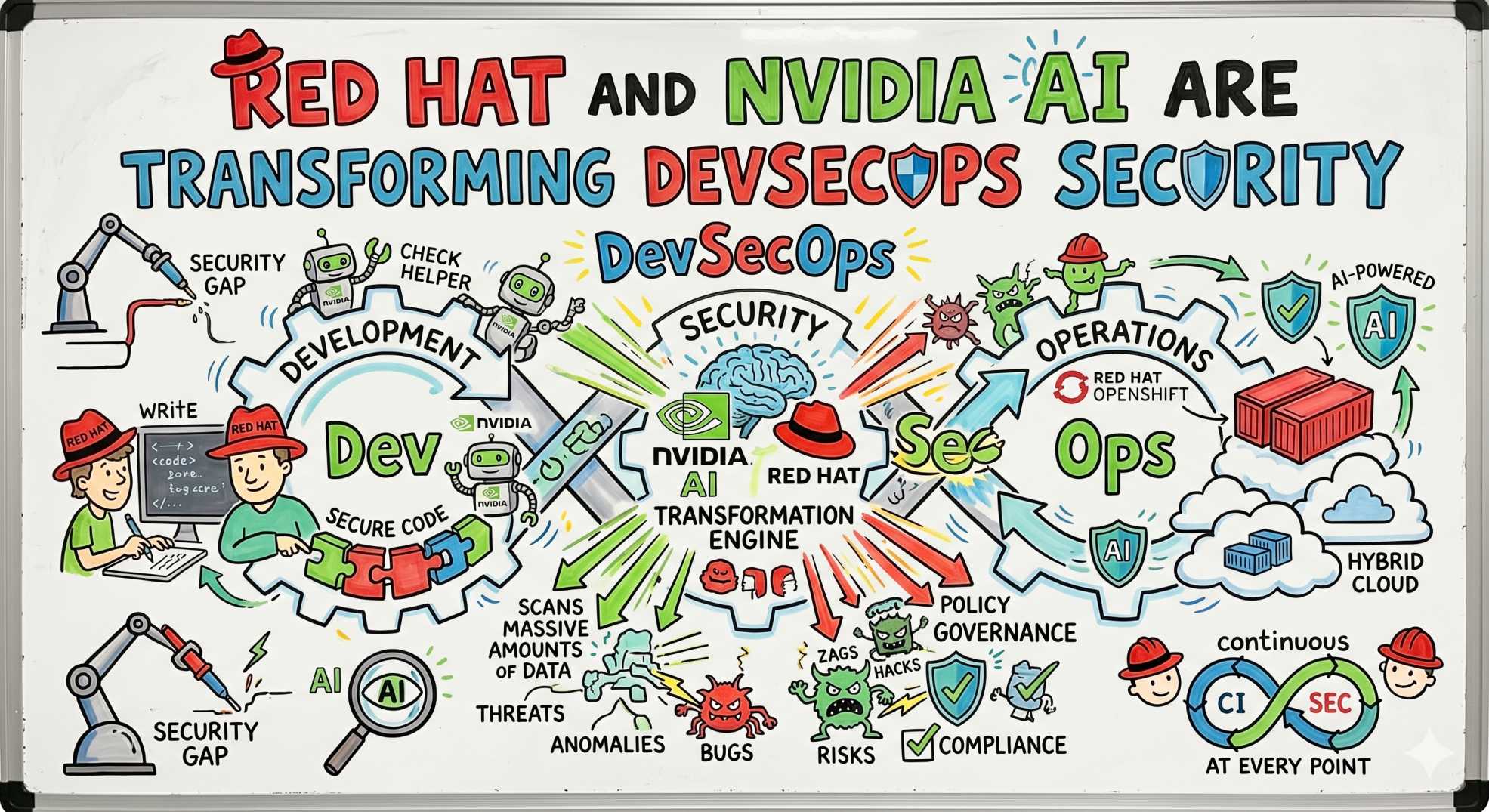
Red Hat and NVIDIA are pushing DevSecOps beyond traditional pattern matching by introducing AI-powered semantic reasoning into modern CI/CD security pipelines.
The team at DevOps Inside knows that modernizing your cluster infrastructure with just-in-time provisioning like Karpenter on OpenShift, which we discussed following the latest Red Hat Summit 2026 updates, is only half the battle.
Efficient computing means nothing if the workloads running on top of it are carrying critical security debt. ⚠️
As software delivery speeds continue accelerating, traditional methods for securing code are starting to collapse under alert fatigue.
That is why the collaborative preview from Red Hat and NVIDIA is generating so much attention across the DevSecOps community.
By embedding an AI reasoning engine directly into the developer workflow, they are attempting to shift the industry away from rigid pattern matching and toward contextual, intent-driven application security.
How NVIDIA AI Security Frameworks Are Changing DevSecOps and Application Security
For years, the promise of “Shift Left” security in DevSecOps has felt like a double-edged sword for engineering teams.
Traditional:
- Static Application Security Testing (SAST)
- Software Composition Analysis (SCA)
Tools often behave like blunt instruments.
They rely heavily on:
- Deterministic rules
- Regular expressions
- Signature matching
- Static pattern detection
To scan source code for known vulnerabilities.
The result?
An endless backlog of:
- False positives
- Noisy alerts
- Non-exploitable findings
- Developer frustration 😵
Security teams hand developers spreadsheets containing hundreds of “Critical” alerts, while many of those issues are completely unreachable within the actual application architecture.
The new framework previewed inside Red Hat’s Advanced Developer Suite, powered by NVIDIA’s AI infrastructure, represents a major shift in how CI/CD security pipelines operate.
This is the transition from:
Syntax scanning
to:
Semantic reasoning.
The Evolution: Syntax vs Semantics
To understand why this matters, compare how a human security architect reviews software versus how traditional scanners behave.
Traditional SAST Workflow
See pattern → Flag vulnerability → Reject build 🚫
AI Reasoning Workflow
Trace data flow → Analyze runtime context → Validate exploitability → Propose remediation ✅
1. The Traditional Approach: The Blunt Instrument
Imagine a microservice accepting external user input.
A traditional SAST engine scans the source code, notices raw SQL interpolation, and immediately flags a SQL injection vulnerability.
But the scanner does not evaluate:
- Validation middleware
- Runtime boundaries
- Kubernetes policies
- Database permission scopes
- API gateway protections
It simply matches a pattern and blocks the pipeline.
That creates operational friction for developers and platform teams alike.
2. The Semantic Approach: The Reasoning Mind 🧠
The Red Hat and NVIDIA framework approaches software as a connected ecosystem instead of isolated text files.
Using:
- Graph-based code representations
- Deep contextual analysis
- Runtime-aware reasoning
- Architectural tracing
The AI evaluates how the application truly behaves in production.
🔍 Contextual Analysis
The engine traces data flow across the entire request path:
- API gateway
- Middleware layers
- Service mesh
- Application runtime
- Database layer
Instead of only inspecting isolated code snippets.
🛡️ Exploitability Validation
The AI evaluates whether a vulnerability is actually reachable based on:
- Routing logic
- Container isolation
- Kubernetes NetworkPolicies
- Runtime permissions
- Deployment architecture
This dramatically reduces false positives.
⚙️ Remediation Precision
If a vulnerability is legitimate, the system does not just point at the broken line.
It understands the architectural intent of the application and proposes a patch designed to preserve functionality while improving security posture.
That is a massive leap beyond static scanning.
Inside the CI/CD Pipeline: Smarter Security Automation 🚀
Integrating semantic reasoning directly into CI/CD pipelines changes the operational model for:
- SRE teams
- DevSecOps engineers
- Platform engineers
- Cloud-native development teams
Instead of security becoming a bottleneck, reasoning engines enable intelligent automated triage at scale.
Because false positives are reduced significantly, organizations can finally enforce stronger security policies inside GitOps workflows with confidence.
If the AI flags a vulnerability, there is a much higher probability that the issue represents a real architectural risk rather than static scanner noise.
From an operational perspective, this improves engineering efficiency dramatically.
Teams spend less time:
- Debating CVEs
- Sorting false positives
- Reviewing static noise
- Triaging low-risk alerts
And more time designing resilient systems.
The platform handles repetitive execution-path analysis while human engineers focus on strategic decisions.
⚠️ The DevSecOps Reality Check: Intent Over Style
As semantic security tooling becomes more common inside cloud-native environments, platform engineers still need strong operational guardrails.
🔎 Verify the Context
A reasoning engine is only as effective as the visibility you provide.
If the AI scanner cannot access:
- Kubernetes manifests
- NetworkPolicies
- Runtime telemetry
- Infrastructure configuration
- Deployment context
Then its assessment of exploitability will remain incomplete.
Bad visibility creates confident but dangerous conclusions.
🧪 The Dependency Trap
Even if AI-generated patches are highly contextual and precise, human validation still matters.
Every automated remediation should pass:
- Integration testing
- Runtime validation
- Regression testing
- Security verification
Before entering production environments.
Automation without verification is still risky.
🛰️ The Interactive Security Challenge
Open your application security backlog right now.
Ask yourself:
📊 What percentage of your open security alerts are actually unreachable in production?
How many findings exist simply because a scanner detected a vulnerable pattern without understanding the runtime context?
⏳ How much engineering time is wasted every week reviewing false positives?
If your CI/CD pipeline could automatically filter non-reachable vulnerabilities, how many development hours would your teams recover?
If your engineers are still manually sorting through hundreds of static scanner warnings, your security posture is probably bottlenecked by legacy tooling.
The Verdict
The collaboration between Red Hat and NVIDIA highlights an important reality for modern DevSecOps:
The future of application security is not about writing more rigid rules.
It is about building systems capable of understanding engineering intent.
Moving beyond simple pattern matching allows security workflows to become:
- Faster
- Smarter
- Contextual
- Scalable
- Developer-friendly
Without sacrificing operational safety.
And as AI-powered software delivery accelerates, semantic reasoning may become the foundation of next-generation cloud-native security pipelines.
Frequently Asked Questions
What is semantic security analysis in DevSecOps?
Semantic security analysis evaluates application behavior, runtime context, and exploitability instead of relying only on static pattern matching.
How is AI improving SAST tools?
AI reasoning engines reduce false positives by analyzing:
- Data flow
- Runtime boundaries
- Deployment architecture
- Exploitability context
Before flagging vulnerabilities.
Why are false positives a major DevSecOps problem?
False positives slow down software delivery, overwhelm developers, and create alert fatigue inside CI/CD pipelines.
What is the advantage of contextual security analysis?
Contextual analysis helps teams prioritize real security risks while ignoring unreachable or non-exploitable vulnerabilities.
“The next evolution of DevSecOps is not teaching developers to think like scanners. It is teaching scanners to think like architects.”