Karpenter on OpenShift and the End of the Kubernetes Cluster Autoscaler Era
Karpenter on OpenShift is redefining Kubernetes autoscaling with workload-aware provisioning, faster GPU scaling, lower cloud costs, and improved hybrid cloud efficiency.
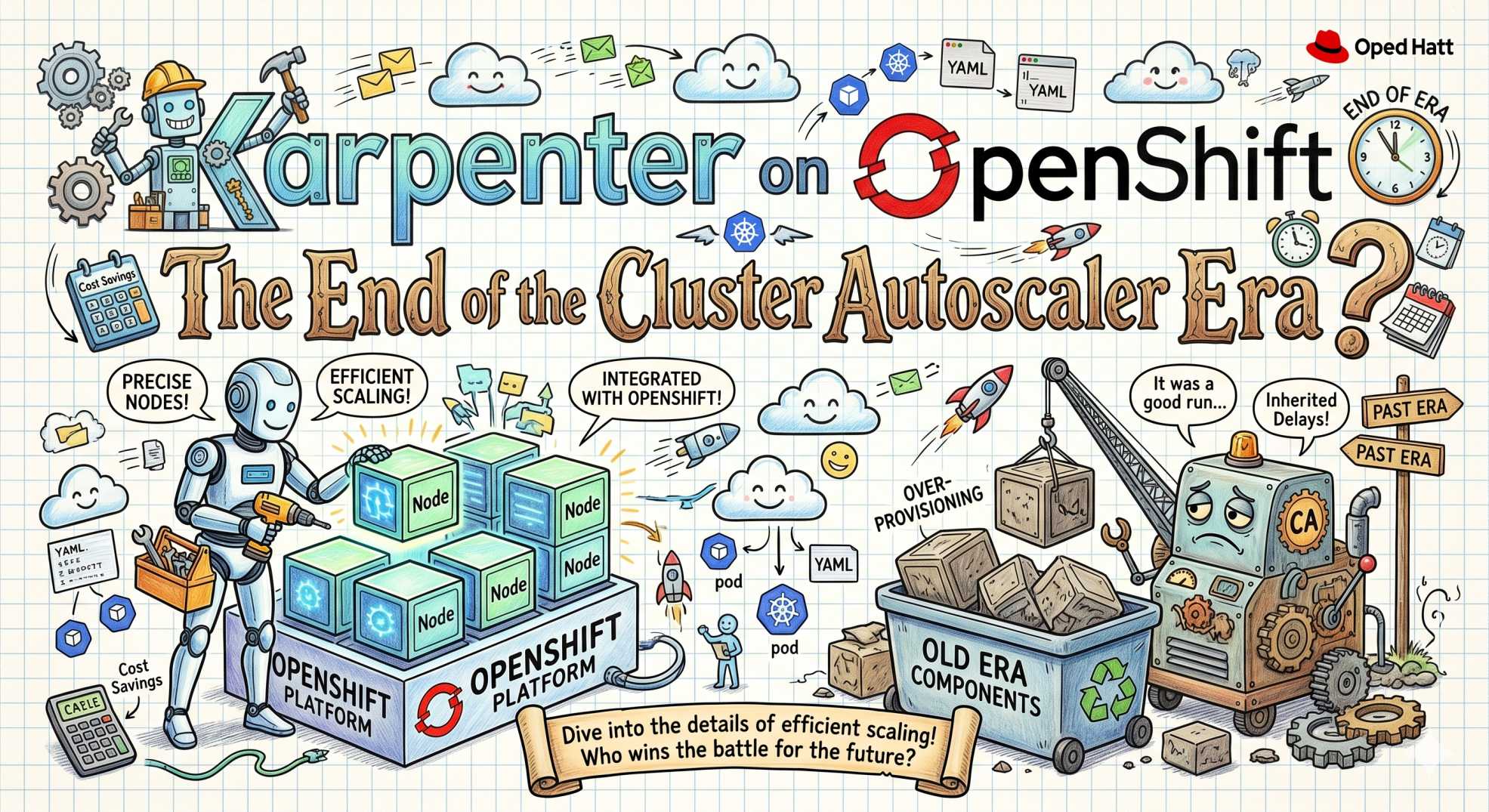
Red Hat’s Karpenter integration for OpenShift could fundamentally change hybrid cloud autoscaling, FinOps efficiency, and AI infrastructure management for enterprise Kubernetes teams.
The team at DevOps Inside knows that an autonomous AI agent can only heal your cluster if the underlying infrastructure is flexible enough to adapt instantly.
In our previous deep dive, we explored how Grafana 13 and the Model Context Protocol (MCP) are transforming observability into a self-healing ecosystem. But if your observability stack triggers a scale-up while your infrastructure remains trapped in slow autoscaling loops, your automation eventually hits a brick wall. ⚠️
That is why one of the biggest announcements from Red Hat Summit 2026 is such a massive shift for platform engineering teams:
Karpenter is officially coming to OpenShift.
Following our “From Pipelines to Prompts” series, we are now looking at what happens when enterprise Kubernetes platforms move beyond rigid node groups and traditional autoscaling logic.
If you are managing a hybrid cloud infrastructure, the traditional Cluster Autoscaler may have just become legacy technology.
Beyond the Cluster Autoscaler: What Karpenter on OpenShift Means for Hybrid Cloud Costs
For years, Karpenter was one of the biggest advantages for teams running Kubernetes workloads on AWS EKS.
It introduced:
- Group-less autoscaling
- Just-in-time compute provisioning
- Intelligent workload placement
- Aggressive node consolidation
While most enterprise OpenShift environments remained dependent on:
- MachineSets
- Static node pools
- Traditional Kubernetes Cluster Autoscaler logic
That divide is now disappearing.
Red Hat’s Karpenter integration means OpenShift is entering the era of hyper-efficient, AI-aware infrastructure scaling. 🤖
The Core Problem: The Rigid “Node Group Tax”
To understand why this matters, we first need to understand the hidden inefficiencies of the traditional Kubernetes Cluster Autoscaler.
The Cluster Autoscaler operates around pre-defined node groups.
In OpenShift environments, those typically exist as:
- MachineSets
- Fixed worker pools
- Static compute templates
When workloads cannot be scheduled due to insufficient resources, the autoscaler:
- Checks existing node groups
- Finds a matching machine template
- Requests a new virtual machine
- Waits for bootstrapping
- Joins the node to the cluster
That process works.
But it is also incredibly wasteful at scale.
⚠️ The Efficiency Drain
🍽️ The Buffet Model
Traditional node groups force teams into fixed compute configurations.
If your application needs:
- 2 vCPUs
- 4 GB RAM
But your MachineSet deploys:
- 8 vCPUs
- 32 GB RAM
Then you are paying for massive amounts of unused infrastructure.
That unused capacity becomes:
“Slack Space”
And in large Kubernetes environments, that slack space quietly destroys cloud efficiency.
🧩 Fragmentation
Over time, workloads create tiny pockets of unused resources scattered across the cluster.
The Cluster Autoscaler struggles to consolidate these efficiently because it only understands:
- Adding node groups
- Removing node groups
Not dynamic workload-aware optimization.
The Karpenter Way: Ordering À La Carte 🍽️
Karpenter completely removes the abstraction of fixed node groups.
Instead of scaling through rigid templates, Karpenter communicates directly with cloud compute APIs.
When a pod enters a Pending state, Karpenter evaluates:
- CPU requirements
- Memory requirements
- Topology constraints
- Taints and tolerations
- GPU requests
- Workload characteristics
and provisions the exact infrastructure required for that workload.
That changes autoscaling from:
“Choose from predefined options.”
to:
“Provision exactly what the workload needs.”
🚀 Just-In-Time Right-Sizing
If a workload suddenly requires:
- Large GPU compute
- High-memory nodes
- Burstable CPUs
- Bare-metal instances
Karpenter provisions the most efficient infrastructure dynamically.
For example:
- AI training jobs may trigger large GPU-backed instances
- Lightweight microservices may share a small VM footprint
- Batch processing jobs may temporarily provision bare-metal resources
Everything becomes workload-aware.
🔄 Intelligent Consolidation
Karpenter is not just a scaling engine.
It is also a continuous optimization engine.
The system constantly audits cluster utilization.
If workloads can be redistributed more efficiently, Karpenter automatically:
- Drains expensive nodes
- Migrates workloads
- Consolidates compute
- Replaces oversized instances
Without human intervention.
This is where FinOps and Kubernetes automation finally begin to merge.
🤖 The AI Connection: Dynamic Compute for Heavy Models
This becomes even more important for AI infrastructure.
Modern enterprise AI workloads require:
- GPU-intensive inference
- Distributed training
- Burst compute capacity
- Temporary acceleration hardware
And GPU infrastructure is brutally expensive. 💸
Leaving an H100 cluster running idle because of slow autoscaler cooldown windows is essentially burning money.
With Karpenter on OpenShift:
- GPU nodes spin up dynamically
- Workloads execute
- Compute gets reclaimed aggressively
- Idle infrastructure disappears quickly
That means:
- Lower AI infrastructure costs
- Faster workload execution
- Improved utilization
- Reduced cloud waste
For modern AI-native platforms.
⚠️ Why Platform Engineers Are Pivoting
This shift is bigger than autoscaling.
It directly impacts:
- Cloud efficiency
- Application latency
- Infrastructure responsiveness
- Hybrid cloud architecture
- Kubernetes performance optimization
Reduced Time-to-Compute
Karpenter bypasses multiple intermediate scaling layers.
That means:
- Faster node provisioning
- Lower pod startup latency
- Quicker scaling during traffic spikes
- Improved application responsiveness
And in modern distributed systems, latency equals revenue.
True Multi-Cloud FinOps
Traditional OpenShift environments often require teams to maintain:
- Dozens of MachineSet templates
- Provider-specific node definitions
- Rigid scaling rules
Karpenter simplifies this dramatically.
Platform teams can define generic workload requirements while allowing Karpenter to handle infrastructure selection dynamically across hybrid environments.
That reduces:
- Operational complexity
- Infrastructure fragmentation
- Template sprawl
- Manual scaling overhead
While improving overall cloud efficiency.
🛰️ The Interactive SRE Challenge
Open your cloud billing console beside your OpenShift dashboard right now.
Ask yourself:
📊 What is your real infrastructure utilization?
If your average worker-node utilization is below:
60%
You are likely paying a massive:
“Node Group Tax”
🧩 How many MachineSet templates are your teams maintaining manually?
If the answer is:
- Dozens
- Hundreds
- “We lost count.”
Then your infrastructure is probably optimized around operational habit instead of efficiency.
If your scaling model still depends on rigid node pools, your cloud budget may already be leaking silently.
The Verdict
Bringing Karpenter to OpenShift marks the beginning of a major shift in enterprise Kubernetes infrastructure.
This is not just about autoscaling anymore.
It is about:
- Intelligent infrastructure orchestration
- Workload-aware compute provisioning
- FinOps optimization
- AI-native scaling
- Hybrid cloud efficiency
The future of platform engineering is no longer:
“How many nodes do we need?”
The future is:
“What is the minimum infrastructure required for this exact workload right now?”
And Karpenter is designed precisely for that future.
Frequently Asked Questions:
What is Karpenter in Kubernetes?
Karpenter is an open-source Kubernetes node provisioning system that dynamically launches infrastructure based on workload requirements instead of relying on fixed node groups.
How is Karpenter different from Cluster Autoscaler?
The Kubernetes Cluster Autoscaler scales predefined node groups, while Karpenter provisions infrastructure dynamically based on real-time workload needs.
Why is Karpenter important for OpenShift?
Karpenter brings:
- Intelligent autoscaling
- Workload-aware provisioning
- Improved cloud efficiency
- Faster scaling
- Better GPU utilization
To enterprise OpenShift environments.
Is Karpenter useful for AI workloads?
Yes. Karpenter is highly effective for AI infrastructure because it dynamically provisions expensive GPU resources only when workloads require them.
💬 Quick Question: Are you ready to move beyond rigid node pools, or are you still paying enterprise cloud prices for empty CPU cycles?
Let’s talk FinOps in the comments.
“The cloud was supposed to feel infinite. Karpenter is the first autoscaler that finally treats compute like it actually costs money.”