Grafana 13 and MCP: The Rise of Agentic Observability in Kubernetes 🔭
Grafana 13 and MCP are bringing AI-powered observability to Kubernetes, enabling autonomous incident detection, telemetry analysis, and faster SRE remediation workflows.
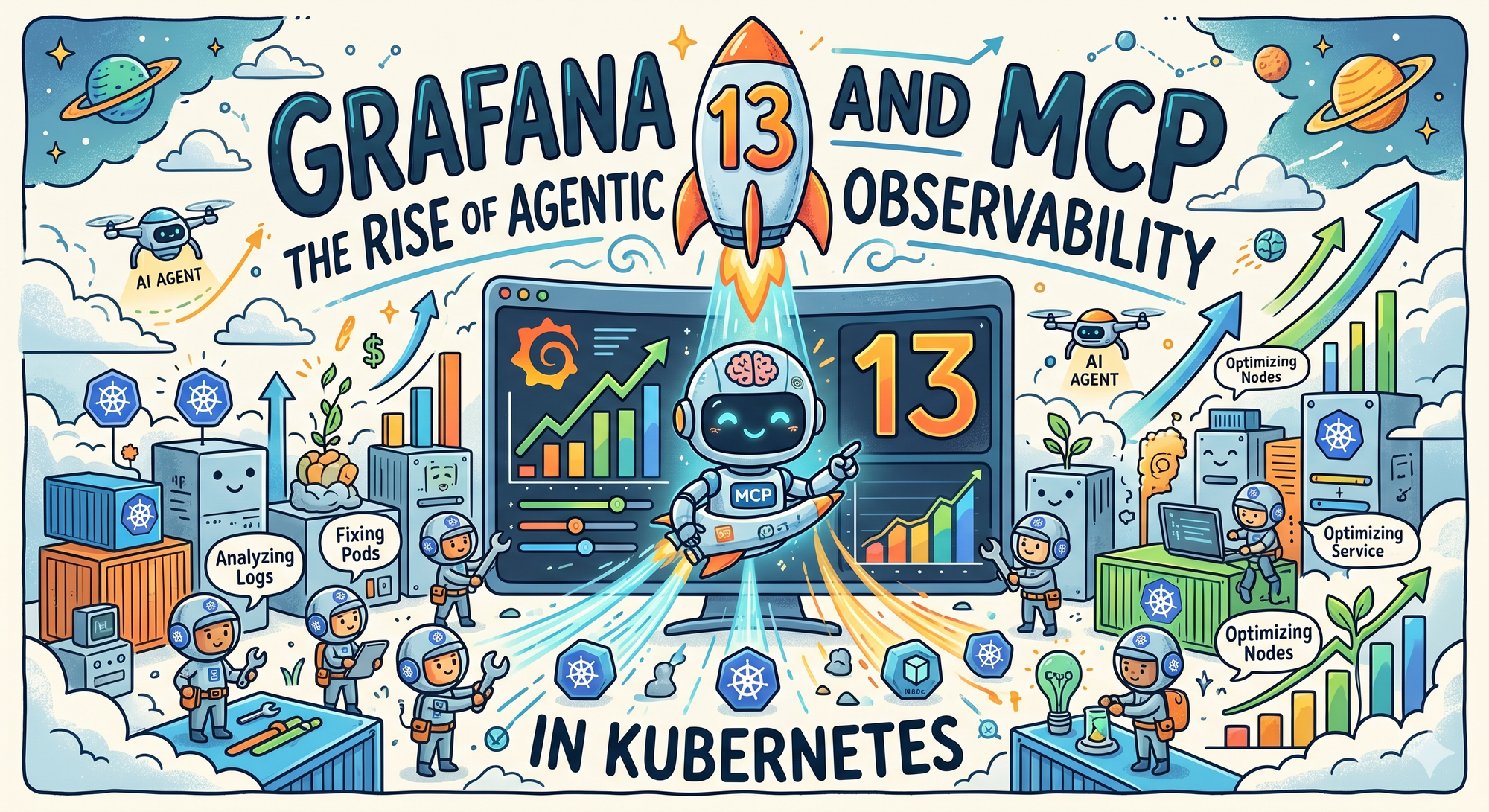
Grafana 13 and the Model Context Protocol (MCP) are transforming Kubernetes observability by enabling AI agents to analyze telemetry, automate remediation, and reshape modern SRE workflows.
The team at DevOps Inside knows that for the last decade, our lives have been defined by the “Dashboard Dilemma.”
We built massive Grafana walls of glass, staring at P99 latencies and memory spikes like they were modern art.
In our previous deep dives, we explored how DevSecOps is moving toward automated patching and how GKE snapshots are killing cold starts.
But let’s be honest:
A dashboard is just a high-tech way of waiting for something to break. ⚠️
Following our “From Pipelines to Prompts” series, we are now witnessing one of the biggest shifts in SRE history.
With Grafana 13 and the Model Context Protocol (MCP), observability is evolving from dashboards that show problems into AI-powered systems that actively resolve them.
Beyond the Dashboard: The Rise of Agentic Observability
In the SRE trenches, observability used to mean having enough telemetry to prove a fire had already started.
But modern Kubernetes observability has reached a scale where the human brain itself is becoming the bottleneck.
No engineer can realistically monitor:
- Thousands of nodes
- Millions of metrics
- Endless traces
- Distributed logs
- Real-time infrastructure drift
All at the same time.
That is where Agentic Observability enters the picture. 🧠
This is not just an LLM sitting on top of your logs.
This is an AI-powered observability layer capable of:
- Understanding infrastructure context
- Correlating telemetry automatically
- Investigating incidents
- Proposing fixes
- Executing controlled remediation workflows
Before the Slack alert even wakes you up.
The Secret Sauce: Model Context Protocol (MCP)
If you are not tracking MCP yet, you are already falling behind.
The Model Context Protocol (MCP) is quickly becoming the universal connection layer for AI systems.
Think of MCP as the “USB-C for AI agents.” 🔌🤖
Previously, building AI-powered observability workflows required custom integrations for every tool:
- Prometheus
- Loki
- Jaeger
- Kubernetes APIs
- Cloud monitoring stacks
- CI/CD pipelines
Every integration was fragile, custom-built, and difficult to maintain.
MCP changes that.
Grafana 13 now acts as an MCP-compatible observability gateway, allowing AI agents to communicate directly with your observability stack using a standardized protocol.
That means an AI agent does not just “look” at dashboards anymore.
It can:
- Query raw telemetry
- Inspect traces
- Analyze deployment metadata
- Evaluate incidents
- Understand infrastructure relationships
In real time.
And that changes everything.
From “Staring” to “Steering”
This shift fundamentally changes the role of the SRE.
We are moving from:
“Eyes-on-Glass”
to:
“Agent-Orchestrators”
The Scenario
A retail microservice suddenly starts showing a 5% increase in HTTP 500 errors.
Old Way
- Alert triggers
- SRE wakes up
- Opens Grafana
- Checks Loki logs
- Correlates deployment history
- Finds ConfigMap mismatch
- Executes rollback
Estimated resolution time:
15–30 minutes
Agentic Way
The AI agent:
- Detects the anomaly automatically
- Queries deployment metadata via MCP
- Identifies the ConfigMap mismatch
- Runs a dry-run fix inside a staging namespace
- Validates the remediation
- Submits a GitOps PR with logs attached
Estimated resolution time:
Under 45 seconds
That is the difference between reactive observability and autonomous observability.
🤖 The Enterprise Reality: SUSE Rancher and AI SRE
This is not theoretical anymore.
Enterprise platforms like SUSE Rancher are already moving toward AI-assisted infrastructure operations and multi-cluster observability workflows.
As Kubernetes environments become larger and more distributed, AI-powered observability systems are beginning to manage:
- Cluster sprawl
- Edge deployments
- Topology-aware scheduling
- Infrastructure entropy
- Workload balancing
With far less human intervention.
Imagine this:
A remote edge node suddenly starts showing abnormal I/O latency.
Traditional observability would:
- Trigger alerts
- Wait for human investigation
- Escalate if unresolved
Agentic Observability can:
- Detect the abnormal telemetry
- Correlate hardware signals
- Analyze workload behavior
- Isolate noisy neighbors
- Evacuate workloads automatically
- Rebalance the cluster
Before users even notice degradation.
This is where observability stops being passive monitoring and starts becoming operational intelligence.
⚠️ The SRE Reality Check: The “Black Box” Fear
At DevOps Inside, we know that giving AI systems write access to production infrastructure sounds terrifying. 😅
And honestly?
It should.
As AI-powered observability grows, organizations will need strong Agentic Guardrails.
🧑💻 Human-in-the-Loop (HITL)
AI agents should propose fixes through GitOps workflows instead of directly modifying production APIs.
Humans still need final approval.
📊 Contextual Truth
An AI system is only as reliable as the telemetry feeding it.
If your:
- Prometheus labels
- Kubernetes metadata
- Observability pipelines
- Tracing relationships
Are messy, then your AI remediation logic becomes dangerous.
Bad telemetry creates confident hallucinations.
🧾 Traceability
Every action executed by an MCP-connected AI agent should generate an:
“Agent Audit Trail”
You must know:
- Why the agent acted
- What telemetry triggered the decision
- What infrastructure changed
- What rollback path exists
Because autonomous remediation without accountability is just automated chaos.
🛰️ The Interactive SRE Challenge
Think about your most repetitive operational incident.
Maybe it is:
- Restarting a hung sidecar
- Clearing a full
/tmpdirectory - Rotating failed pods
- Fixing DNS drift
- Scaling noisy workloads
Now ask yourself:
Does an AI agent already have enough observability context to detect this automatically?
And more importantly:
Would you trust that agent to execute the fix? 🤔
If the answer is “yes,” then you have already started your journey into Agentic Observability.
Frequently Asked Questions
What is MCP in Grafana?
MCP (Model Context Protocol) is a standardized protocol that allows AI agents to connect directly with observability tools like Grafana, Prometheus, Loki, and Kubernetes systems.
What is Agentic Observability?
Agentic Observability refers to AI-powered observability systems capable of analyzing telemetry, understanding infrastructure context, and executing remediation workflows automatically.
Can AI agents fix Kubernetes incidents automatically?
Yes, modern AI observability systems can already:
- Detect anomalies
- Analyze telemetry
- Investigate incidents
- Suggest fixes
- Automate remediation workflows
Though most enterprises still prefer human approval before production execution.
Why is Grafana 13 important for AI observability?
Grafana 13 strengthens AI-powered observability workflows by supporting MCP integrations that allow AI agents to access observability data directly instead of relying only on dashboards.
The Verdict
Grafana 13 is not just another UI update.
It represents the beginning of an AI-native observability infrastructure.
With MCP, Kubernetes observability is evolving beyond dashboards and into autonomous operational systems capable of understanding, reasoning, and responding to infrastructure events in real time.
The dashboard is not disappearing.
It is simply becoming the agent’s secondary monitor. 🖥️
Are you ready to let AI handle your P3 alerts, or are you still keeping the delete key under strict human supervision?
Let’s talk about Agentic Trust in the comments.
“The future SRE might not spend nights staring at dashboards. They might spend them supervising fleets of AI agents fixing infrastructure before incidents even exist.”