Why Platform Engineers Are Replacing Helm With Score
Learn how the Score Specification is transforming Kubernetes platform engineering by replacing complex Helm-based workflows with developer-friendly, workload-centric deployments that improve productivity and reduce operational overhead.
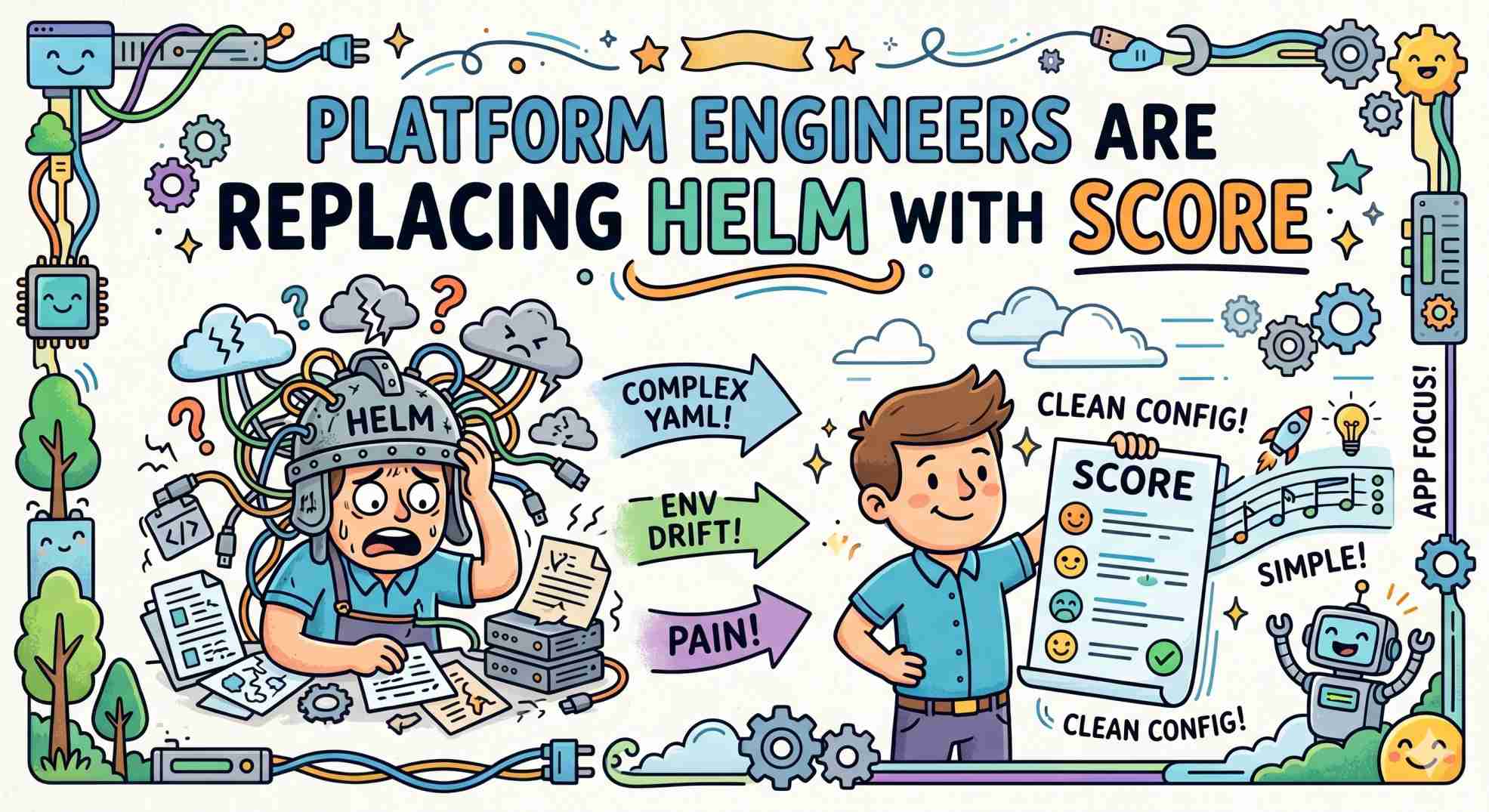
Remember the last time a developer needed to deploy a simple service?
The application code was finished. The container image worked perfectly. Testing passed.
Then the deployment process began.
Suddenly, the developer was staring at a massive Helm values file packed with ingress annotations, node affinities, taints, tolerations, resource policies, and cluster-specific configurations. Instead of focusing on application development, they were forced to understand Kubernetes infrastructure internals just to deploy a service.
This is one of the biggest sources of developer friction in modern cloud-native platforms.
For years, organizations accepted this complexity as the price of running Kubernetes. But platform engineering is changing that assumption.
A new workload-centric approach is emerging, and it is rapidly becoming one of the most interesting trends in modern Internal Developer Platforms (IDPs). At the center of that shift is the Score Specification.
The Problem With Helm as a Developer Interface
Helm remains one of the most valuable tools in the Kubernetes ecosystem.
It is excellent for installing and managing infrastructure packages such as:
- Prometheus
- Grafana
- Argo CD
- HashiCorp Vault
- NGINX Ingress Controller
The problem starts when Helm becomes the primary interface for application developers.
Developers should not need to understand cluster implementation details simply to describe an application.
The distinction becomes obvious when comparing the two approaches:
| Focus | Helm | Score |
|---|---|---|
| Primary Goal | Package & Infrastructure Management | Application Workload Definition |
| Perspective | Cluster Centric | Developer Centric |
| Configuration Style | Environment Specific Templates | Platform Agnostic Intent |
| Developer Experience | High Cognitive Load | Simplified Workflow |
| Portability | Environment Dependent | Environment Independent |
Helm templates often force developers to describe how infrastructure should be provisioned rather than simply declaring what the application needs.
This creates unnecessary complexity and often leads to duplicated configurations across:
- Local development
- QA environments
- Staging clusters
- Production clusters
The result is configuration sprawl and increasing developer cognitive load.
What Is the Score Specification?
The Score Specification is an open standard designed specifically for developers.
Instead of writing environment-specific Kubernetes manifests, developers create a simple workload definition that describes:
- Containers
- Dependencies
- Resource requirements
- Environment variables
A Score file focuses entirely on application intent.
For example:
apiVersion: score.dev/v1b1

metadata:
  name: billing-processor

containers:
  web-app:
    image: release/billing-service:v3.4.2

    variables:
      DATABASE_URL: "${resources.primary-db.connection_string}"

    resources:
      limits:
        cpu: "500m"
        memory: "512Mi"

resources:
  primary-db:
    type: postgres
Notice what is missing:
- Ingress definitions
- Storage classes
- Security contexts
- Service accounts
- Node selectors
- Cluster-specific networking
The developer simply describes the workload and its dependencies.
The platform decides how those requirements should be implemented.
How Platform Engineering Translates Intent Into Infrastructure
Score does not replace Kubernetes.
Instead, it introduces a translation layer between developers and infrastructure.
The platform engineering team defines environment-specific implementation rules while developers focus on workload requirements.
The same Score file can generate entirely different outputs depending on the target environment.
Example Translation Flow
Declared Intent
type: postgresLocal Development
- Launches a PostgreSQL container through Docker Compose
- Creates a local network
- Injects local credentials
Production Environment
- Provisions an encrypted managed PostgreSQL service
- Applies backup policies
- Enforces network isolation
- Integrates with secrets management
The developer never needs to know how the infrastructure is implemented.
They only declare that a database dependency exists.
This separation dramatically improves portability and consistency across environments.
Why Score Fits Perfectly Into Modern Platform Engineering
One of the primary goals of platform engineering is reducing cognitive load.
Developers should spend their time building business features, not learning Kubernetes internals.
With Score, responsibilities become much clearer.
Developer Responsibilities
- Build applications
- Define dependencies
- Declare runtime requirements
Platform Team Responsibilities
- Security policies
- Networking standards
- Infrastructure provisioning
- Compliance controls
- Environment-specific configurations
This creates a cleaner boundary between application ownership and infrastructure ownership.
Instead of every developer becoming a part-time Kubernetes administrator, platform teams provide secure abstractions that developers can consume safely.
Why Score Works Better With AI Coding Assistants
AI tools are becoming increasingly common across software delivery workflows.
However, generating Kubernetes manifests with AI often creates problems.
Large manifests contain:
- Multiple API versions
- Vendor-specific annotations
- Complex networking rules
- Environment-specific configurations
This increases the likelihood of hallucinated parameters, invalid YAML, and broken deployments.
Score simplifies the problem.
Because the schema is smaller and focused entirely on workload intent, AI tools can generate Score files much more reliably than raw Kubernetes manifests.
Instead of generating hundreds of lines of infrastructure boilerplate, AI only needs to describe:
- Containers
- Dependencies
- Resources
- Variables
The platform translation layer handles everything else.
This significantly reduces the risk of AI-generated infrastructure errors reaching production systems.
Integrating Score Into a Modern Delivery Pipeline
Adopting Score typically follows a straightforward workflow.
Step 1: Define Application Intent
Developers create a score.yaml file describing:
- Application containers
- Dependencies
- Runtime requirements
Step 2: Configure Platform Rules
Platform engineers define how Score resources map to infrastructure across environments.
Step 3: Execute Translation During CI/CD
Pipeline runners invoke tools such as:
- score-k8s
- score-compose
These tools generate environment-specific deployment manifests automatically.
Step 4: Deploy Through GitOps
The generated manifests are committed to GitOps repositories.
Controllers such as Argo CD or Flux reconcile the desired state and deploy changes automatically.
The result is a cleaner, more maintainable delivery workflow with significantly less operational complexity for developers.
Why This Matters for the Future of Developer Platforms
As organizations continue investing in Internal Developer Platforms, the industry is moving toward higher-level abstractions.
The goal is not to hide Kubernetes.
The goal is to prevent every developer from needing to understand every Kubernetes detail.
Score represents a shift from infrastructure-centric thinking toward workload-centric development.
Instead of asking developers to describe clusters, networking policies, and deployment mechanics, we allow them to describe their application requirements while platform teams handle implementation.
That separation creates faster delivery cycles, lower cognitive load, and more consistent infrastructure across environments.
Frequently Asked Questions
What is the Score Specification?
The Score Specification is an open standard that allows developers to define application requirements without writing environment-specific infrastructure configurations.
Is Score replacing Helm?
No. Helm remains valuable for packaging and deploying infrastructure software. Score focuses on defining application workloads and developer intent.
Does Score work with Kubernetes?
Yes. Tools such as score-k8s translate Score files into Kubernetes manifests that can be deployed through standard Kubernetes workflows.
How does Score reduce developer cognitive load?
Developers describe application requirements while platform teams manage infrastructure implementation details, reducing exposure to Kubernetes complexity.
Can Score be used with GitOps?
Yes. Score-generated manifests can be committed to Git repositories and deployed using GitOps platforms such as Argo CD and Flux.
Is Score useful for AI-assisted development?
Yes. The smaller and more structured schema makes it easier for AI tools to generate reliable workload definitions compared to traditional Kubernetes manifests.
Conclusion
Platform engineering is ultimately about removing unnecessary complexity from the developer experience.
Developers should focus on building applications, not memorizing infrastructure implementation details.
The Score Specification moves the industry closer to that goal by creating a clean separation between workload intent and infrastructure execution.
As Internal Developer Platforms continue to evolve, workload-centric development models like Score may become one of the most important abstractions in the modern cloud-native ecosystem.
The future of Kubernetes is less Kubernetes.