Why Enterprise AI Infrastructure Is Becoming a DevOps Problem
Enterprise AI infrastructure is becoming a major challenge for DevOps and platform engineering. Discover how Kubernetes, GPU scaling, model serving, and AI operations are reshaping enterprise platforms beyond simple RAG demos.
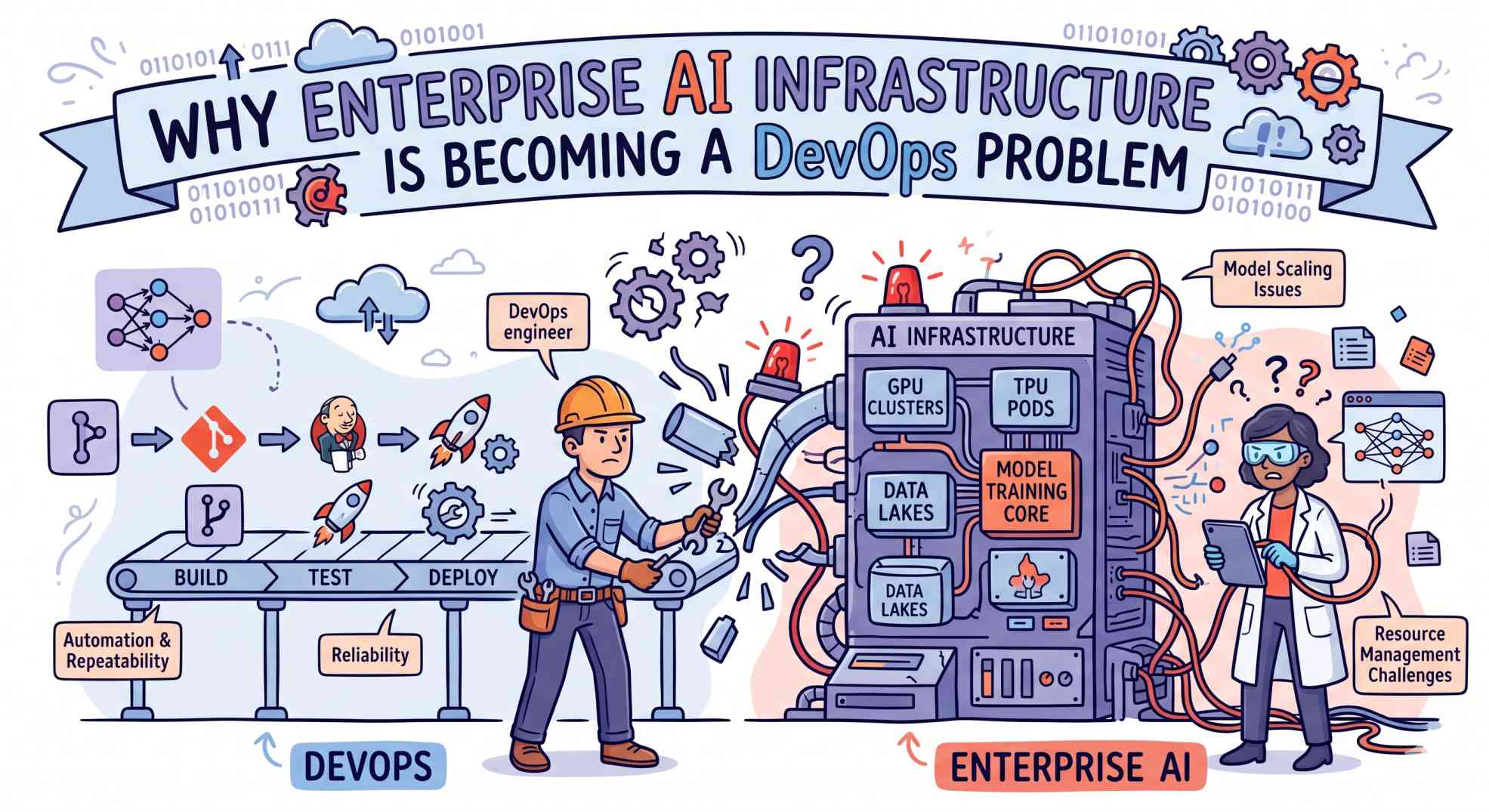
Remember when building an AI application seemed as simple as connecting a chatbot to your company documents?
A few engineers gather internal knowledge from Jira, Confluence, SharePoint, and databases. They create an embedding pipeline, connect a vector database, and build a polished user interface. The Retrieval-Augmented Generation (RAG) demo works flawlessly.
Executives love it.
The system instantly finds design documents, summarizes historical decisions, and answers questions that previously required hours of searching through internal knowledge bases.
Then the application launches company-wide.
Usage explodes. GPU utilization spikes. Inference queues begin growing. Model servers hit out-of-memory errors. Latency increases. Cloud costs surge.
Welcome to Day 2 operations.
Building an AI prototype is relatively easy. Operating enterprise AI infrastructure at scale is rapidly becoming one of the biggest challenges facing DevOps, SRE, and platform engineering teams.
Why AI Infrastructure Is Different From Traditional Enterprise Search
Traditional enterprise search is primarily an indexing problem.
A user submits a query, the search engine finds matching documents, and returns relevant links.
The compute requirements are predictable and relatively lightweight.
Large Language Models work differently.
Instead of simply retrieving information, they retrieve, analyze, synthesize, and generate entirely new responses in real time.
Traditional Search
Query → Index → Matching Documents
AI-Powered Knowledge Systems
Query → Context Retrieval → LLM Inference → Generated Answer
This additional inference layer dramatically increases infrastructure complexity.
Every request now consumes GPU memory, model-serving capacity, networking resources, and orchestration overhead.
As organizations move beyond simple RAG demos, AI quickly becomes an infrastructure challenge rather than a software challenge.
The Three Enterprise AI Infrastructure Paths
When enterprise workloads outgrow prototypes, teams usually choose one of three deployment strategies.
1. Bare-Metal GPU Infrastructure
The most common instinct is to purchase dedicated GPU hardware.
Benefits include:
- Full data ownership
- Maximum compliance control
- No third-party API dependency
- Predictable long-term infrastructure costs
However, operational complexity increases significantly.
Platform teams must manage:
- Multi-GPU scheduling
- NVIDIA driver lifecycles
- CUDA compatibility
- Hardware maintenance
- Cooling and power requirements
- Capacity planning
Hardware purchased today may become outdated within 18 to 24 months as newer accelerator architectures enter the market.
2. SaaS AI APIs
The opposite approach is to outsource inference entirely.
Benefits include:
- Fast deployment
- Minimal infrastructure management
- Instant scalability
- Faster experimentation
The tradeoff comes in the form of operational risk.
Enterprise teams must evaluate:
- Data residency requirements
- Regulatory compliance
- Vendor lock-in
- API availability
- Unpredictable token costs
For organizations handling proprietary engineering knowledge, customer records, or sensitive internal data, these concerns become significant.
3. Private Cloud Kubernetes AI Platforms
Many platform engineering teams view Kubernetes as the ideal middle ground.
Managed cloud services provide flexibility while maintaining infrastructure control.
The reality is often more complicated.
Teams quickly find themselves managing:
- GPU node pools
- CUDA version compatibility
- NVIDIA device plugins
- Model-serving frameworks
- Karpenter autoscaling
- KEDA event-driven scaling
- vLLM optimization
- Triton Inference Server deployments
What started as an AI application becomes a full-scale infrastructure platform.
The Hidden Problem: AI Still Lacks Mature Infrastructure Abstractions
Most modern software benefits from decades of abstraction.
Application developers do not think about:
- CPU scheduling
- Storage controller operations
- Memory paging
- Network packet routing
Operating systems handle those responsibilities automatically.
AI infrastructure has not reached that level of maturity.
Today, platform teams still need to understand:
- Tensor parallelism
- GPU memory allocation
- KV cache optimization
- Model sharding
- Accelerator scheduling
- High-speed GPU networking
In many ways, organizations are building custom operating systems simply to serve AI workloads reliably.
Until better platform abstractions emerge, AI infrastructure will remain heavily dependent on specialized operational expertise.
Why Enterprise AI Is Becoming a DevOps Problem
The early AI race focused on model capabilities.
Today, the conversation is shifting toward operational efficiency.
The winning organizations will not necessarily be those running the largest models.
They will be the teams that can:
- Serve models reliably
- Control infrastructure costs
- Maintain security and compliance
- Meet strict service-level objectives
- Scale without operational chaos
This places AI directly within the responsibilities of:
- DevOps engineers
- Site Reliability Engineers (SREs)
- Platform engineering teams
- Infrastructure architects
Inference is no longer a research experiment.
It is becoming a production infrastructure asset.
The Interactive Infrastructure Challenge
Take a look at your current AI deployment strategy.
Ask yourself:
- Could your platform handle a 10x increase in inference traffic tomorrow?
- How quickly can you identify the root cause of a GPU memory bottleneck?
- What percentage of your AI infrastructure spend comes from idle resources?
If these questions are difficult to answer, your organization may be approaching AI as a development project rather than an operational platform.
Frequently Asked Questions
What is enterprise AI infrastructure?
Enterprise AI infrastructure includes the compute, storage, networking, orchestration, and security systems required to run AI workloads reliably in production environments.
Why are GPUs important for AI infrastructure?
GPUs accelerate machine learning inference and training workloads by processing large volumes of parallel computations significantly faster than traditional CPUs.
What is the biggest challenge in scaling AI applications?
Operational complexity. As usage grows, organizations must manage GPU capacity, model serving, observability, security, compliance, and infrastructure costs.
Is Kubernetes a good platform for AI workloads?
Yes. Kubernetes provides scalability and automation, but running AI workloads on Kubernetes introduces additional complexity around GPU scheduling, model serving, and autoscaling.
Why is AI becoming a platform engineering concern?
Because production AI systems require continuous infrastructure management, reliability engineering, observability, governance, and cost optimization.
The Verdict
The future of enterprise AI is not defined by model size.
It is defined by operational excellence.
As AI moves from experimentation to production, the organizations that succeed will be those that treat inference infrastructure like any other critical platform service: observable, scalable, secure, and cost-efficient.
The AI race is no longer just about building smarter models.
It is about building smarter infrastructure. 🚀
Internal Linking Opportunities
- Karpenter autoscaling → Link to your Karpenter on OpenShift article
- Platform engineering teams → Link to your Crossplane article
- Kubernetes AI platforms → Link to your CNCF Score article
- Observability → Link to your Grafana MCP article
"The AI demo wins the meeting. The infrastructure wins the business."