Claude Security vs. GitHub Advanced Security 🛡️ - The Patch War
Claude Security vs GitHub Advanced Security: which AI security tool wins? This blog explores AI-generated security patches, DevSecOps automation, hallucination risks, and the future of agentic vulnerability remediation.
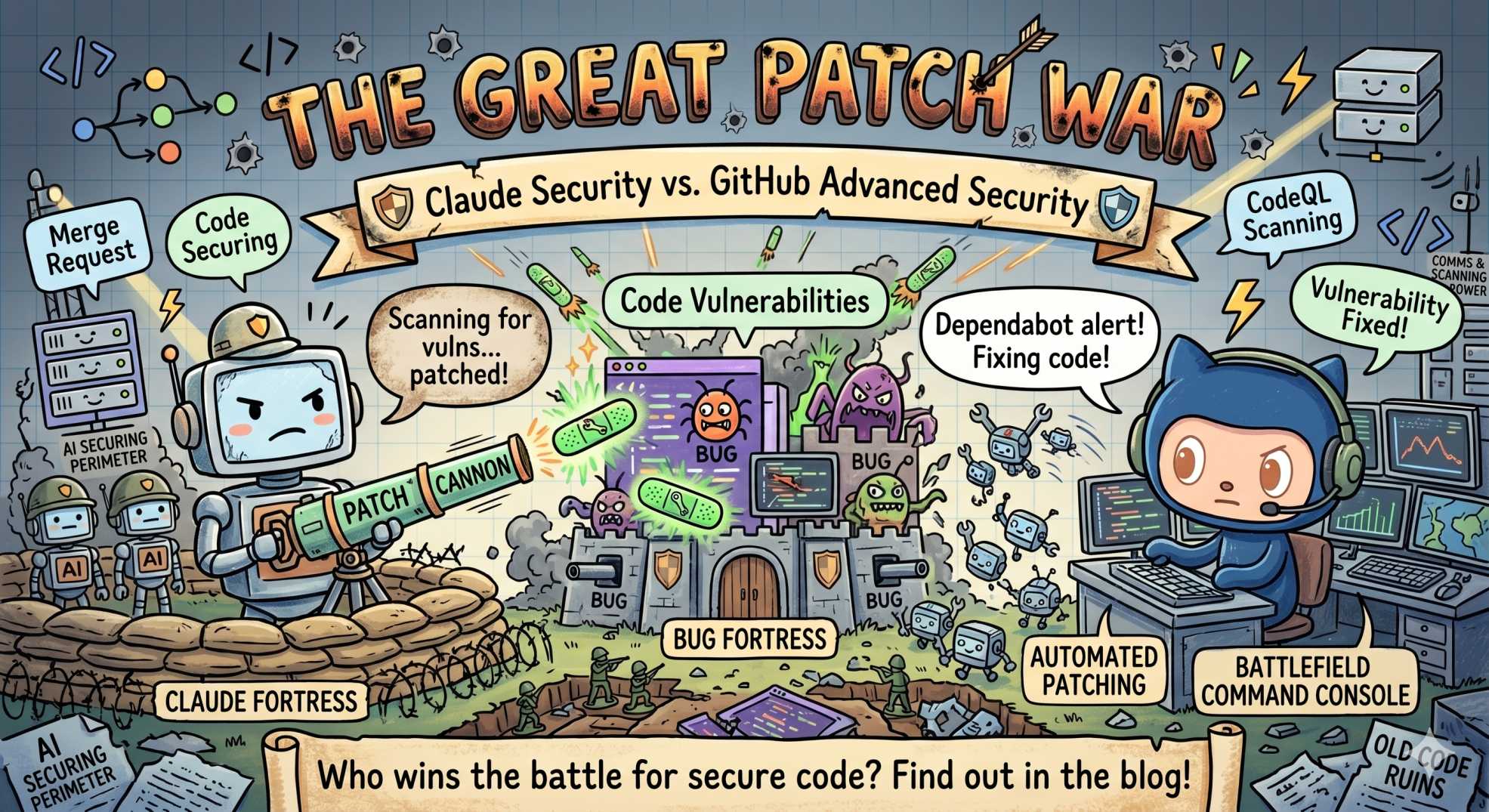
The team at DevOps Inside knows that if 75% of the code we are shipping is now AI-generated, then our security debt is probably growing at the same rate.
We’ve spent the last few weeks talking about the “Deep State” of the control plane and the “Pod-Level Resource Managers” of Kubernetes v1.36. But while we optimize the hardware, the software itself is becoming a battlefield of bots. ⚔️
This month, a new front opened in the DevSecOps world.
With the launch of Claude Security for Enterprise, Anthropic has officially declared war on the reigning king of the repository: GitHub Advanced Security.
Following our “From Pipelines to Prompts” series, it is time to ask a dangerous question:
Who do you want guarding your codebase, the incumbent platform or the AI-native brain?
⚔️ The Great Patch War
In the SRE world, we have moved beyond the era of “Shift-Left.”
We are now entering the era of “Shift-Automatic.”
Finding vulnerabilities is no longer enough. The expectation now is that your tooling should already have a pull request waiting before you even open the alert.
But as we move from detection to automated remediation, a dangerous problem appears:
Is the AI generating a secure patch, or just secure-looking code?
🧠 The Contenders: Logic vs. Context
🛡️ GitHub Advanced Security (GHAS)
The established veteran.
It has home-field advantage.
With CodeQL and Copilot Autofix, GHAS understands your workflow, integrates deeply into CI/CD pipelines, and relies on years of static analysis logic.
It is fast, predictable, and trusted by enterprise engineering teams worldwide.
🤖 Claude Security for Enterprise
The AI-native challenger.
Claude does not just look at syntax. It uses a massive context window to understand architectural intent.
Claude does not simply detect a SQL injection.
It sees the entire data flow, from your frontend request to the database layer.
That changes the game entirely.
⚠️ The “Hallucination” Trap: Secure vs. Secure-Looking
The biggest risk in the AI security race is not malicious code.
It is the hallucination of safety. 🚨
The SRE Example
Imagine you have a hard-coded API key inside a legacy Python service.
GHAS will likely flag it and suggest moving it into an environment variable.
Simple. Logical. Reliable.
Claude might go much further.
It could propose a complete secret rotation workflow that looks incredibly professional and enterprise-ready.
But it might also hallucinate configuration parameters for your specific vault provider, whether that is HashiCorp Vault or AWS Secrets Manager.
And that is where things become dangerous.
Because if teams start “merge-and-forget” behavior with AI-generated security fixes, they may end up deploying infrastructure that looks like a fortress while behaving like a house of cards. 🃏
🤖 The AI Edge: Agentic Security Remediation
In 2026, we are watching the rise of Agentic Security.
This is no longer just vulnerability scanning.
This is AI behaving like a security engineer that never sleeps.
🔍 Automated Triage
Instead of humans spending four hours debating whether a CVE is critical or a false positive, AI agents are now:
- Running code in sandboxes
- Testing exploitability
- Evaluating runtime context
- Simulating attack paths
In some cases, these workflows are even leveraging snapshot-style infrastructure environments similar to the GKE Pod Snapshots we discussed previously. ⚙️
🧩 Contextual Patching
Claude’s biggest advantage is contextual adaptation.
It can generate fixes that match your team’s coding conventions, architectural patterns, and repository style.
But at DevOps Inside, we believe “style compatibility” should never outrank stability and predictability.
Because elegant hallucinations are still hallucinations.
⚠️ The SRE Reality Check: Trust, but Verify
As AI-native scanners become embedded inside modern pipelines, the role of the SRE is evolving again.
We are no longer just the fixers.
We are becoming the sanity checkers.
🌐 The Context Test
Does the AI understand your NetworkPolicies?
Does it recognize your security boundaries?
If the generated “fix” requires exposing ports your security team intentionally locked down, then the tool is not helping your infrastructure.
It is actively weakening it.
🧪 The Test-Driven Fix
Never merge an AI-generated security patch without accompanying validation.
If the patch does not include:
- Unit tests
- Validation logic
- Security verification
- Runtime proof
Then it should not enter production.
If the AI cannot prove the fix works, do not trust it.
🛰️ The Interactive SRE Challenge
Open your GitHub “Security” tab right now.
How many open alerts have been sitting there for more than 30 days?
Now imagine an AI agent submits a “correct-looking” PR for every single one of them tonight.
Would you confidently click “Merge All”?
If the answer is “No,” then the industry has not solved the security problem.
It has simply shifted the debt from “Security Engineering” to “Code Review.”
🚀 The Verdict
GitHub Advanced Security is the reliable shield enterprises have trusted for years.
Claude Security represents something different.
A new AI-native brain that understands context, architecture, and intent.
But the winner of this war will not be the tool that finds the most vulnerabilities.
It will be the tool that produces the fewest hallucinations.
And in the age of AI-generated infrastructure, that distinction matters more than ever.
💬 Quick Question: Who do you trust more to fix a critical CVE at 3 AM: a pre-defined CodeQL rule or a Large Language Model?
Let the patch war begin in the comments.
“The scariest vulnerability in 2026 might not be malicious code. It might be AI-generated code that looks too confident to question.”