How to Build Pull Request Cost Gates with Infracost and OpenCost
Learn how to implement Shift Left FinOps using Infracost and OpenCost to catch cloud cost overruns before deployment. Build pull request cost gates, optimize Kubernetes spending, and improve cloud cost visibility across DevOps workflows.
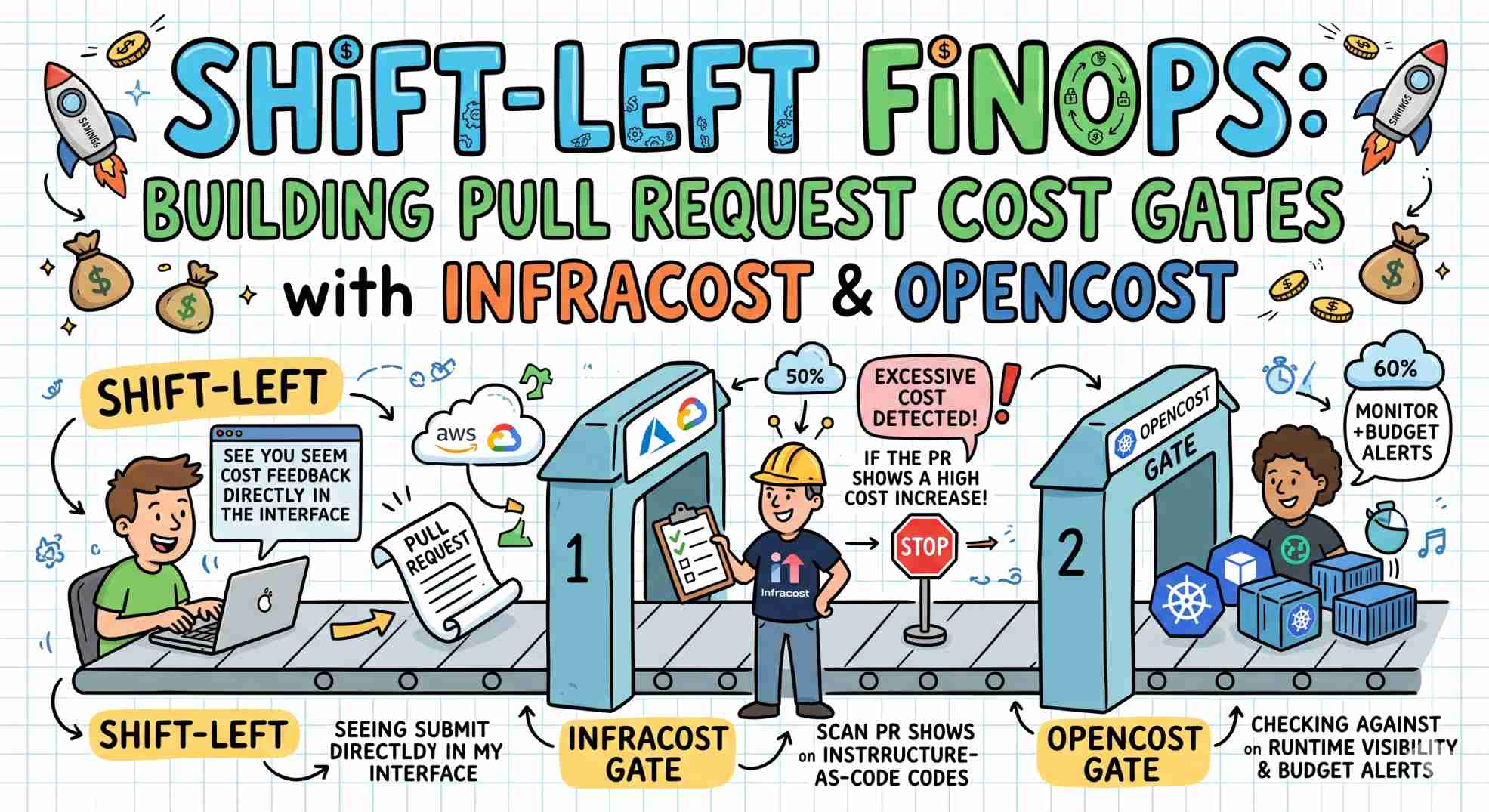
Shift-Left FinOps: Building Pull Request Cost Gates with Infracost & OpenCost
We’ve all experienced that specific sinking feeling on the first day of the month. You open the AWS Cost Explorer or GCP billing dashboard, and there it is—a massive, unexpected spike in your infrastructure spend.
After spending three days running cross-team post-mortems and digging through CloudTrail logs, you finally track down the culprit. A product developer spun up a massive, multi-node GPU cluster for an isolated testing sandbox, configured it with non-expiring persistent volumes, and then forgot about it over a long holiday weekend.
Traditional FinOps models are broken because they treat cost management as an autopsy. Looking at an aggregate cloud bill weeks after the resources were provisioned means you're acting purely reactively. By the time you notice the anomaly, the money is already gone.
If you want to survive the budget strains of modern engineering fleets, you need to treat cost exactly like code quality or security vulnerabilities. You need to shift left. By building an automated pull request cost tracking system directly into your continuous integration and continuous delivery (CI/CD) pipelines, you can catch over-provisioned infrastructure before it gets applied to production.
The Shift-Left FinOps Architecture
To build a comprehensive shift-left finops toolchain, we look at infrastructure from two distinct perspectives: static configuration states and dynamic container footprints. We bridge this gap by pairing two prominent open-source tools:
- Infracost: Acts as a static analyzer for Infrastructure as Code (IaC). It parses your Terraform, OpenTofu, or CloudFormation manifests during a pull request (PR) build, looks up real-time cloud provider pricing APIs, and determines exactly how much your bill will change if that PR is merged.
- OpenCost: Functions as an in-cluster Kubernetes cost monitoring engine. It tracks actual runtime resource allocation, CPU/memory usage anomalies, and shared network egress metrics, allowing your platform to feed back real-world resource footprints into future planning.
When combined, they create a protective ring around your infrastructure budget.
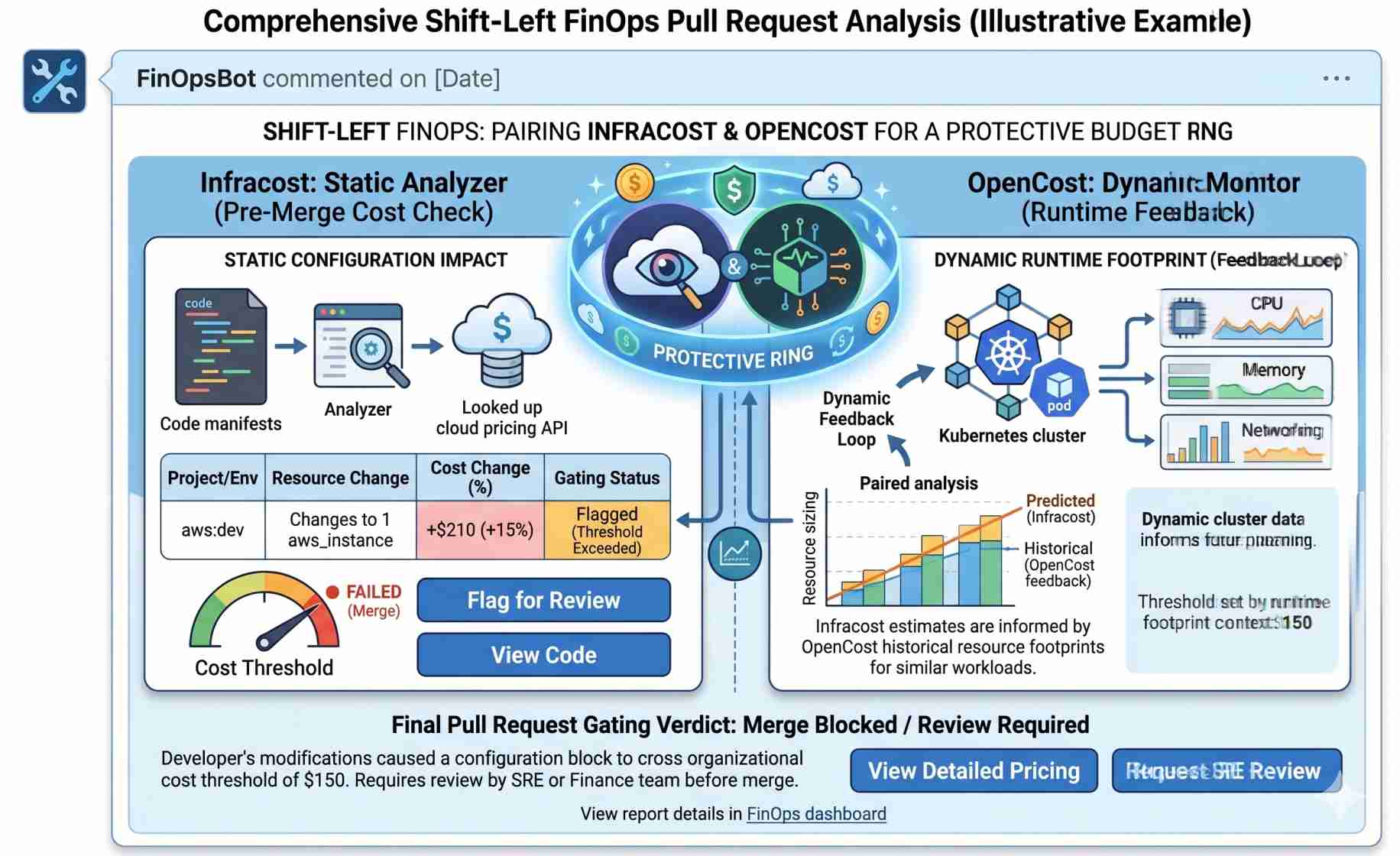
As shown in the pull request report example above, engineers receive immediate visual feedback on the financial consequences of their code changes. If a developer's modifications cause a configuration block to cross an organizational cost threshold, the gate can flag the modification or block the merge entirely until an SRE or finance team member reviews it.
Step-by-Step: Setting Up an Infracost Cost Gate
Implementing automated cost tracking requires embedding static calculation checks directly into your branch protection pipeline. Let's look at an authentic infracost GitHub Actions setup that scans a Terraform directory whenever a developer opens a pull request.
The Cost Gate Automation Sequence
- Retrieve Your Infracost API Token: Prerequisite.
Sign up for a free or enterprise API key from the Infracost portal. Register this token securely as an encrypted secret within your repository settings under the name INFRACOST_API_KEY.
- Check Out Source and Setup Infracost CLI: CI Step 1.
Configure your workflow runner to clone your code repository and download the native Infracost binary package directly into the pipeline container's runtime environment.
- Generate the Pricing Baseline Diff: CI Step 2.
Instruct the CLI to analyze the main production branch configuration, evaluate the incoming PR branch modifications, and compile a JSON output detailing the net cost delta.
- Inject the Cost Comment to the PR: CI Step 3.
Pass the raw JSON data through the official markdown formatter action to post an interactive, scannable breakdown table directly on the active developer pull request thread.
Here is the declarative YAML configuration file required to implement this cost gate framework within GitHub Actions:
YAML
name: FinOps Pull Request Cost Gate

on:
  pull_request:
    paths:
      - 'terraform/**'

jobs:
  infracost-analysis:
    name: Infracost Cost Analysis
    runs-on: ubuntu-latest
    permissions:
      pull-requests: write

    steps:
      - name: Check out code
        uses: actions/checkout@v4
        with:
          ref: ${{ github.event.pull_request.head.ref }}

      - name: Setup Infracost CLI
        uses: infracost/actions/setup@v3
        with:
          api-key: ${{ secrets.INFRACOST_API_KEY }}

      - name: Generate Baseline and Diff
        run: |
          infracost breakdown --path terraform/ \
                              --format json \
                              --out-file /tmp/infracost.json

      - name: Post Cost Estimate Comment
        uses: infracost/actions/comment@v3
        with:
          path: /tmp/infracost.json
          behavior: update
Dynamic Layer: Taming K8s Spend with OpenCost
Static analysis catches macro-level provisioning errors (like upgrading an EC2 instance from an m5.large to an r5.4xlarge). However, static checks can't predict what happens inside an elastic orchestration layer where workload costs change dynamically based on traffic swings.
This is where Kubernetes cost optimization CI/CD workflows integrate with OpenCost.
By running OpenCost inside your staging and production clusters, your SRE teams can track actual runtime utilization efficiency. If your Infracost gate shows that a microservice costs $200 per month based on its declarative CPU requests, but OpenCost telemetry indicates the container's real-world memory utilization never crosses 5%, you have discovered a prime target for automated down-sizing.
| Operational Horizon | Analysis Tool | Evaluation Vector | Primary Value Proposition |
| Pre-Deployment (Static) | Infracost | Declared IaC resource specs (tfplan, HCL blocks) | Blocks budget overruns before cloud infrastructure is built. |
| Post-Deployment (Runtime) | OpenCost | Real-time container metrics (vCPU, RAM, network egress) | Exposes internal idle resource waste and guides accurate resizing. |
The AI Infrastructure Catalyst: Why Proactive Gates Matter
The urgency surrounding modern FinOps pipelines has been supercharged by the industry's widespread transition toward enterprise AI workloads. Traditional web applications are relatively cheap to run; hosting micro-frontends or simple REST APIs rarely threatens an enterprise's balance sheet.
Large language model clusters, vector database indices, and dedicated GPU nodes (like NVIDIA H100s or A100 instances) represent a completely different category of expense.
A single misconfigured high-performance cluster node pool configuration can accumulate thousands of dollars in unoptimized cloud spend within a matter of days.
If your team utilizes predictive horizontal pod autoscalers (HPAs) or automated node provisioning engines, an unmonitored script or runaway data-ingestion loop can cause your cluster infrastructure to scale out exponentially. Implementing proactive pull request cost gates creates an absolute line of defense, ensuring that any modifications targeting high-cost infrastructure segments require explicit organizational sign-off.
Establish Clear Cost Ownership
Transitioning toward a shift-left FinOps model isn't about micro-managing your development teams or locking down resource access. It is about establishing transparent, automated feedback loops.
When developers can immediately visualize the budget impact of their architectural decisions directly within their native GitHub or GitLab environment, they naturally make more efficient design choices. By deploying tools like Infracost and OpenCost across your delivery lifecycle, you transform financial governance from a painful monthly accounting discussion into a fast, integrated engineering standard.
"The cheapest cloud resource is the one your pull request never created."