Cloud Native DevOps Accelerates Modern Software Delivery
Discover how Cloud-Native DevOps accelerates software delivery through Kubernetes, GitOps, platform engineering, observability, and DevSecOps while improving scalability, reliability, and developer productivity.
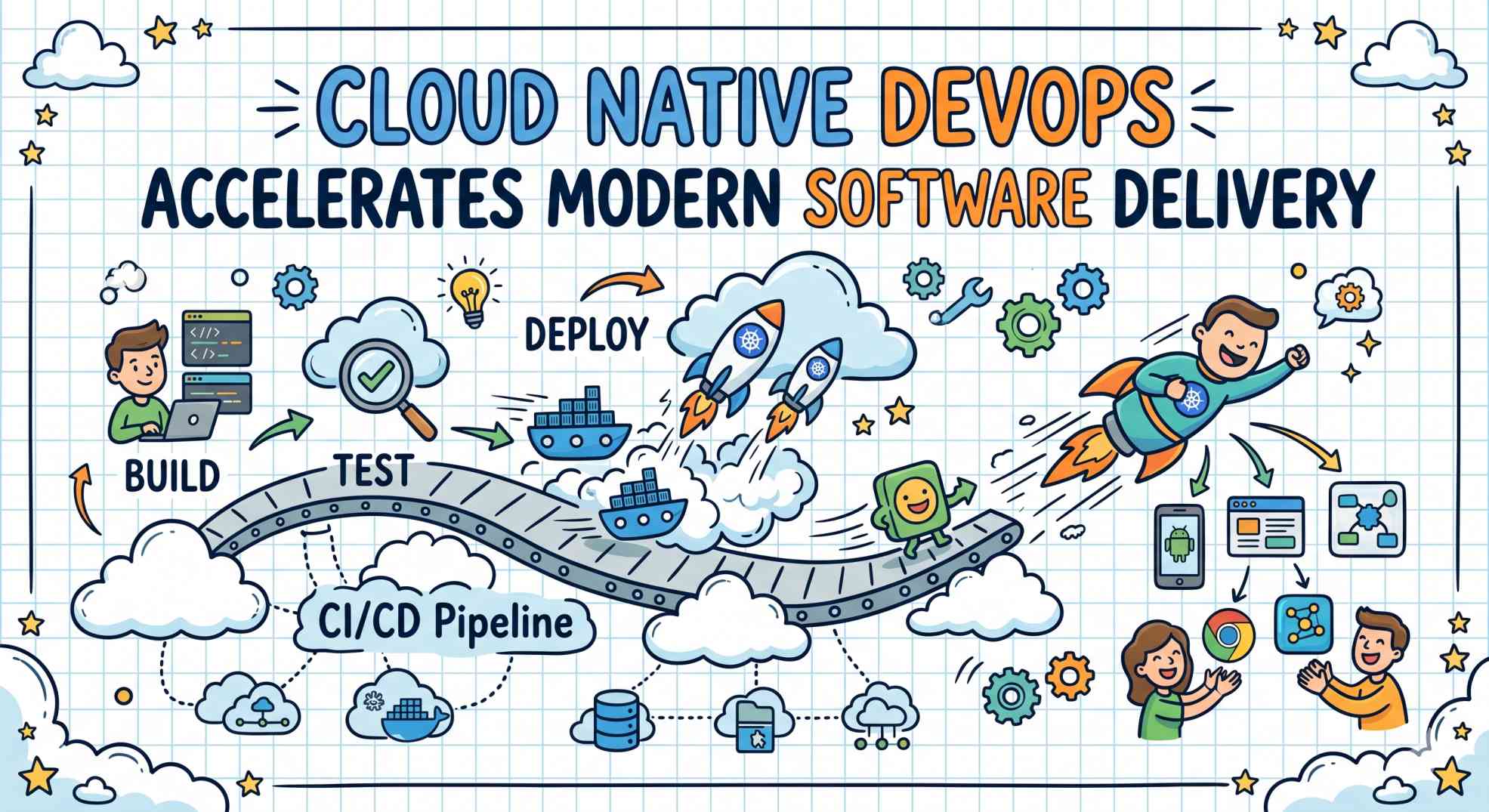
Remember the old days of scheduled deployment windows?
The midnight calendar invites. The rollback spreadsheets. The senior engineer, who somehow knew exactly which server needed a manual fix when production started misbehaving.
Deployments happened once every few months, everyone held their breath, and the rollback plan was often just as important as the release itself.
Today, that approach feels like ancient history.
Modern organizations operate in cloud-native environments powered by microservices, containers, Kubernetes, and highly automated delivery pipelines. The goal is no longer to release software occasionally. The goal is to deliver value continuously.
This shift has given rise to Cloud-Native DevOps, a modern approach that combines automation, cloud-native architecture, platform engineering, and security practices to accelerate software delivery without sacrificing reliability.
Why Traditional DevOps Hits a Velocity Ceiling
Traditional DevOps successfully improved collaboration between development and operations teams.
However, many organizations still rely on large monolithic applications where even a minor code change requires building, testing, and deploying the entire application.
This creates a natural bottleneck.
A single update can impact multiple business functions, increasing release risk and slowing delivery speed.
Cloud-native architectures solve this problem by breaking applications into independently deployable services.
Traditional Monolith
Code Change → Full Application Build → High-Risk Release
Cloud-Native Microservices
Code Change → Service Pipeline → Independent Deployment
When services are decoupled, teams can deploy updates independently without coordinating massive release windows.
This dramatically improves software delivery velocity while reducing deployment risk.
Containers and Kubernetes Eliminate Environment Problems
Every engineer has heard the phrase:
"It worked on my machine."
Containers were created to eliminate that excuse.
By packaging applications together with their dependencies and runtime requirements, containers ensure consistency across environments.
The same container image runs reliably on:
- Developer laptops
- Test environments
- Staging clusters
- Production systems
Kubernetes takes this even further by automating:
- Workload scheduling
- Service discovery
- Self-healing
- Horizontal scaling
- High availability
Together, containers and Kubernetes create a consistent platform that allows teams to deploy quickly without worrying about environmental differences.
GitOps Brings Predictability to Modern Infrastructure
As Kubernetes adoption grows, infrastructure management becomes increasingly complex.
This challenge led to the rise of GitOps.
Rather than manually applying infrastructure changes, engineers store the desired system state inside version-controlled repositories.
Git becomes the single source of truth.
GitOps platforms such as Argo CD and Flux continuously compare the live environment with the desired state stored in Git.
Whenever differences appear, the platform automatically reconciles the environment.
Benefits include:
- Reduced configuration drift
- Faster disaster recovery
- Complete audit trails
- Improved change visibility
- More reliable infrastructure management
For modern cloud-native organizations, GitOps has become a cornerstone of operational reliability.
Platform Engineering Removes Infrastructure Complexity
As Kubernetes environments grow more sophisticated, developer productivity often suffers.
Most developers do not want to spend hours writing deployment manifests, configuring ingress policies, or troubleshooting infrastructure components.
This challenge led to the rise of Platform Engineering.
Instead of exposing developers directly to infrastructure complexity, platform teams build Internal Developer Platforms (IDPs) that provide self-service capabilities through standardized workflows and Golden Paths.
Developers can:
- Deploy new services
- Provision databases
- Configure networking
- Access observability tools
- Request infrastructure resources
All while remaining compliant with organizational standards.
This approach reduces cognitive load and allows developers to focus on delivering business value rather than managing infrastructure.
Observability Powers Reliable Cloud-Native Operations
Fast deployments mean very little if teams cannot identify problems quickly.
Modern distributed systems generate massive amounts of telemetry data through:
- Logs
- Metrics
- Traces
- Events
Traditional monitoring tools often struggle to provide enough context.
Modern observability platforms help teams understand system behavior across complex cloud-native environments.
By combining telemetry with intelligent analytics, engineering teams can identify performance bottlenecks, latency spikes, and infrastructure anomalies before they become customer-facing incidents.
Strong observability helps organizations:
- Improve reliability
- Reduce MTTR
- Strengthen SLO compliance
- Detect issues faster
- Minimize operational risk
As systems become more distributed, observability becomes a critical business requirement rather than a nice-to-have feature.
DevSecOps Secures the Software Supply Chain
As software delivery accelerates, security must evolve alongside it.
Modern attackers increasingly target software supply chains instead of application front ends.
Cloud-native DevSecOps shifts security controls directly into the development workflow.
Key practices include:
Automated Security Scanning
Identify secrets, vulnerabilities, and coding risks during pull request validation.
Container Image Verification
Use technologies such as Cosign and Software Bills of Materials (SBOMs) to validate image integrity before deployment.
Policy Enforcement
Tools such as Kyverno and Open Policy Agent automatically enforce security and compliance requirements across Kubernetes environments.
By embedding security directly into delivery pipelines, organizations can move faster without increasing risk.
AI Is Accelerating DevOps
Artificial intelligence is rapidly becoming part of modern software delivery workflows.
AI-powered tools assist with:
- Code generation
- Incident analysis
- Infrastructure optimization
- Capacity planning
- Predictive scaling
- Operational troubleshooting
However, AI amplifies existing processes.
Well-designed platforms become more efficient.
Poorly designed platforms accumulate technical debt faster.
The organizations benefiting most from AI are those that first establish strong cloud-native foundations built on automation, observability, and operational discipline.
Why Cloud-Native DevOps Matters
Cloud-Native DevOps is not simply about adopting Kubernetes or building CI/CD pipelines.
It is about creating an engineering platform capable of supporting continuous innovation.
Organizations that embrace cloud-native principles gain:
- Faster release cycles
- Greater operational reliability
- Better developer experience
- Improved scalability
- Stronger security
- Sustainable engineering velocity
The result is a delivery model that allows teams to focus on building customer value rather than fighting infrastructure challenges.
Frequently Asked Questions
What is Cloud-Native DevOps?
Cloud-Native DevOps combines DevOps practices with cloud-native technologies such as containers, Kubernetes, GitOps, platform engineering, and automation to improve software delivery speed and reliability.
Why is Kubernetes important for Cloud-Native DevOps?
Kubernetes automates deployment, scaling, recovery, and infrastructure management, making it a core component of modern cloud-native platforms.
What is the difference between DevOps and Cloud-Native DevOps?
Traditional DevOps focuses on collaboration and automation. Cloud-Native DevOps extends those principles using cloud-native architectures designed for highly scalable and distributed systems.
What role does GitOps play in Cloud-Native DevOps?
GitOps uses Git repositories as the source of truth for infrastructure and application configurations, improving consistency, security, and operational reliability.
How does platform engineering improve developer productivity?
Platform engineering provides self-service tools and standardized workflows that reduce infrastructure complexity and allow developers to focus on building applications.
Final Thoughts
Cloud-Native DevOps has transformed software delivery from a slow, high-risk process into a continuous, scalable engineering capability.
Organizations that combine Kubernetes, GitOps, platform engineering, observability, and DevSecOps are building delivery platforms capable of supporting the next generation of software innovation.
"The goal is not to deploy faster. The goal is to make fast deployments feel boring."