WebAssembly on Kubernetes for Serverless Applications
WebAssembly on Kubernetes reduces container overhead, cuts cold starts, and improves resource efficiency. Discover how Wasm, SpinKube, and runwasi enable faster serverless workloads and edge AI applications.
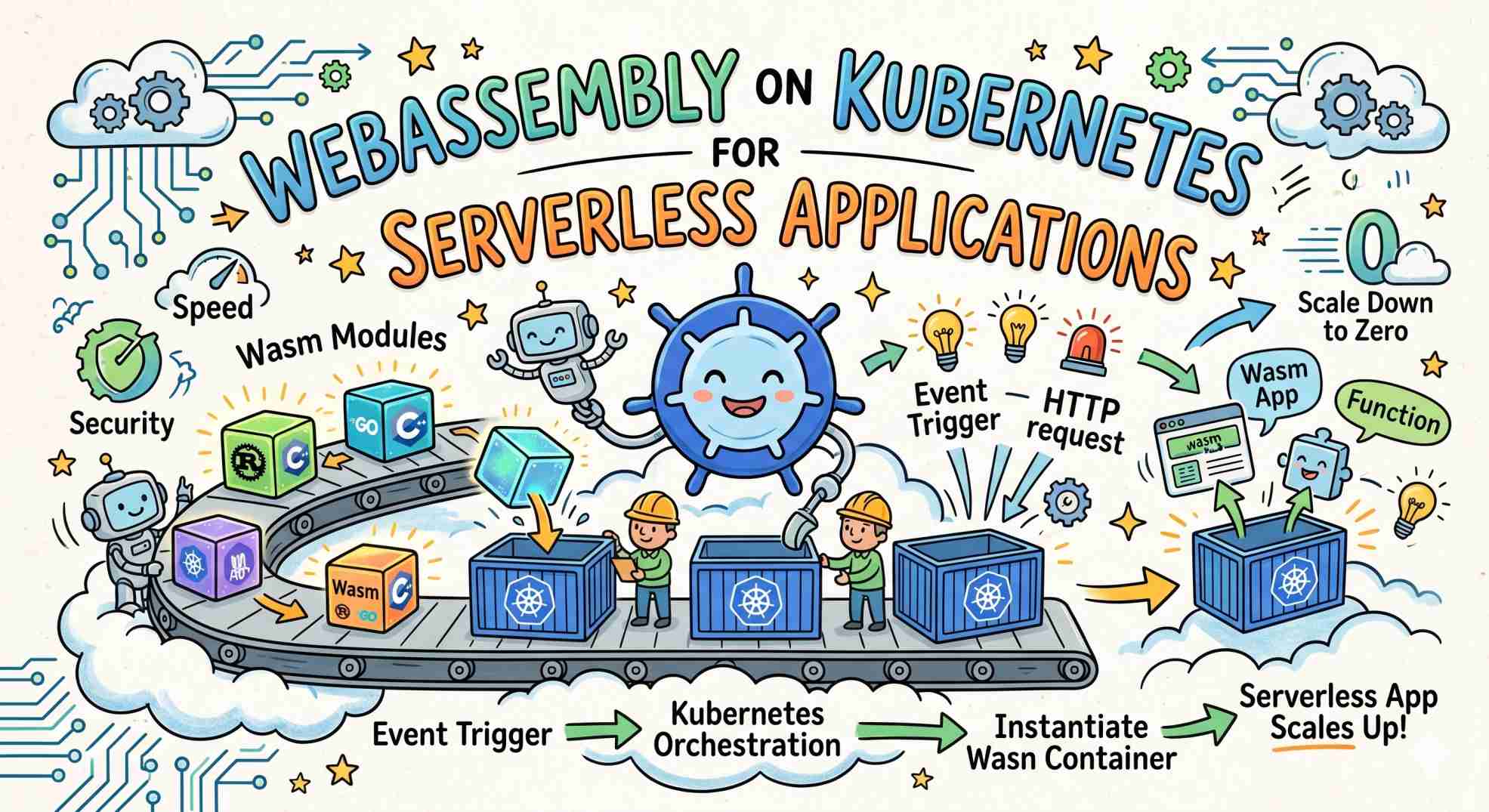
Serverless Without Containers: Running WebAssembly (Wasm) on Kubernetes
We’ve all accepted a specific architectural tax when building and shipping cloud-native applications: the container tax.
To run a simple, lightweight microservice that processes an incoming webhook or validates an API payload, we pack our code inside a Docker image. But that application logic doesn’t live alone. To survive, it carries along a minimal Linux filesystem, native OS C-libraries, package manager configurations, and a multi-layer runtime environment.
By the time you compile, your 15MB application binary is buried inside a 300MB OCI image.
When traffic spikes across an elastic cluster, your orchestration engine has to fetch that image from a remote registry, unpack the layers, configure host namespaces, and initialize the container runtime. In a spiky, event-driven serverless ecosystem, this entire dance results in a painful cold start that can take anywhere from a few hundred milliseconds to several long seconds.
While tools like eBPF have successfully stripped the performance and resource overhead out of our networking and service mesh layers, platform engineers are turning to a new runtime primitive to optimize the application layer itself. We are moving past traditional containers and into the era of server-side WebAssembly.
By running WASM on Kubernetes, teams are achieving a level of efficiency that traditional containers simply cannot match, turning the cluster into an ultra-low-latency execution fabric.
The Architectural Showdown: WebAssembly vs Docker
To understand why this change is capturing the attention of SREs and platform architects, we have to look at exactly what these two primitives are trying to make portable.
Docker packages the operating environment. It wraps an application inside a secure namespace prison, pretending it owns a private Linux kernel, network stack, and root directory. This makes it incredibly robust for heavy, stateful, or deeply coupled applications.
WebAssembly packages the compiled logic. Originally engineered to execute complex code inside web browsers at native execution speeds, Wasm translates code compiled from compiled languages (like Rust, Go, C++, or Zig) into cross-architecture bytecode. Thanks to the standardization of WASI (WebAssembly System Interface), those binaries can now run securely on server infrastructure.
When evaluating WebAssembly vs Docker performance serverless workloads, the numbers reveal a dramatic efficiency gap:
| Performance Vector | Traditional OCI Containers (Docker) | Server-Side WebAssembly (WASI) |
| Cold Start Boot Time | 100ms to 3,000ms (Container initialization) | Sub-millisecond (Immediate instruction execution) |
| Average Artifact Size | 150MB to 800MB+ | 1MB to 25MB (Pure bytecode binaries) |
| Memory Footprint | High baseline overhead (OS layer bloat) | Near-zero idle footprint (~60% less RAM usage) |
| Isolation Boundary | Kernel-level (Linux namespaces & cgroups) | Instruction-level (Capability-based linear memory sandbox) |
Inside the Node: How K8s Runs Wasm Alongside Containers
A common misconception is that adopting WebAssembly means tearing down your existing Kubernetes clusters and starting from scratch. The reality is much cleaner. Thanks to modern high-level container runtime abstractions, Wasm modules can run seamlessly alongside standard Docker containers on the same worker nodes.
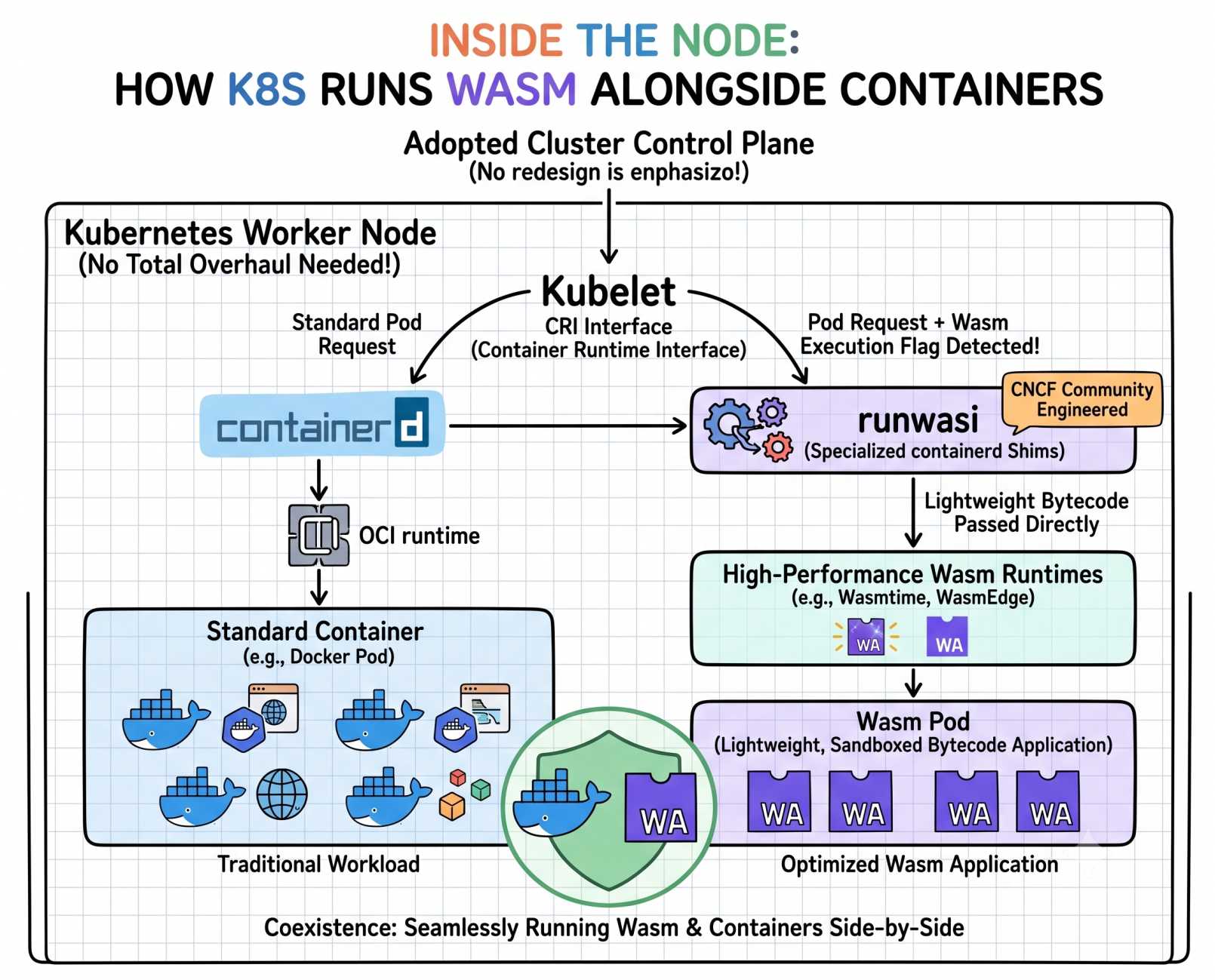
If you examine the native runtime abstraction architecture above, notice how the cluster control plane doesn't require a total overhaul. Instead of building a unique container orchestration engine, the CNCF community engineered runwasi , a specialized set of containerd shims.
When a standard pod request hits the node, containerd routes the instruction through a low-level container runtime like runc. But when the scheduler detects a specific Wasm execution flag, it bypasses the standard container path entirely, passing the lightweight bytecode artifact directly to high-performance Wasm runtimes like Wasmtime or WasmEdge.
The Blueprint: Deploying Wasm Workloads via SpinKube
To make this architecture production-ready, platforms like SpinKube and wasmcloud cloud native production operators utilize standard Kubernetes Custom Resource Definitions (CRDs) and RuntimeClasses to manage the lifecycle of these micro-binaries.
Here is the exact operational flow required to bootstrap a node and execute a WebAssembly module inside a standard cluster topology:
The Wasm Scheduling Logic Loop
- Register the RuntimeClass: Platform Step 1.
Apply a cluster-wide RuntimeClass manifest that maps a custom handler string (such as wasmtime-spin) directly to the matching runwasi containerd-shim binary installed on your worker nodes.
- Compile and Package Code: Developer Step 2.
Compile your application logic into a standard .wasm target module and push it to an OCI-compliant registry (like GitHub Packages or AWS ECR) using standard container packaging tools.
- Declare the Runtime Target: Deployment Step 3.
Write a standard Kubernetes deployment manifest for your application, adding an explicit runtimeClassName: wasmtime-spin parameter inside the main pod spec block.
- Execute with Sub-Millisecond Speed: Orchestration Step 4.
The kubelet schedules the pod. Containerd intercepts the OCI package, bypasses the standard container creation process, and fires up the module inside the sandbox, securing sub-millisecond cold starts and k8s response paths.
Here is what that final declarative deployment manifest looks like. Notice how it feels identical to standard Kubernetes resources, maintaining compatibility with your existing GitOps, ArgoCD, or corporate network policy pipelines:
YAML
apiVersion: apps/v1
kind: Deployment
metadata:
  name: edge-api-handler
  namespace: production
spec:
  replicas: 3
  selector:
    matchLabels:
      app: edge-api-handler
  template:
    metadata:
      labels:
        app: edge-api-handler
    spec:
      runtimeClassName: wasmtime-spin
      containers:
        - name: api-logic
          image: ghcr.io/devopsinside/wasm-handlers/api-service:v1.0.0
          resources:
            limits:
              cpu: "100m"
              memory: "32Mi"
The AI Edge Catalyst: Micro-Inference Without the Python Tax
The intersection of WebAssembly and Kubernetes is becoming highly relevant due to the sudden surge in edge AI processing demands. Historically, running a small machine learning model or executing a text embedding calculation required deploying a massive Python-based container image stuffed with heavy runtime libraries, complex CUDA dependencies, and high memory requirements.
Server-side Wasm completely transforms this operational dynamic.
Modern WASI standards allow WASM runtimes to map directly to host hardware accelerators, like underlying GPUs or Neural Processing Units (NPUs). This means you can compile lightweight model inference loops directly into highly compact Wasm modules.
Instead of waiting for a 1.2GB container image to pull down to a remote edge location during a traffic spike, your platform can scale out a 15MB Wasm module that executes deterministic vector processing or semantic analysis instantly. You achieve the benefits of distributed AI inference without draining your node's memory pools or running up high cloud bills.
Right-Sizing Your Infrastructure Strategy
WebAssembly is not an absolute replacement for every single traditional container image in your corporate environment. If you are operating a heavy, stateful, legacy Java application or a massive monolithic framework packed with complex OS system calls, containers remain the standard tool for the job.
But for the world of modern serverless infrastructure, where stateless HTTP routers, high-frequency event consumers, secure third-party plugin engines, and ultra-fast edge AI microservices dictate operational scaling, Wasm is proving to be an invaluable primitive.
By combining the battle-tested orchestration scale of Kubernetes with the near-zero resource footprint of server-side WebAssembly, you eliminate the hidden performance taxes holding your delivery speed back.
The future of serverless may not be smaller containers; it may be no containers at all.