The Linux Journey: Why You Can’t “AI-Prompt” Your Way Through a Kernel Panic
Can AI fix a kernel panic? Discover why Linux fundamentals like processes, systemd, and networking still define real SRE and DevOps expertise.
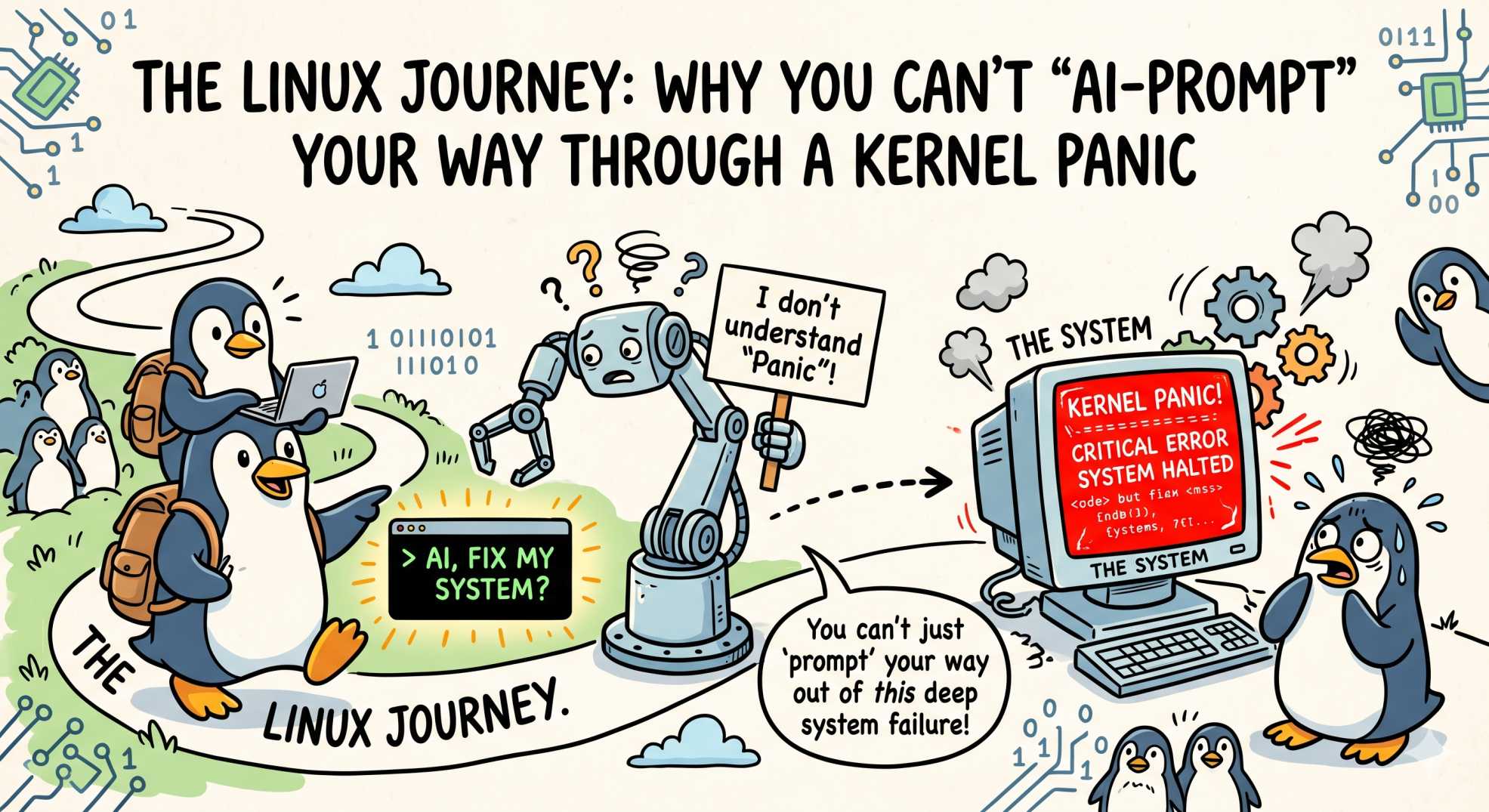
At DevOps Inside, we’ve noticed a dangerous trend in 2026: developers are getting so good at “vibe-coding” with AI agents that they’ve forgotten how the actual OS works.
It’s all fun and games until your AI agent hallucinations lead to a recursive deletion of your root directory because you didn’t understand how rm -rf interacts with symlinks.
In a world where everyone has a “Senior AI Assistant,” the real value and the big SRE paychecks go to the person who can step in when the agent hits a kernel panic. If you’re heading into an interview this year, “I’ll ask Claude” isn’t an answer. You need Linux Journey fundamentals.
Let’s be honest: Linux is the “boring” foundation that runs the entire world. But “boring” is another word for “mission-critical.” ⚙️
Whether you’re a Grasshopper just learning to navigate or a Networking Nomad fixing BGP leaks, here are the fundamentals you actually need to brush up on.
1. The “Everything is a File” Philosophy
In Linux, your hard drive is a file. Your keyboard is a file. Even your running processes are just files sitting in /proc.
Interview Filter: If an interviewer asks, “How do you check a process’s environment variables without using env?” and you don’t mention /proc/[pid]/environ, you’ve lost them.
Pro Tip: Spend time exploring /sys and /proc. These aren’t just directories; they are direct windows into the kernel’s behavior. 🔍
2. Process Life and Death (Beyond kill -9)
Most juniors think kill -9 is the off button. At DevOps Inside, we call that the nuclear option. ☢️
The SRE Way: You should know your signals.
SIGTERM (15) is a polite request to stop.
SIGKILL (9) is a forceful eviction.
Interactive Check: Do you know what a zombie process actually is?
It’s a dead process whose parent hasn’t read its exit status yet.
If you can’t explain why you cannot “kill” a zombie, you are not ready for a senior-level conversation.
3. The “Journeyman” Internals: systemd and Boot
In 2026, systemd is the undisputed king of the init world. You need to know more than systemctl restart.
The Scenario: A service fails to start on boot.
Do you check journalctl -u?
Do you know how to write a .service file with Restart=always?
The Wild Card: Interviewers love the Linux boot process.
BIOS or UEFI → GRUB → Kernel → systemd (PID 1).
Knowing this flow is the difference between “try rebooting” and actually knowing what failed.
🤖 The AI Intersection: The “Agent Sandbox”
Here’s where things get serious. In 2026, we aren’t just running apps. We’re running autonomous AI agents.
These agents need to be sandboxed so they don’t accidentally or maliciously access sensitive data like /etc/shadow. 🔐
The Tech: Landlock LSM and Seccomp are no longer niche. They are becoming core knowledge.
Why it matters: If you’re building AI platforms, you are using kernel-level controls to restrict what code can do.
Interview Reality:
“How would you prevent an untrusted binary from creating a raw network socket?”
Correct Answer:
You don’t rely on prompts. You enforce it using Seccomp to block the syscall at the kernel level.
🛰️ Networking Nomad: The SRE Survival Kit
Networking is where most interviews fall apart. Don’t let that happen.
| Task | Old Way | SRE Way | Why |
|---|---|---|---|
| Ports | netstat | ss -tuln | Faster, kernel-level data |
| IPs | ifconfig | ip addr | Modern standard |
| DNS | nslookup | dig +short | Better debugging |
| Tracing | ping | mtr | Real-time path visibility |
The DevOps Inside Reality Check
Linux is not something you “finish.” It’s a shift from:
“I hope this works.” → “I know exactly why this works.”
AI agents are great at writing scripts. But during a real outage, they lack context.
If you can explain the difference between a hard link and a symbolic link while a production database is hanging, you are the person teams trust. 💪
💬 Quick Question: What’s the one Linux command you always forget during an interview? (Mine is still tar -zxvf every single time 😄)Let’s hear it.
“AI can follow instructions, but only engineers who understand the system can take control when everything breaks.”