Killing the AI COLD START with GKE Pod Snapshots
Tired of AI model cold starts slowing down your Kubernetes workloads? This blog explores how GKE Pod Snapshots reduce LLM startup latency by restoring full runtime state instantly, helping AI applications scale faster and cut expensive GPU idle time.
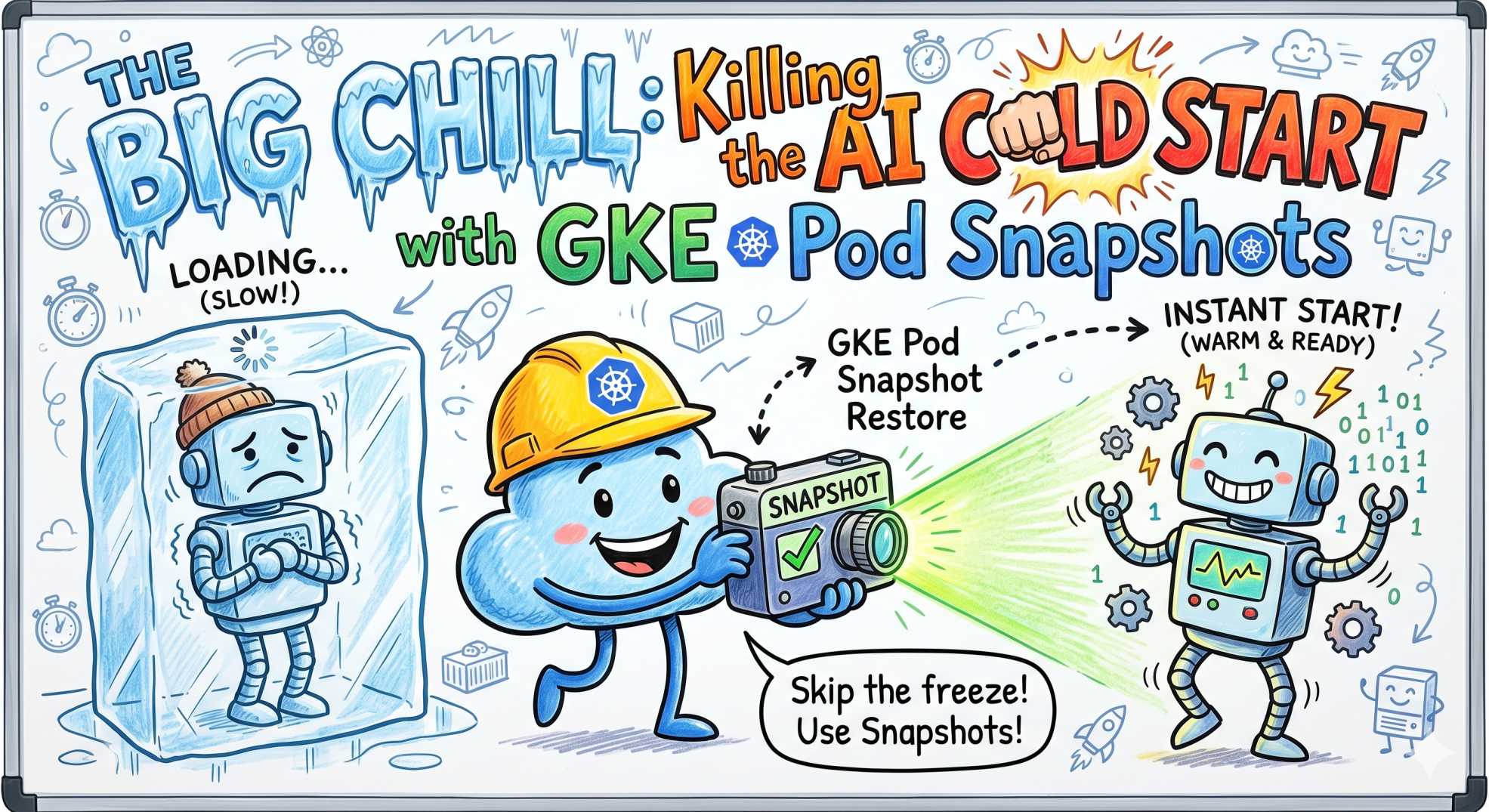
The team at DevOps Inside knows that in the world of SRE, “patience” is a luxury we usually cannot afford.
We’ve spent the last few weeks talking about the “100 Reasons Your Cluster is Crying” and the rise of AI-generated code. But now, it’s time to talk about the physical weight of those AI dreams.
If you’re running large-scale LLMs on Kubernetes, you’ve felt the “Big Chill.” Tugging a 70B parameter model checkpoint through a network straw every time a pod scales up is not just slow, it’s an operational nightmare.
But as of May 6, 2026, Google has finally handed us the thermal blanket we’ve been waiting for.
Here’s why GKE Pod Snapshots are about to make your “Cold Start” problems a relic of the past.
The Big Chill
In the SRE trenches, we’ve spent years optimizing Docker layers and warming up caches. But AI models are a different beast.
They are giant digital boulders.
Loading a heavy model into GPU memory often takes longer than the actual inference task it’s meant to perform.
Until now, we just lived with it. We over-provisioned “warm” standby pods simply to avoid a 5-minute wait during a traffic spike.
That is not engineering. That is just throwing money at a latency problem.
What’s Changing? (Hint: It’s the State)
Standard Kubernetes restarts from zero.
GKE Pod Snapshots restart from hero mode.
Instead of just pulling an image and running an entrypoint script, GKE now captures the full runtime state, including memory, CPU registers, GPU buffers, and the filesystem.
When a new replica spins up, it does not “boot.” It “resumes.”
The Admin Trio: The CRDs You Need to Know
To pull this off, you’re going to spend a lot of time with three new Custom Resource Definitions.
Think of these as your “Warm Start” manifest.
PodSnapshotStorageConfig
This is where you tell GKE where to stash the snapshots, usually a high-performance GCS bucket.
PodSnapshotPolicy
This defines the “when” and “how.”
Do you want to trigger a snapshot manually, or should it happen automatically after a successful workload initialization?
PodSnapshot
This is the actual artifact.
The “Save Game” file for your infrastructure.
🤖 The AI Edge: Scaling at the Speed of Inference
This is not just a nice-to-have for DevOps. It is becoming a structural necessity for agentic workflows.
Dynamic Inference Bursting
Imagine a sudden viral trend hits your AI-powered app.
Normally, your HPA (Horizontal Pod Autoscaler) spins up pods that sit in Initializing for 3 minutes while model weights load.
With snapshots, those pods can become “Live” in seconds.
By bypassing the model-loading phase, you are not just saving time; you are saving GPU compute cycles.
Every minute a GPU sits idle waiting for a memory transfer is a minute you are paying for “expensive silence.”
⚠️ The SRE Reality Check: The Fine Print
Before you start snapshotting every pod in your cluster, there are a few gotchas we found in the May 2026 GA release.
PVC Caveats
Pod Snapshots capture the root filesystem, but they do not snapshot your external Persistent Volume Claims (PVCs) as part of the same loop.
If your app relies on external state that changes constantly, you still need a data synchronization strategy.
Hardware Lock-In
You cannot snapshot a pod on an A100 and restore it on an H100.
The hardware profiles must match.
The “One-Time” Tax
You still have to pay the cold-start cost exactly once to create the initial snapshot.
Think of it as “baking” your runtime state.
🛰️ The Interactive Challenge
Go to your monitoring dashboard and look at your Pod Startup Latency for your heaviest ML workloads.
How much of that time is spent on image pulling versus model loading?
If you could delete that “Model Loading” block entirely, how much lower would your MTTR be?
If you are still waiting minutes for your 70B models to wake up, you are essentially running a 2026 infrastructure with a 2015 mindset.
The Verdict
GKE Pod Snapshots turn “Cold Starts” from an ongoing operational tax into a one-time capital expense.
It is the ultimate “Save State” for the cloud-native era.
Are you ready to stop cold-starting and start instant-resuming?
Let’s talk about your migration plans in the comments.
“Nothing humbles an expensive GPU cluster faster than watching it spend 3 minutes loading a model just to answer ‘Hello.’”