The 'Beautiful Hellscape': 10 Underrated CNCF Tools You’re Sleeping On
Think Kubernetes and Prometheus are enough? Discover 10 underrated CNCF tools like KEDA, Falco, and OpenCost that solve real DevOps problems in production.
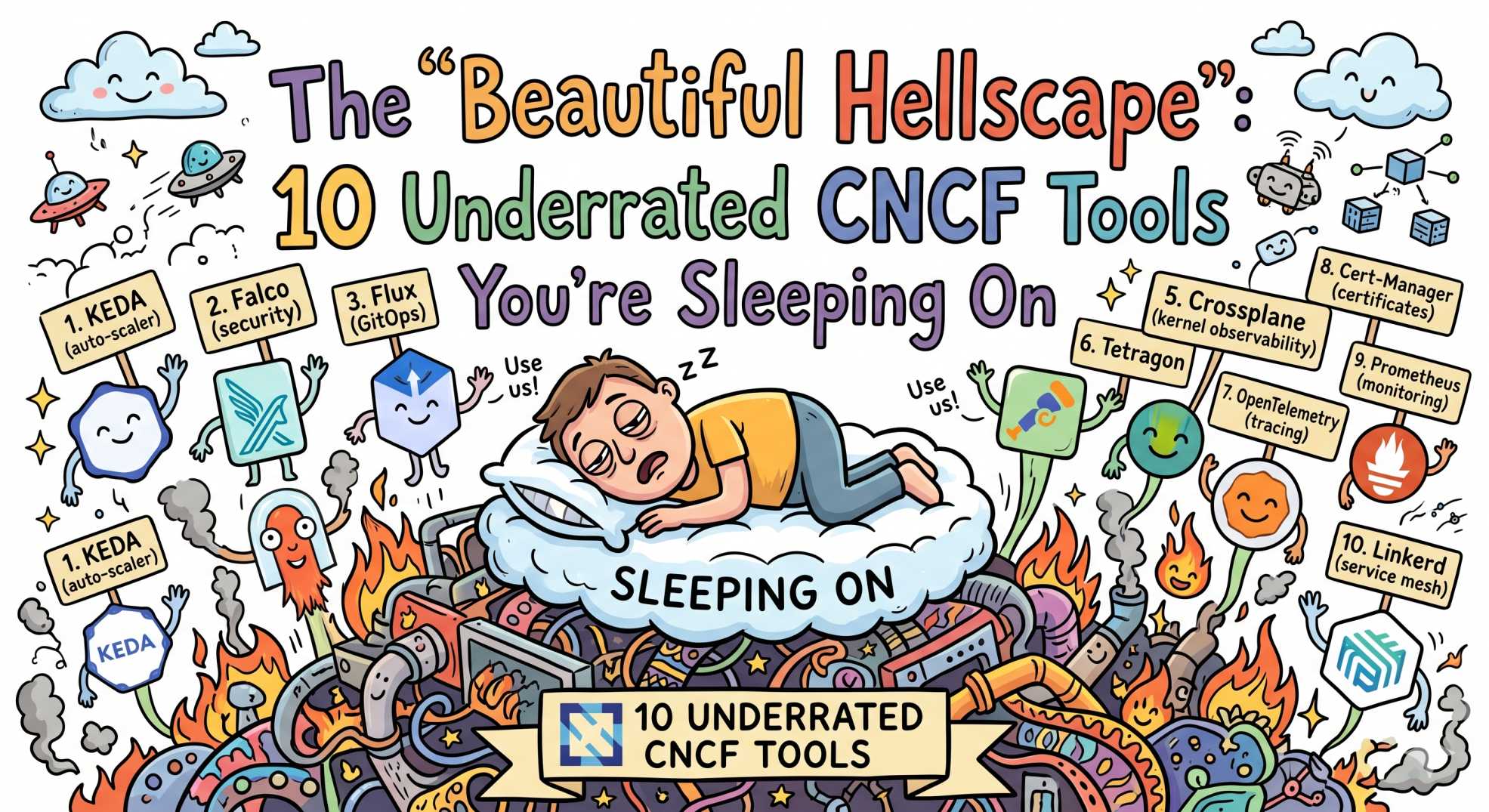
The CNCF landscape is often described as a “beautiful hellscape” of logos. Everyone knows the big names Kubernetes, Prometheus, and Helm. They are the tools that show up on almost every DevOps resume.
But if you’re actually working in production, you already know something important.
Those tools don’t solve everything.
Sometimes what you really need is a focused tool that does one job extremely well so you can avoid firefighting at 2 AM.
At DevOps Inside, we like digging beyond the obvious stack. Here are 10 underrated CNCF tools that most teams overlook but shouldn’t.
1. KEDA: The Event-Driven Speedster ⚡
Traditional autoscaling in Kubernetes relies on CPU and memory. That model starts to break when your workload depends on events.
KEDA lets you scale based on real signals like Kafka lag, queue depth, or external triggers. Even better, it can scale workloads down to zero when there is no activity.
For AI workloads, this is a big win. GPU nodes are expensive, and idle inference services burn money fast. KEDA ensures you only scale when requests actually exist.
2. Kyverno: Policies Without the Pain
Policy enforcement is necessary, but complexity usually kills adoption.
While many teams use OPA, writing policies in Rego adds a learning curve. Kyverno takes a different approach. It works directly with YAML.
If you understand Kubernetes manifests, you can write policies.
You can enforce things like required labels, restrict image registries, or block risky configurations without introducing a new language into your workflow.
3. Falco: Runtime Security That Actually Alerts 🔐
Most security stops at the perimeter. Falco focuses on what happens inside your cluster.
It monitors system behavior using eBPF and detects suspicious activity in real time.
If a container unexpectedly spawns a shell or tries to access sensitive files, Falco sends alerts instantly through Slack, PagerDuty, or webhooks.
This is the kind of visibility that turns silent breaches into actionable signals.
4. OpenCost: Know Where Your Money Is Going 💸
Cloud costs rarely grow slowly. They spike when no one is paying attention.
OpenCost gives you clear visibility into how much each namespace, workload, or team is actually costing.
Most teams discover waste quickly, from idle resources to over-provisioned environments. It is one of the fastest ways to bring cost awareness into engineering decisions.
5. Crossplane: Infrastructure Without Leaving Kubernetes
Infrastructure and Kubernetes often live in separate workflows.
Crossplane brings them together.
It lets you define cloud resources like databases, buckets, and IAM roles as Kubernetes objects. Everything becomes part of the same control loop.
Instead of switching tools, your infrastructure and applications follow the same model, versioned, declarative, and consistent.
6. Pixie: Observability Without Instrumentation 👀
Instrumentation slows teams down. Pixie removes that friction.
Using eBPF, it captures network activity, application behavior, and performance metrics automatically.
No code changes. No manual setup.
You get deep visibility into your system without asking developers to rewrite services.
7. Volcano: Built for Heavy Workloads
Kubernetes works great for services, but not everything is a stateless API.
Volcano is designed for batch processing, high-performance computing, and machine learning workloads.
One of its key features is gang scheduling, which ensures that all resources for a job start together.
For distributed training, this matters. Without coordination, GPUs sit idle waiting for other nodes, which wastes both time and cost.
8. LitmusChaos: Test Failure Before It Finds You 🔥
Resilience is not something you assume. It is something you test.
LitmusChaos lets you simulate real-world failures like node crashes, latency spikes, and network issues.
Running controlled experiments helps you understand how your system behaves under stress.
If your system never breaks in testing, it probably will in production.
9. Telepresence: Faster Dev Without the Cluster Pain
Working with Kubernetes during development is slow.
You make a small change, build the image, push it, deploy it, and then test. That loop kills productivity.
Telepresence shortcuts this.
It connects your local machine directly to the cluster so your service runs locally but interacts with real cloud dependencies.
You get faster iteration without losing real environment context.
10. Knative: Serverless Without Vendor Lock-In ☁️
Knative brings serverless capabilities to Kubernetes.
It handles scaling, routing, and event-driven execution without requiring you to manage low-level details.
You get features like scale-to-zero and traffic splitting while staying in control of your infrastructure.
It is a strong option for teams that want serverless behavior without depending entirely on cloud providers.
The DevOps Inside Verdict
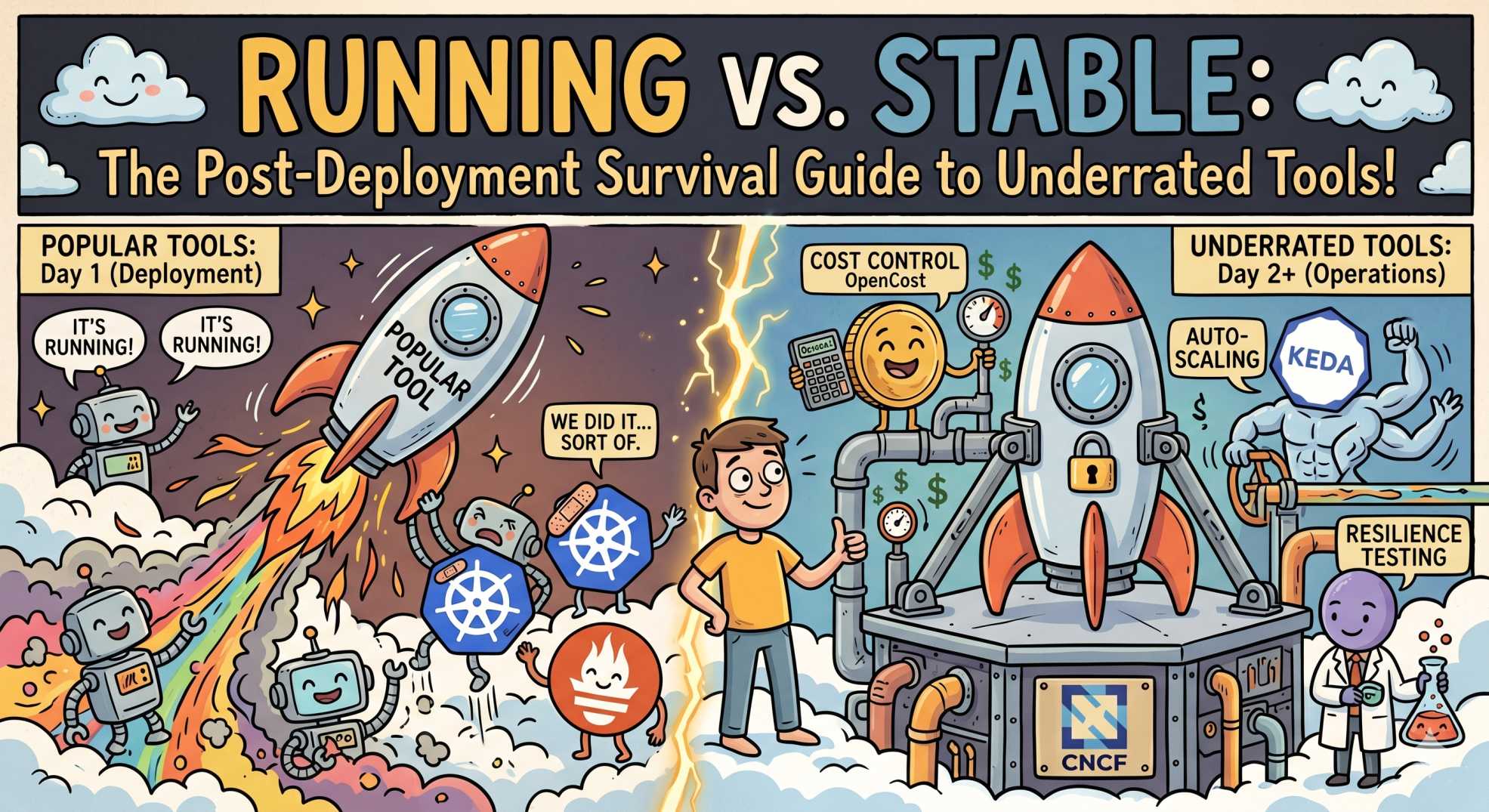
Popular tools get systems running.
Underrated tools keep systems stable.
Whether it is controlling cost with OpenCost, improving scaling with KEDA, or testing resilience with LitmusChaos, these tools solve real problems that show up after deployment.
This is where operational maturity actually starts.
💬Quick Question: Which of these tools are already part of your stack, and which one are you curious to try next?
“Scaling systems is easy. Scaling sanity is what separates good engineers from great ones.”