Modern Test Data Management for DevOps
As AI agents become part of DevOps, platform engineering, and cloud operations, organizations need an AI operating model to govern automation, observability, security, and infrastructure decision-making at scale.
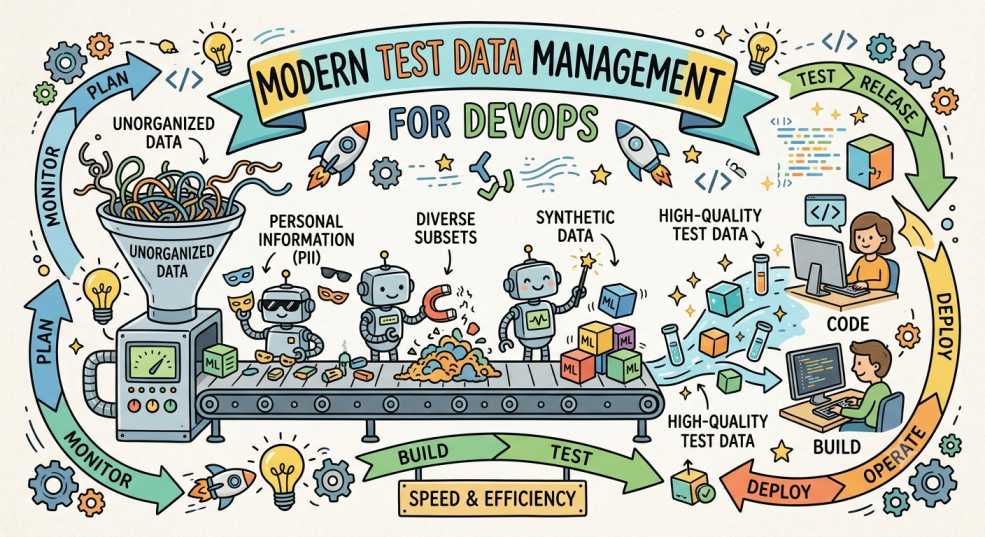
Breaking the Data Bottleneck: Why Modern Test Data Management is the Missing Layer in DevOps
Your CI/CD pipeline finishes in six minutes. Infrastructure is provisioned automatically through Terraform. Kubernetes spins up fresh environments on demand. Security scans run on every pull request.
Yet your release is still delayed.
Not because the pipeline failed, but because the test data wasn't ready.
Someone is refreshing a staging database manually. Another engineer is waiting for masked production data. Integration tests are failing because the dataset no longer matches the latest schema. Suddenly, the fastest part of your delivery pipeline is waiting on the slowest dependency.
For many engineering teams, test data has quietly become the largest source of friction in modern DevOps.
The Hidden Bottleneck Behind Fast Pipelines
Engineering teams have spent years automating infrastructure, deployments, and application delivery. Test data often remains trapped in outdated workflows built around manually copied databases and static snapshots.
That approach worked when applications were deployed every few weeks.
It falls apart when environments are created and destroyed dozens of times every day.
Modern cloud-native platforms rely on short-lived Kubernetes environments, GitOps workflows, and continuous integration. Static datasets simply cannot keep pace with infrastructure that changes every few minutes.
The result isn't just slower deployments, it creates operational problems throughout the delivery pipeline.
- Tests fail because the underlying data no longer reflects the current application schema.
- Developers waste time investigating flaky failures that disappear after another database refresh.
- Sensitive production information is copied into lower environments, creating unnecessary compliance risks.
- QA teams become bottlenecks because every environment depends on manually prepared datasets.
Your infrastructure may be fully automated, but your data pipeline is still operating like it's 2018.
Treat Test Data Like Infrastructure
The biggest shift isn't adopting another testing platform.
It's changing how engineering teams think about test data.
Modern Test Data Management (TDM) treats data as an infrastructure resource that can be provisioned, versioned, refreshed, and destroyed automatically alongside applications.
Instead of waiting for databases to be prepared manually, every pipeline creates exactly the dataset required for that specific workload.
The workflow becomes predictable:
Code Commit → CI/CD Pipeline → Automated Test Data Provisioning → Testing → Environment Cleanup
Once data becomes part of the delivery pipeline, infrastructure and testing finally move at the same speed.
Building a Modern TDM Workflow
1. Provision Data on Demand
Every temporary environment should receive its own isolated dataset automatically.
Rather than relying on shared staging databases, the pipeline provisions fresh data through APIs or infrastructure automation, guaranteeing every execution starts from a known state.
No waiting.
No manual refreshes.
No unexpected conflicts.
2. Replace Database Copies with Virtualization
Copying multi-terabyte production databases into every testing environment is both slow and expensive.
Modern platforms use data virtualization and copy-on-write cloning to create lightweight environments in seconds.
Developers receive realistic datasets without consuming massive amounts of storage.
3. Generate Synthetic Data for Edge Cases
Production data rarely contains every scenario engineers need.
Complex payment failures, unusual customer journeys, and rare business conditions often never appear naturally.
Synthetic datasets allow teams to generate these scenarios safely while eliminating privacy concerns associated with real customer information.
As AI-assisted testing becomes more common, synthetic data is becoming a critical part of automated quality assurance.
4. Automate Privacy from the Beginning
Security should never depend on someone remembering to anonymize a database export.
Modern TDM platforms automatically mask sensitive fields during ingestion, so every downstream environment receives production-realistic but fully compliant datasets.
Compliance becomes part of the pipeline instead of another manual approval step.
Why This Matters for Kubernetes and GitOps
Cloud-native infrastructure has fundamentally changed how applications are delivered.
Kubernetes clusters create ephemeral workloads constantly.
GitOps continuously reconciles infrastructure state.
Preview environments are deployed for every pull request.
But if each environment still depends on manually prepared data, infrastructure automation reaches a hard limit.
The application is ready.
The cluster is ready.
The pipeline is ready.
The data isn't.
Modern TDM closes this gap by provisioning datasets with the same automation principles used for infrastructure as code.
AI is Raising the Stakes
The growth of AI-assisted software development is making reliable test data even more important.
AI can generate code rapidly.
It can create test cases.
It can even build infrastructure templates.
But every AI-generated workflow still depends on realistic data to validate whether the application actually works.
Poor-quality datasets don't just create unreliable tests; they train engineers to ignore failures altogether.
As AI accelerates software delivery, high-quality automated test data becomes a competitive advantage rather than an operational convenience.
Build Faster by Removing the Real Bottleneck
Most DevOps teams have already automated deployments.
Many have automated infrastructure.
Some have automated security.
Far fewer have automated the data flowing through those systems.
Treating test data as a first-class infrastructure component removes one of the last major sources of delivery friction. Instead of waiting for databases, fixing flaky tests, or copying production snapshots manually, engineering teams can focus entirely on shipping reliable software.
The future of DevOps isn't just infrastructure as code.
It's test data as code.
"The fastest pipeline isn't the one that deploys first, it's the one that never waits for data."