Why Platform Engineers Are Adopting MCP?
Discover why platform engineers are adopting Model Context Protocol (MCP) to connect AI assistants with Kubernetes, observability platforms, CI/CD pipelines, and enterprise infrastructure while reducing integration complexity.
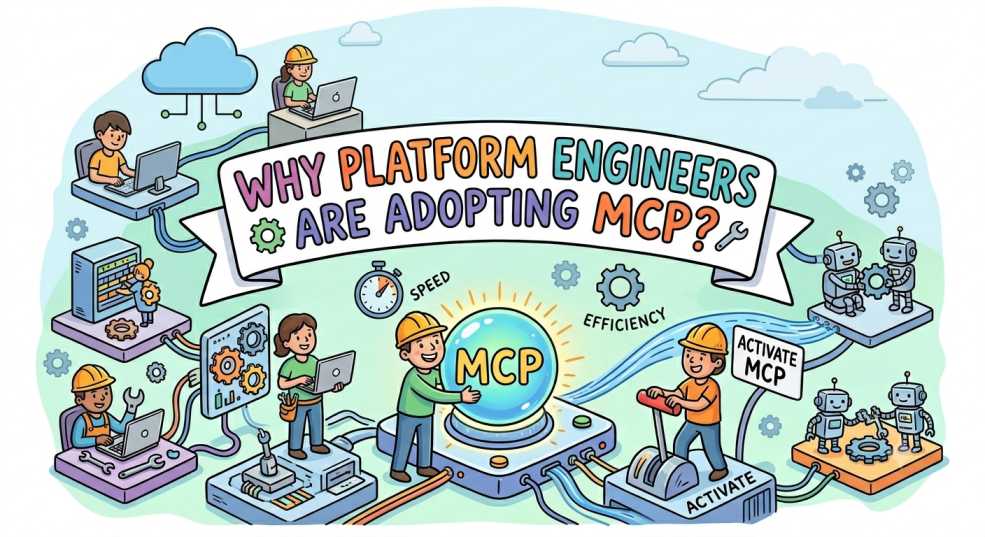
Your team finally rolls out an AI assistant across engineering.
Developers use it to review pull requests. SREs use it to investigate incidents. Platform engineers use it to generate Kubernetes manifests and troubleshoot CI/CD pipelines.
At first, everything looks impressive.
Then reality arrives.
The AI can explain what a failing deployment means, but it cannot access the deployment itself. It can suggest how to investigate a production incident, but it cannot query Grafana, inspect Kubernetes events, or read the latest GitHub Actions logs without custom integrations. Every new tool requires another API connection, another authentication flow, and another maintenance burden.
The problem isn't the intelligence of the AI model.
The problem is connectivity.
As organizations push AI deeper into software delivery workflows, they are discovering the same challenge that cloud-native teams faced years ago: every system speaks a different language.
This is why platform engineers are increasingly paying attention to Model Context Protocol (MCP), an emerging standard designed to create a common interface between AI systems and the tools they need to operate.
The Integration Problem Nobody Wants to Maintain
Most enterprise engineering environments are packed with disconnected systems.
A typical DevOps workflow may involve:
- GitHub repositories
- Kubernetes clusters
- Jira projects
- Prometheus metrics
- Grafana dashboards
- Internal documentation
- Cloud provider APIs
- CI/CD platforms
Traditionally, connecting AI to these systems requires custom integrations.
AI Assistant
│
├─ GitHub API Integration
├─ Kubernetes API Integration
├─ Jira API Integration
├─ Grafana API Integration
└─ Internal Documentation Connector
The more tools you connect, the more maintenance you inherit.
Authentication methods change. APIs evolve. Permissions become difficult to manage. Teams spend more time maintaining integrations than improving workflows.
This is creating a new operational bottleneck for organizations investing heavily in AI-driven engineering.
MCP: A Universal Interface for AI Systems
Model Context Protocol introduces a different approach.
Instead of every AI tool building custom integrations for every service, MCP creates a standardized communication layer.
Think of it as an API standard specifically designed for AI interactions.
Instead of teaching every AI model how to connect directly to every system, organizations expose tools and data through MCP servers.
The architecture becomes dramatically simpler:
The AI only needs to understand MCP.
The MCP server handles the complexity of interacting with underlying systems.
This separation dramatically reduces integration sprawl while improving portability across AI platforms.
Why DevOps Teams Care
For platform engineers, the value of MCP extends far beyond chatbots.
The real opportunity is operational automation.
Imagine an engineer investigating a production outage.
Without MCP:
- Open Grafana
- Open Kubernetes dashboard
- Query logs
- Review deployment history
- Check recent pull requests
- Search internal runbooks
With MCP:
"Why did checkout-api latency increase during the last deployment?"The AI can retrieve deployment metadata, inspect cluster events, analyze observability data, and correlate the information into a single response.
The engineer focuses on solving the problem instead of gathering context.
This shift is why many organizations view MCP as an infrastructure capability rather than simply another AI feature.
MCP vs Traditional Integrations
| Capability | Traditional Integrations | MCP Architecture |
|---|---|---|
| Tool Connectivity | Custom API Development | Standardized Protocol |
| Maintenance Burden | High | Lower |
| AI Platform Portability | Limited | High |
| Context Sharing | Fragmented | Unified |
| Scaling Across Tools | Complex | Simplified |
| Operational Visibility | Tool-by-Tool Analysis | Cross-System Reasoning |
The key difference is that MCP treats context as a shared resource rather than a collection of isolated integrations.
The Platform Engineering Connection
The rise of platform engineering created a fundamental principle:
Developers should not need to understand infrastructure complexity.
Internal Developer Platforms (IDPs) emerged to abstract Kubernetes, networking, security policies, and cloud provisioning behind simple interfaces.
MCP is bringing the same philosophy to AI operations.
Instead of exposing raw APIs and authentication workflows to every AI assistant, platform teams can expose a controlled MCP layer.
Developers interact with AI.
AI interacts with MCP.
MCP interacts with infrastructure.
This creates a cleaner separation of responsibilities while maintaining governance and security controls.
The AI Operations Workflow
Organizations adopting MCP are increasingly following a common implementation pattern.
The MCP Integration Workflow
1. Deploy MCP Servers
Create standardized interfaces for engineering systems such as GitHub, Kubernetes, observability platforms, and internal knowledge bases.
2. Define Access Controls
Apply existing RBAC and security policies to determine what information AI systems can access.
3. Connect AI Clients
Attach engineering assistants, internal copilots, or external AI platforms to the MCP layer.
4. Centralize Context Retrieval
Allow the AI to gather information across multiple systems without requiring custom integrations.
5. Automate Operational Tasks
Enable workflows such as incident analysis, deployment reviews, runbook generation, and infrastructure auditing.
Why AI Infrastructure Is Becoming a Platform Problem
The first generation of AI adoption focused on model capabilities.
The next generation is focused on context.
A powerful model without access to operational data is limited.
A moderately capable model with access to infrastructure, documentation, monitoring systems, and deployment history becomes dramatically more useful.
This is why platform engineering teams are increasingly becoming responsible for AI infrastructure.
The challenge is no longer choosing the best model.
The challenge is creating reliable, secure pathways between AI systems and enterprise data sources.
MCP is rapidly emerging as one of the leading solutions to that problem.
Security Still Matters
Despite the excitement, MCP should not be viewed as unrestricted infrastructure access.
Platform teams must still implement strong controls:
- Role-based access control (RBAC)
- Audit logging
- Data classification policies
- Secret management
- Least-privilege permissions
- Approval workflows for sensitive actions
AI assistants should have access to the information they need, but not unrestricted authority over production environments.
The same governance principles that protect Kubernetes clusters should also protect AI operations.
The Bigger Shift
The cloud-native movement standardized infrastructure management through APIs, operators, and declarative control planes.
AI systems are now facing a similar evolution.
Organizations are discovering that building hundreds of one-off integrations is unsustainable. Just as Kubernetes provided a common control plane for infrastructure, MCP is emerging as a common interaction layer for AI.
The companies that move fastest won't necessarily be the ones with the largest models.
They'll be the ones that can securely connect those models to the systems where work actually happens.
FAQ
What is Model Context Protocol (MCP)?
Model Context Protocol is an open standard that allows AI systems to securely interact with external tools, services, and data sources through a standardized interface.
Why are DevOps engineers learning MCP?
MCP enables AI assistants to access infrastructure systems such as Kubernetes, GitHub, observability platforms, and internal documentation without requiring custom integrations for every tool.
How is MCP different from traditional APIs?
Traditional APIs connect applications directly. MCP provides a standardized layer specifically designed for AI systems to access multiple tools and data sources consistently.
Can MCP be used with Kubernetes?
Yes. MCP servers can expose Kubernetes resources, events, deployments, and operational data to AI assistants while maintaining existing security controls.
Is MCP secure?
MCP supports enterprise security practices such as RBAC, auditing, authentication, and least-privilege access controls. Security implementation ultimately depends on how organizations deploy and govern their MCP infrastructure.
APIs connected applications. MCP is connecting intelligence.