Why Every Platform Team Needs an AI Operating Model
As AI agents become part of DevOps, platform engineering, and cloud operations, organizations need an AI operating model to govern automation, observability, security, and infrastructure decision-making at scale.
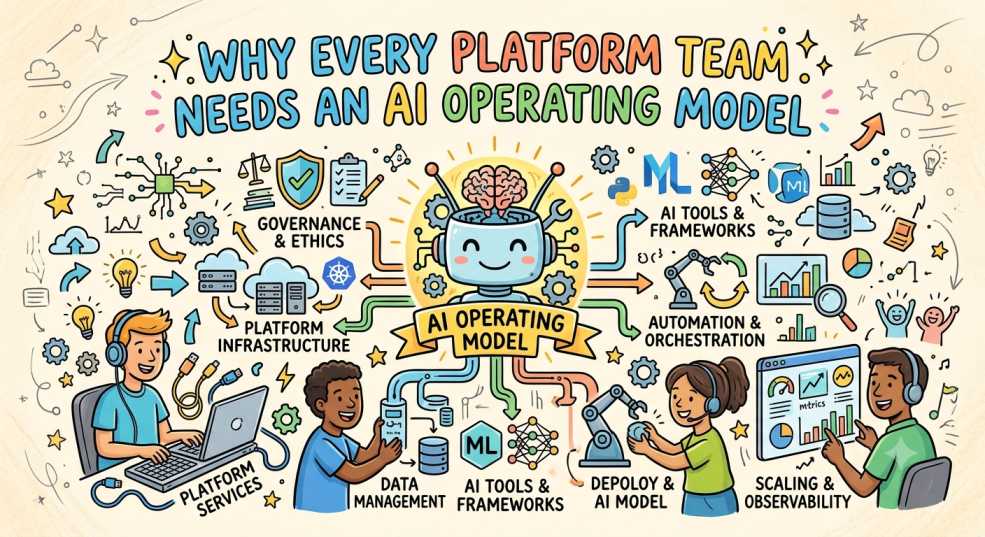
A year ago, most infrastructure teams were experimenting with AI.
Today, AI is becoming infrastructure.
A single enterprise application might now include multiple AI agents reviewing pull requests, generating Terraform code, analyzing incidents, querying internal documentation, and responding to support requests. Each agent consumes data, executes actions, and creates new operational dependencies.
At first glance, this looks like progress.
Then the complexity arrives.
Your observability platform is monitoring hundreds of microservices. Your Kubernetes clusters are scaling dynamically across multiple environments. Your GitOps controllers are continuously reconciling infrastructure state. Now add dozens or eventually hundreds of AI agents interacting with those systems simultaneously.
The question is no longer how to deploy AI.
The question is how to operate it safely.
As enterprises accelerate AI adoption, platform engineering is entering a new phase: the rise of the AI Operating Model. Organizations that fail to establish clear operational boundaries for AI will quickly discover that automation without governance creates more problems than it solves. This shift is already reshaping how DevOps teams think about observability, automation, security, and infrastructure management.
The Hidden Cost of AI Adoption
The first generation of enterprise AI projects focused on productivity.
Teams used AI to:
- Generate code
- Write documentation
- Create infrastructure templates
- Analyze logs
- Summarize incidents
Those workloads were relatively isolated.
The next generation is different.
AI agents are becoming active participants inside operational systems.
An AI assistant may:
- Open Jira tickets
- Trigger CI/CD workflows
- Provision infrastructure
- Query production telemetry
- Execute remediation runbooks
Suddenly, AI isn't helping operations.
It is operations.
The challenge is that every new AI agent introduces another layer of permissions, context management, observability requirements, and governance controls.
What starts as a simple automation initiative can rapidly become an operational sprawl problem.
Why Traditional DevOps Models Break Down
Classic DevOps assumes that humans remain the primary decision makers.
Automation exists to accelerate execution.
AI changes that assumption.
Instead of:
We increasingly see:
The AI layer becomes an entirely new operational surface.
Every agent requires:
- Access controls
- Policy enforcement
- Observability
- Cost tracking
- Auditability
Without centralized management, organizations quickly lose visibility into who or what is making infrastructure decisions.
The Four Pillars of an AI Operating Model
Modern platform teams are converging around four foundational requirements.
| Capability | Traditional DevOps | AI Operating Model |
|---|---|---|
| Observability | Monitor systems | Monitor systems and AI agents |
| Automation | Pipeline execution | Autonomous decision loops |
| Governance | User permissions | Agent permissions and policy controls |
| Operations | Human-driven workflows | Human and AI collaboration |
Let's examine each layer.
1. Observability Must Expand Beyond Infrastructure
Traditional monitoring focuses on:
- CPU utilization
- Memory pressure
- Network traffic
- Application latency
AI workloads introduce entirely new telemetry streams.
Platform teams now need visibility into:
- Prompt execution
- Token consumption
- Agent behavior
- Context retrieval
- Model latency
- Agent-to-agent interactions
If an AI agent suddenly begins making poor infrastructure decisions, traditional metrics won't reveal the root cause.
Observability must evolve from monitoring systems to monitoring decisions.
2. Automation Requires Governance
Most organizations already automate deployments.
Very few organizations automate governance.
This becomes dangerous once AI agents gain access to production systems.
Imagine an AI troubleshooting assistant with permission to:
- Restart workloads
- Modify Kubernetes resources
- Trigger rollbacks
Without policy boundaries, a faulty recommendation can escalate into a major outage.
Future AI operating models will rely heavily on:
- Policy engines
- RBAC controls
- Approval workflows
- Continuous auditing
Automation without governance is simply accelerated risk.
3. Infrastructure Context Must Become Unified
One of the biggest challenges facing platform teams is fragmented operational visibility.
Infrastructure data often lives across:
- Kubernetes
- Terraform
- Cloud platforms
- Monitoring tools
- Ticketing systems
- Documentation platforms
Humans struggle to connect all of these signals.
AI agents struggle even more.
This is why organizations are investing heavily in unified operational context layers.
The goal is simple:
| Traditional DevOps Stack | MCP Enabled Workflow |
|---|---|
| Applications | Applications |
| Infrastructure | Infrastructure |
| Security | Security |
| Observability | Observability |
| Separate Tool Contexts | Unified Context Layer |
| Manual Correlation | AI Agents with Shared Context |
Instead of forcing agents to interpret fragmented systems independently, teams provide a continuously updated source of operational truth.
This dramatically improves decision quality.
4. AI Requires an Operational Control Plane
Kubernetes transformed infrastructure by introducing a control plane.
AI needs something similar.
As organizations scale from a handful of AI agents to hundreds, they must answer difficult questions:
- Which agents can access production?
- Which agents can execute actions?
- Which agents can access sensitive data?
- How are permissions managed?
- How are actions audited?
Without a centralized control model, agent sprawl becomes inevitable. Enterprise leaders are increasingly viewing AI governance as a control-plane problem rather than a model problem.
The Coming Wave of Agentic Operations
The next five years will likely bring an explosion of AI-driven operational workloads.
Instead of deploying:
- More dashboards
- More alerts
- More manual runbooks
Organizations will deploy:
- Incident response agents
- Security agents
- Cost optimization agents
- Deployment agents
- Compliance agents
Each agent introduces value.
Each agent also introduces complexity.
The winners won't necessarily be the organizations with the largest models.
They will be the organizations that build the strongest operational foundations around those models.
Building an AI-Ready Platform Team
Platform engineering has always been about reducing complexity.
AI changes the shape of that complexity but not the mission itself.
The goal remains the same:
- Standardize operations
- Improve visibility
- Reduce toil
- Scale safely
The difference is that modern platform teams must now govern both humans and machines.
An AI operating model isn't a future requirement.
For organizations already deploying AI across engineering workflows, it's becoming a present-day necessity.
Conclusion
The biggest challenge in enterprise AI isn't model selection.
It's operational control.
As AI agents become embedded across infrastructure, observability, security, and delivery pipelines, platform teams need a new operating framework that treats AI as a first-class operational resource rather than a standalone productivity tool.
The organizations that master AI governance, visibility, and automation today will be the ones scaling reliable AI-driven operations tomorrow.
" The next generation of outages won't come from broken servers; they'll come from unmanaged agents."