OpenAI’s Codex Micro is a future picture where vibe coding is the future
OpenAI's move into AI hardware signals a major shift in the technology industry. As Apple challenges its hardware ambitions through a legal battle, the bigger story is the beginning of a new AI computing race.
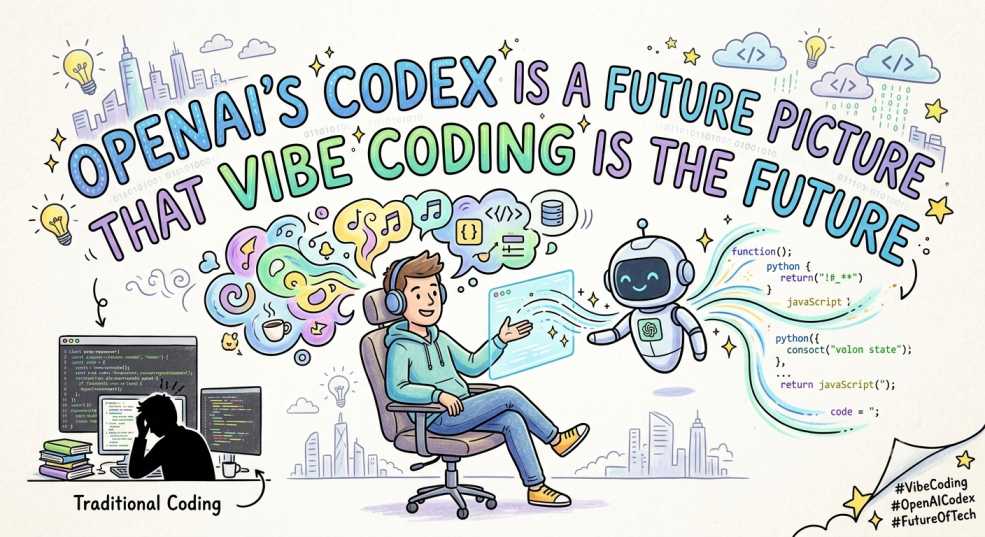
For the past couple of years, "vibe coding" has mostly existed as an internet joke.
The idea is simple: instead of spending hours writing every function yourself, you describe what you want in plain English and let AI generate the code. You review it, tweak it, maybe reject a few suggestions, and move on.
It sounded like a meme.
Then OpenAI introduced Codex Micro.
At first glance, it's easy to dismiss the device as another expensive desk accessory. It's a compact mechanical macropad with RGB lighting, a rotary dial, a joystick, and a handful of programmable keys. At around $230, plenty of people immediately questioned whether anyone actually needed it.
But looking at Codex Micro as just another keyboard misses the bigger picture.
This isn't really a story about hardware.
It's a story about how software development itself is beginning to change.
For decades, developers have interacted with computers in essentially the same way. We type code into an editor, press Enter, fix errors, repeat the process, and eventually ship software. Every tool on our desk, from the keyboard to the mouse, was designed around one assumption:
Humans write the code.
AI is quietly challenging that assumption.
Today, developers are increasingly asking AI to generate tests, explain unfamiliar codebases, write documentation, create infrastructure templates, or even refactor thousands of lines of existing code. Instead of producing every line manually, we're starting to supervise systems that produce code alongside us.
That's a fundamentally different workflow.
And when workflows change, the tools built around them usually change too.
Codex Micro may look like a small piece of hardware, but it represents something much larger. Rather than helping you type faster, it's designed to help you coordinate AI agents more efficiently.
Whether it becomes a mainstream product or remains a niche gadget is almost secondary.
The interesting question is this:
If developers spend less time typing code and more time directing AI, what should the next generation of developer tools actually look like?
That's the question Codex Micro is trying to answer.
And regardless of whether this particular device succeeds, it's giving us an early glimpse of what AI-native software development could look like over the next few years.
Why Codex Micro Exists
To understand why OpenAI built something like Codex Micro, it helps to stop thinking about it as a keyboard.
It's closer to a control panel for AI agents.
Traditional keyboards were designed for developers who spent their day writing syntax. Every key exists because humans needed to manually type every variable name, every bracket, every command, and every line of code.
But modern AI-assisted development looks very different.
A typical engineer today might have one AI generating unit tests, another explaining an unfamiliar codebase, and a third drafting infrastructure configurations. Instead of writing everything from scratch, the developer's job increasingly becomes reviewing, steering, and validating the work being produced.
In that kind of workflow, constantly switching between IDE tabs, chat windows, terminals, and browser sessions quickly becomes frustrating.
That's the problem Codex Micro is trying to solve.
Rather than replacing your primary keyboard, it acts as a dedicated interface for managing AI-powered development workflows. Every control is designed around interacting with agents instead of typing syntax.
Among its most notable features are:
- RGB Agent Keys that provide instant visual feedback on background tasks. Instead of opening another window to check progress, developers can see whether an AI task is still running, has completed successfully, or requires attention.
- A Reasoning Dial that lets users adjust how much computational effort an AI agent should spend on a task. Straightforward jobs can be completed quickly, while more complex work can be given additional reasoning time.
- A Workflow Joystick for navigating between active coding sessions, pull requests, or AI-generated suggestions without constantly reaching for a mouse.
- A dedicated Push-to-Talk button that allows developers to issue voice instructions directly to AI agents, reducing the need to repeatedly switch between keyboard shortcuts and chat interfaces.
Individually, none of these features are revolutionary.
Together, however, they point toward something much more interesting.
The interface is no longer being designed around writing code.
It's being designed around managing autonomous systems that write code on your behalf.
That's a subtle but significant shift, and it hints at how developer workstations could evolve as AI agents become a standard part of everyday software development.
From Writing Code to Conducting Systems
The interesting part isn't the hardware.
It's what the hardware says about the direction software engineering is heading.
For years, productivity was measured by how quickly you could write clean, correct code. Fast typists, IDE shortcuts, keyboard macros, and multiple monitors all existed to help developers produce more code, faster.
AI changes that equation.
If an AI agent can generate hundreds of lines of boilerplate in seconds, typing speed stops being the bottleneck. The challenge shifts to something else: deciding what should be built, reviewing what the AI produced, and making sure it actually belongs in production.
That's a very different job.
Instead of acting as the person doing every task, the developer increasingly becomes the person coordinating multiple tasks happening at once.
Imagine working on a feature where one AI agent is generating unit tests, another is refactoring legacy code, and a third is preparing Terraform modules for a new environment.
You're no longer waiting for one task to finish before starting the next.
You're supervising several parallel workflows.
That starts to look less like programming and more like air traffic control.
This is why physical controls like a dial or dedicated status keys suddenly make more sense than they might have a year ago.
Think about other creative industries.
Audio engineers don't mix music with only a mouse and keyboard they use physical mixing consoles because they're managing multiple channels simultaneously.
Video editors use jog wheels and hardware controllers because navigating complex timelines is faster with dedicated controls.
Pilots don't fly aircraft using a touchscreen alone. They rely on switches, knobs, and physical instruments because those interfaces reduce friction when managing complex systems.
Software engineering is beginning to move in a similar direction.
As AI agents take on more of the repetitive implementation work, developers spend less time creating individual pieces and more time directing an entire workflow.
That's the bigger idea behind Codex Micro.
It's not trying to make you type faster.
It's trying to make it easier to manage AI-assisted development as if you're directing a team instead of working alone.
Whether this particular device succeeds or not almost doesn't matter.
The workflow it's designed for is already starting to emerge.
More Than a Gadget, It's a Signal
It's easy to dismiss Codex Micro as an expensive niche product.
After all, developers have seen plenty of "must-have" productivity gadgets come and go. Split keyboards, programmable macro pads, touch bars, stream decks—most find a loyal audience, but very few fundamentally change how software is built.
Codex Micro could end up following the same path.
Or it could become one of those products that people laugh at initially, only to realize a few years later that it quietly predicted where the industry was heading.
We've seen this pattern before.
When Git first appeared, many developers questioned why anyone would replace established version control systems. Cloud computing faced similar skepticism, with concerns about trusting critical infrastructure to someone else's servers. Even containers were dismissed by some as unnecessary complexity before becoming the foundation of modern cloud-native development.
The first generation of a new idea is rarely perfect.
What's important is the direction it points.
That's why Codex Micro deserves attention.
It isn't introducing a revolutionary new keyboard.
It's introducing a new assumption:
Developers won't spend all day writing code anymore. They'll spend more of their day directing AI systems that write code for them.
If that assumption turns out to be correct, then today's keyboard-and-mouse workflow starts looking increasingly outdated.
The next generation of developer tools may not be optimized for typing faster.
They'll be optimized for monitoring, reviewing, approving, and coordinating multiple AI agents working simultaneously.
Whether those interfaces take the form of dedicated hardware, voice commands, AR workspaces, or something we haven't imagined yet is still an open question.
But the destination seems increasingly clear.
The interface between developers and software is evolving from a coding environment into a control environment.
And Codex Micro is one of the first products built specifically for that future.
The Bigger Question Isn't About Hardware
Whether Codex Micro succeeds or disappears in a couple of years almost feels beside the point.
The more interesting question is what it says about the future of software engineering.
For decades, the industry's biggest productivity improvements came from helping developers write code faster. Better IDEs, smarter autocomplete, keyboard shortcuts, multiple monitors, and faster compilers all optimized the same workflow.
Write. Test. Debug. Repeat.
AI changes that cycle.
Today, the bottleneck isn't always writing code. In many cases, it's reviewing AI-generated changes, verifying that they make sense, ensuring they follow architectural patterns, and deciding what should actually reach production.
That's a fundamentally different kind of work.
If this trend continues, developers won't be judged by how quickly they can type a sorting algorithm from memory. They'll be judged by how effectively they can manage multiple AI agents, validate their output, and make architectural decisions.
In other words, engineering becomes less about implementation and more about orchestration.
That's exactly what products like Codex Micro are quietly betting on.
Our Take
Calling Codex Micro "just another keyboard" misses the bigger story.
This isn't really about thirteen keys, RGB lighting, or a rotary dial.
It's about a shift in how developers interact with software.
Whether you call it AI-assisted development, agentic coding, or simply vibe coding, one thing is becoming increasingly clear: developers are spending less time writing every line themselves and more time collaborating with intelligent systems.
Will everyone rush out and buy a $230 Macropad?
Probably not.
But five years from now, developer desks may look very different from today's.
Some engineers might be directing multiple coding agents with dedicated hardware.
Others may rely entirely on voice.
Some may work through IDEs that feel more like mission control than text editors.
Nobody knows exactly which interface will win.
What seems increasingly likely, however, is that the future developer won't be typing significantly more code than today's developer.
They'll be making significantly more decisions.
And that's why Codex Micro matters.
Not because it's the perfect piece of hardware.
But because it offers one of the first tangible glimpses into what AI-native software development could look like.
Final Thoughts
Every major shift in software development starts with a tool that initially seems unnecessary.
Version control once felt complicated.
Containers were dismissed as niche.
Infrastructure as Code looked excessive.
GitOps sounded like overengineering.
Today, they're part of everyday engineering.
Codex Micro may or may not follow the same path.
But the idea behind it that developers will increasingly direct AI rather than manually produce every line of code already feels much less like science fiction than it did a year ago.
The hardware may change.
The interface may evolve.
The terminology may even disappear.
But the direction is becoming difficult to ignore.
If software engineering over the last twenty years was about becoming better programmers, the next decade may be about becoming better conductors of intelligent systems.
And perhaps that's the real picture of the future.
Not a tiny mechanical keypad.
But a world where vibe coding isn't a meme anymore; it's simply how software gets built.
"The next computing revolution may not happen when machines become smarter, but when interacting with them becomes effortless."