The Linux Files: 30 Things You Didn't Know About Linux (Part 1)
Think you know Linux? This post uncovers 30 surprising facts and hidden capabilities that even experienced users often miss.
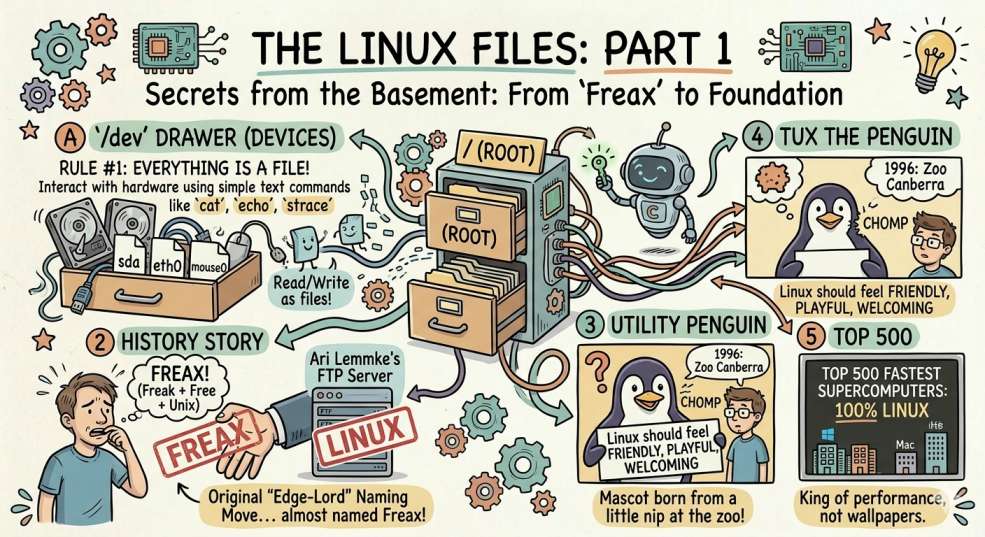
From "Freax" to the Foundation of Everything
In our previous blogs at DevOps Inside, we’ve covered a lot. We analyzed the beginner roadmap, discussed why the cognitive tax is bankrupting DevOps, and explored how Platform Engineering and AI are paving "Golden Paths," with agents like Clawd-Bot leading the charge.
But here’s the thing: no matter how fancy your internal developer platform is, or how intelligent your AI assistant is, if your foundation is shaky, your entire structure will fail. And the foundational "bridge" of modern infrastructure? It’s Linux. 🐧
We talk about Kubernetes, Docker, and the cloud every day. But do we really know the operating system that’s running beneath it all?
For this new 6-part series, we are going to unlock 30 Things You Didn't Know About Linux, layer by layer.
In each post, we will share 5 powerful, fun, and engaging secrets, showing you how to build a better, more resilient, and AI-assisted foundation.
So, let's look back to see where we're going. Here are the first 5 things about Linux.
1. The Original Name: FREAX? (Yes, really) 🤯
Before it was the bedrock of cloud computing, Linus Torvalds, a Finnish student, was just looking to build "a free operating system (just a hobby, won't be big and professional like gnu)."
In his now-famous 1991 post, he asked for feedback, explicitly stating:
"NOT FOR PROFIT! (just for fun)."
When deciding on a name, Linus wanted something cool. His first choice? Freax- a blend of "freak" and "Unix."
Luckily, Ari Lemmke, a colleague at Helsinki University of Technology, didn’t think that was a great idea. He didn’t want the work to be seen as a "freak show."
So, without Linus’ explicit consent, Ari named the distribution "Linux" (a portmanteau of Linus + Unix) when he made it available on his FTP server.
The rest, as they say, is history.
2. Tux the Penguin: Why? (Hint: Linus Got Bit!) 🐧
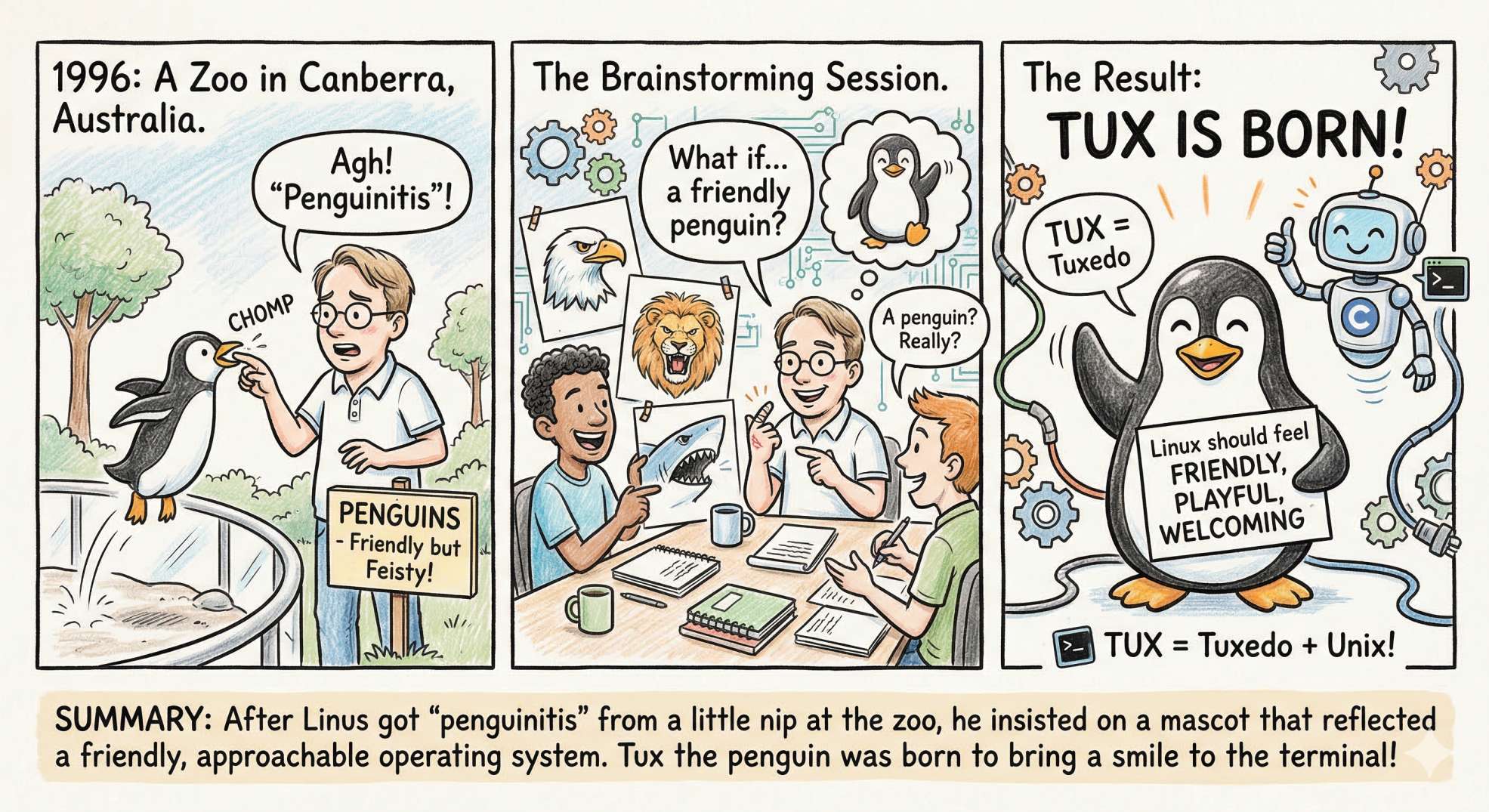
Every successful platform needs a mascot, but a penguin?
Back in 1996, the decision wasn’t exactly popular. Others wanted more aggressive symbols: a dynamic flying bird or maybe a large feline.
But Linus insisted.
Why?
He became fascinated with penguins after visiting a local zoo in Canberra, Australia. He found them cute, calm, and non-threatening.
But there’s also a famous (and slightly legendary) story behind it.
During that trip, a penguin actually bit him. Linus joked that he must have contracted "penguinitis."
Later, during a brainstorming session, he casually suggested:
"What if we use a penguin as a mascot?"
At first, no one took the idea seriously. But when he explained that Linux should feel friendly, playful, and welcoming, the idea stuck.
And so Tux (short for Tuxedo + Unix) was born.
3. Linux Rule #1: "Everything is a File." 📂
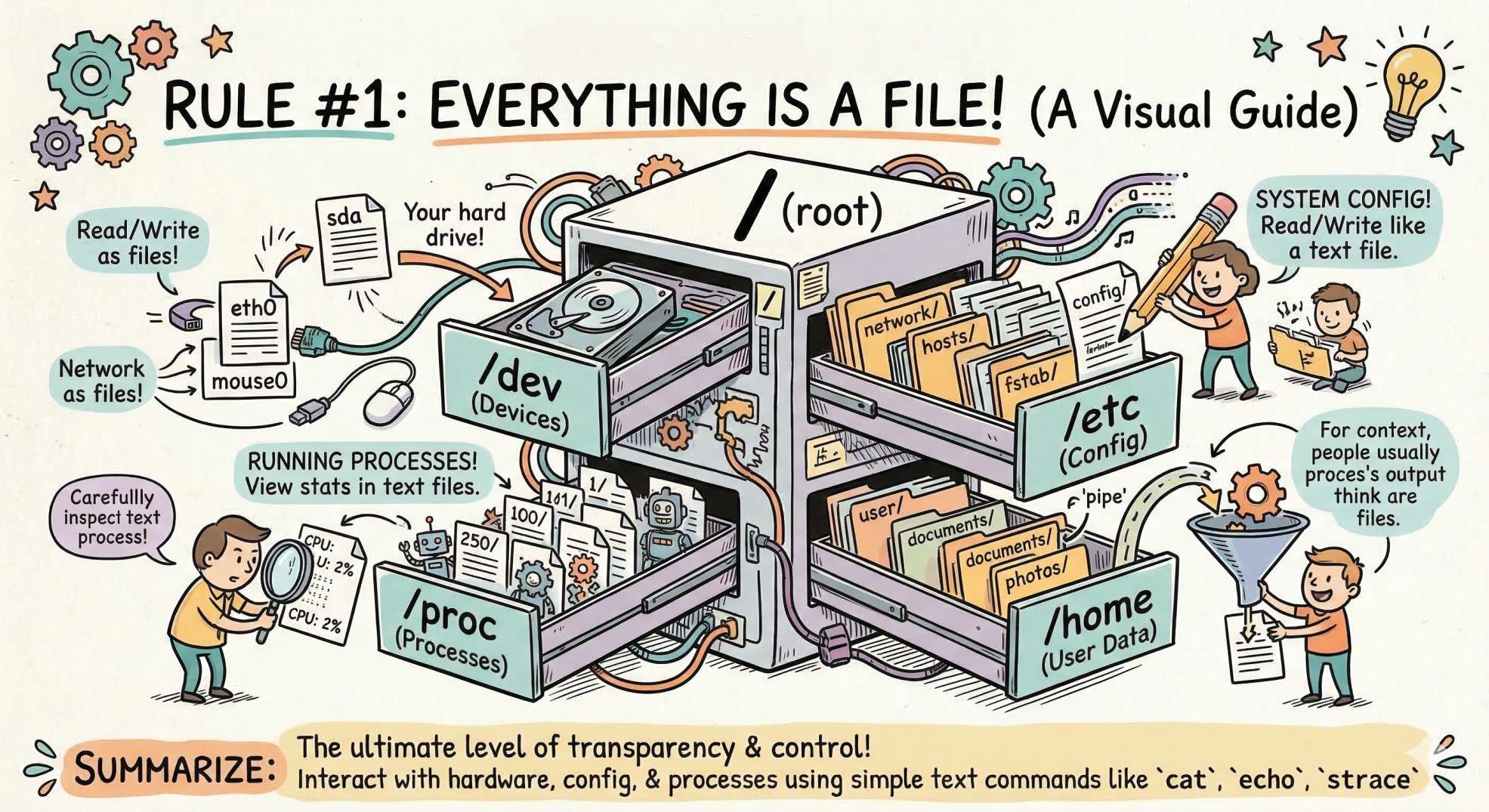
If you understand this one concept, the entire Linux philosophy starts to make sense.
In most operating systems, a file is simply a collection of data.
In Linux, the file system is the interface to the entire system.
Yes, your documents and images are files.
But so are:
- Your physical hard drive →
/dev/sda - System configuration →
/etc/network - Running processes →
/proc
Linux treats devices, processes, and configuration as files.
The Real-World DevOps Truth ⚙️
This means you can use simple tools like:
catto read hardware statsechoto configure kernel parametersstraceto monitor system calls
All as if you're just interacting with text files.
This is the ultimate level of transparency and control.
4. A Classic CLI Time-Saver: sudo !! ⚡

We’ve all been there.
You type a long, complex command, hit Enter, and suddenly:
PERMISSION DENIED
Now what?
Most people press the Up Arrow, move to the beginning of the command, and add sudo.
But there’s a much faster trick.
In Bash, !! (pronounced "bang-bang") refers to the previous command in your history.
The Mic-Drop Trick 🎤
If you forgot sudo, just type:
sudo !!
Your shell instantly re-runs the previous command with superuser privileges.
One of the smallest tricks, but one that saves hundreds of keystrokes over time.
5. The First Commercial Distribution: Softlanding Linux System (SLS) 💾
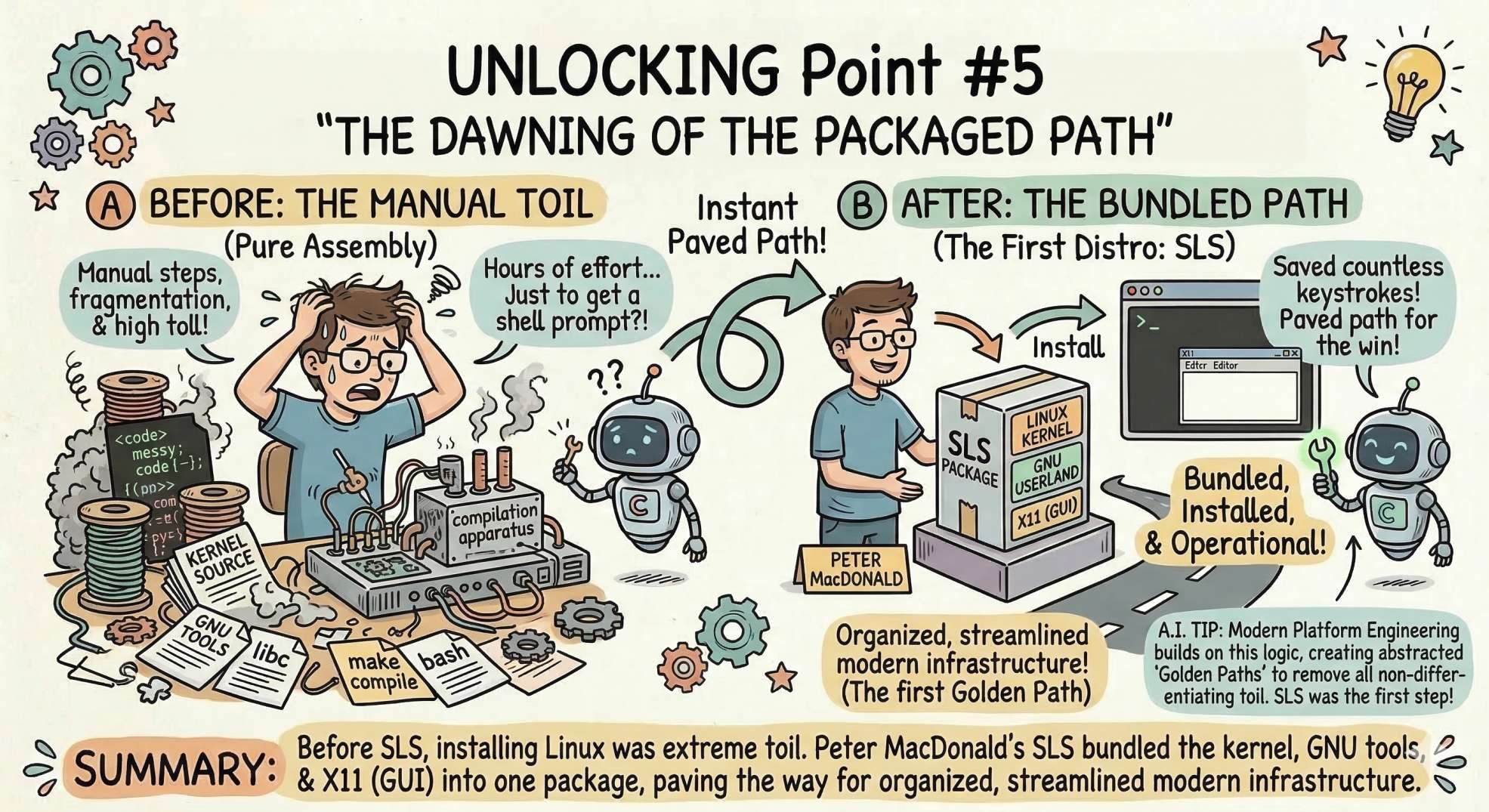
Today we have powerful enterprise distributions like:
- Red Hat Enterprise Linux (RHEL)
- SUSE
- Ubuntu
But which one came first?
The answer is Softlanding Linux System (SLS), released in 1993.
Before SLS, installing Linux was extremely difficult.
You had to:
- Download the kernel source
- Compile it yourself
- Manually gather system tools
Just reaching a working shell prompt was a challenge.
Peter MacDonald created SLS to solve this problem.
It bundled:
- The Linux kernel
- The GNU userland
- An early graphical interface (X Window System)
Although SLS didn't last long (it was later replaced by Slackware), it pioneered the concept of packaged Linux distributions.
Looking Ahead to Part 2: We’ve laid the groundwork in Part 1.
In the next post, I will go deeper, moving from Linux history to the technology that powers modern containers:
- Kernel Namespaces
- Control Groups (cGroups)
These are the mechanisms behind Docker, Kubernetes, and modern cloud infrastructure.
💬 Quick Question: What’s your favorite foundational Linux fact? Are you still building your own "Freax" distribution, or are you already walking the Golden Path?
Let us know in the comments!
"Linux isn't just an operating system; it's a superpower.
Most people use it to fly, but real engineers know how to rewrite the physics underneath."