The $30 Hour: Is the AWS DevOps Agent a Genius or a Gold Digger?
Would you pay $30/hour for an AI DevOps agent? Discover how AWS DevOps Agent cuts MTTR, handles incidents, and whether it’s genius or just expensive.
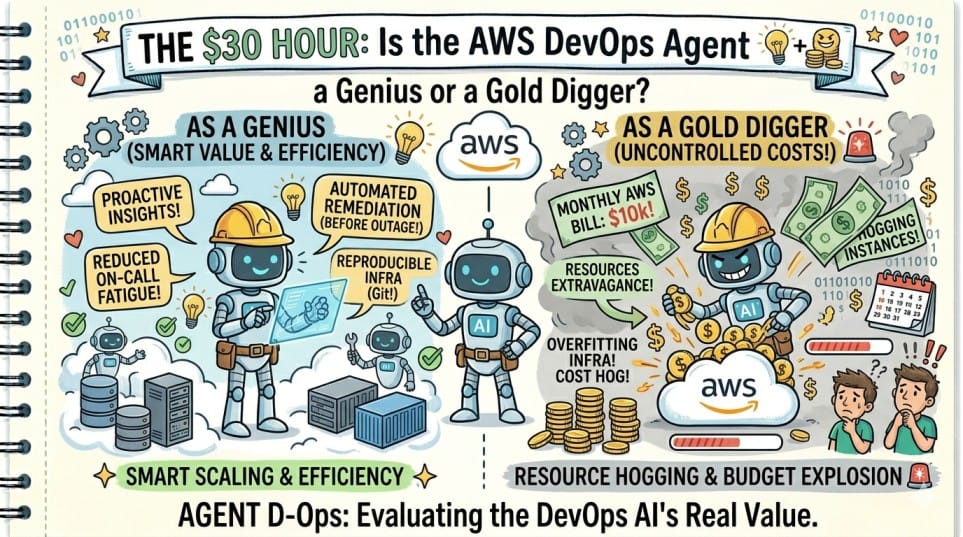
If you’ve ever been the primary on-call during a massive production outage, you know the feeling. It’s 3 AM; your Grafana dashboard is bleeding red, and you’re trying to remember which developer touched the IAM policies last Tuesday.
AWS wants to solve that. But it comes at a price.
The Math of the Machine
AWS DevOps Agent pricing is set at $0.0083 per agent-second. That comes out to roughly $29.88 per hour of active work. The important detail is that you are only billed when the agent is actually thinking or acting, not while it’s idle waiting for your input.
Put that into perspective. If the agent spends an hour fixing a broken Kubernetes deployment, you are paying about the price of a decent lunch. The real question is whether that cost is worth cutting your MTTR by 75 percent.
Three Levels of "Agent Burn"
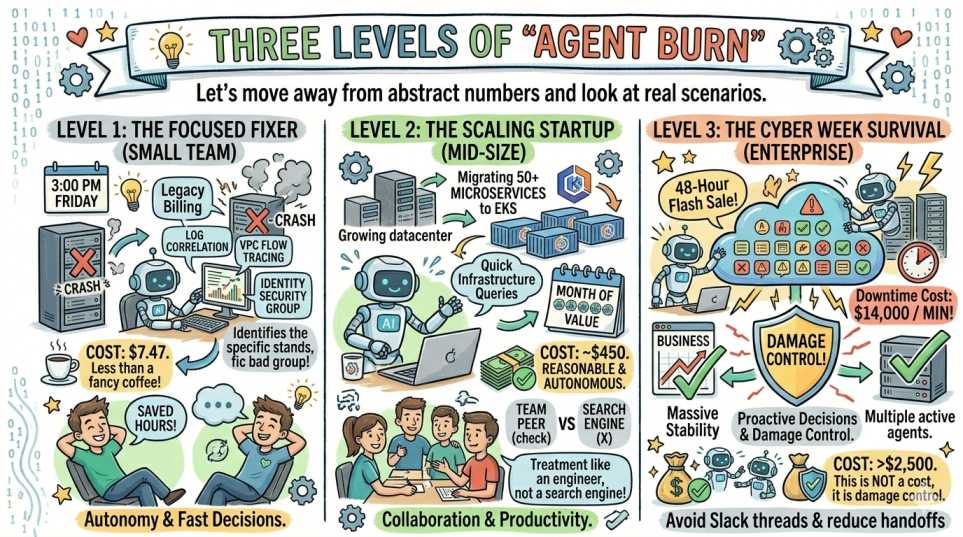
Let’s move away from abstract numbers and look at real scenarios.
1. The Focused Fixer (Small Team)
Your legacy billing service crashes on a Friday afternoon. The agent spends 15 minutes correlating logs, tracing VPC flow, and identifying a misconfigured security group. The cost comes to about $7.47. You just saved two senior engineers from hours of debugging for less than the cost of a coffee.
2. The Scaling Startup (Mid-Size)
You are migrating 50 microservices to EKS. The team uses the agent for deep investigations and quick infrastructure queries throughout the month. The cost lands around $450. This is reasonable, as long as the team treats the agent like an engineer and not a search engine for basic commands.
3. The Cyber Week Survival (Enterprise)
A large e-commerce company runs multiple active agent sessions during a 48-hour flash sale. They deal with hundreds of incidents and proactive checks. The cost crosses $2,500. When downtime costs around $14,000 per minute, this is not a cost. It is damage control.
Sounds Good So Far. Here’s Where Things Get Real.
The agent fee is not the full bill. When the DevOps Agent investigates a problem, it actively interacts with your infrastructure. It runs CloudWatch Logs Insights queries, pulls X-Ray traces, and accesses data across services like S3.
You are billed for all of that separately.
If the agent scans large volumes of logs to find a root cause, you are paying for both the agent’s time and the data it processes. This is where costs can quietly increase if you are not paying attention.
Why This Works
This is not just a chatbot with better branding. The agent follows a reasoning and acting loop. It builds a plan, executes actions like running queries, observes the results, and adjusts its approach.
For example, it can query logs, detect a spike in failures, connect that to a recent deployment, and point directly to a misconfiguration. This is why AWS claims high root cause accuracy. The agent is not guessing. It is being investigated.
Our Conclusion: Toy or Tool?
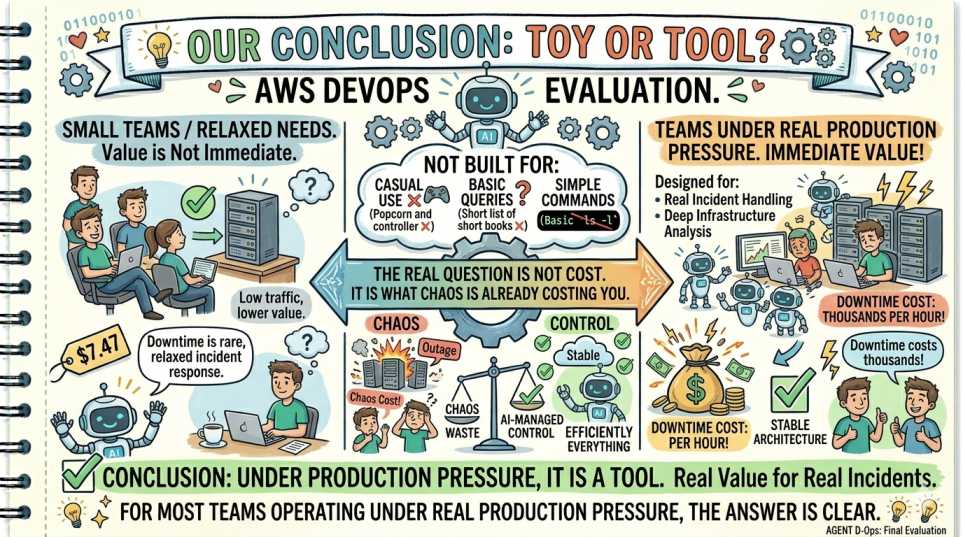
The AWS DevOps Agent is not built for casual use. It is not meant for basic queries or simple commands. It is designed for real incident handling and deep infrastructure analysis.
Teams where downtime costs thousands per hour will see immediate value. Smaller teams with low traffic and relaxed incident response needs may not.
The real question is not cost. It is what chaos is already costing you.
For most teams operating under real production pressure, the answer is clear.
Final Thought
Would you rather spend $30 per hour on an agent or spend hours debugging production at 3 AM?
💬 What’s your take? Would you let an AI agent spend $30 per hour on your behalf? Let’s discuss in the comments below.
“You don’t pay $30 per hour for an AI agent. You pay to not be the one debugging production at 3 AM.”