Stop Debugging, Start Orchestrating: The Rise of Agentic DevOps and SRE
Stop confusing "AI" with "Magic." In the high-stakes world of modern infrastructure, the real competitive advantage isn't just "automation"- it’s Agentic Orchestration.
Welcome to DevOps Inside, where we untangle incident chaos with coffee, code, and a touch of autonomous logic ☕🤖.
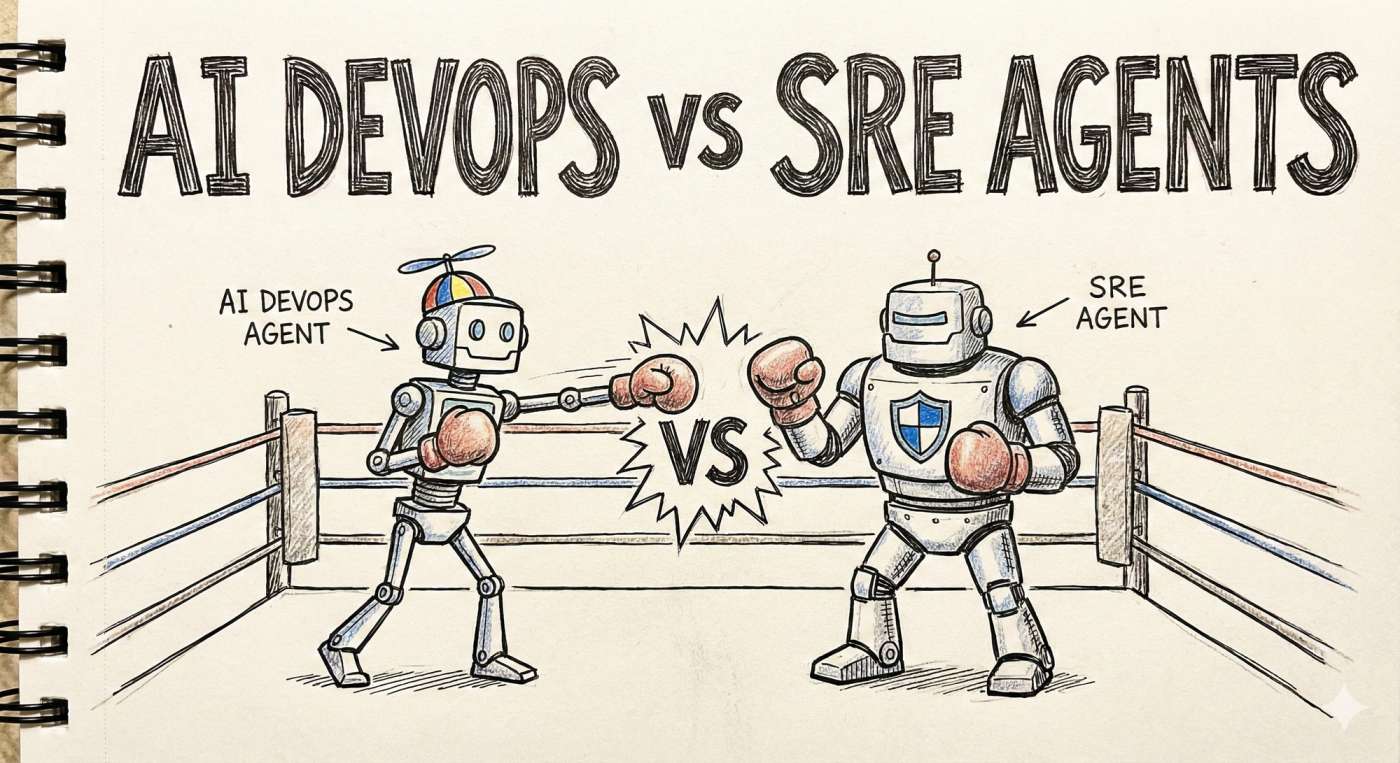
When production breaks at 3 AM, you don't need a chatbot to tell you "it's broken." You need a system that can see the signal in the noise and an engine that knows how to fix it safely. Today, we’re looking at the two specialized brains running modern infrastructure: Agentic DevOps AI and Deterministic SRE Agents.
🧠 The Brain vs. The Guardrail
To build a self-healing system, you need two distinct types of intelligence. Using generic "AI" for everything is a mistake—real reliability comes from pairing Probabilistic Intelligence with Deterministic Logic.
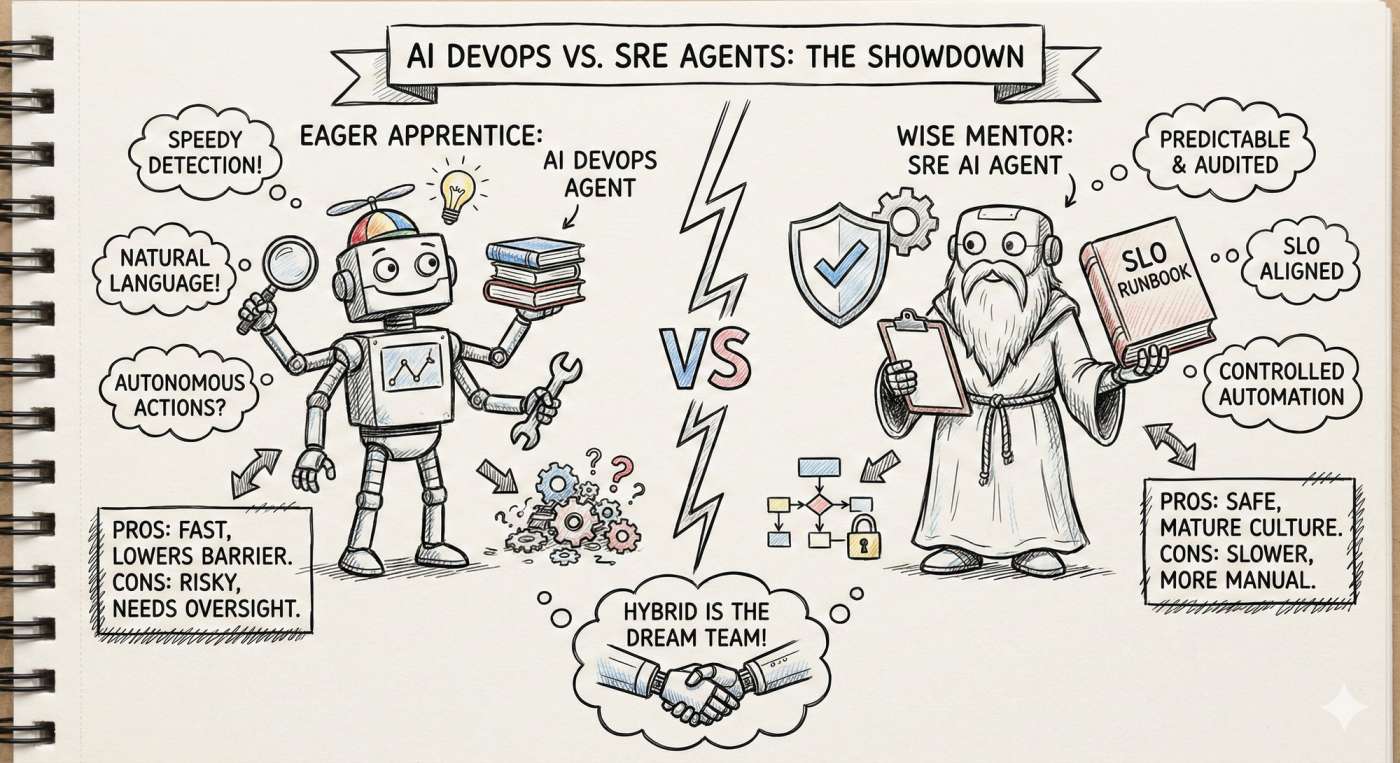
1. Agentic DevOps AI (The Intelligence Layer)
This isn't just an LLM; it's an Autonomous Agent with read-access to your telemetry. It doesn't wait for a threshold; it looks at the "pattern" of your system.
- The Role: Probabilistic Discovery. It calculates the likelihood that a specific event caused an outage.
- The Example: It sees a 15% latency spike and correlates it with a database lock in a different region. It tells you: "There is an 88% probability that Commit #X caused this contention."
- The Value: It saves the 45 minutes of "log-grepping" that usually happens during triage.
2. SRE Agents (The Policy Engine)
SRE Agents are Deterministic. They don't guess; they follow the math of your SLOs (Service Level Objectives).
- The Role: Safe Execution. It governs what actions are allowed based on your "Error Budget."
- The Example: It receives the analysis from the Agentic DevOps AI. It checks the budget. If the budget is healthy, it executes a pre-validated rollback. If the budget is depleted, it freezes the environment and pings a human.
- The Value: It ensures that no matter how "smart" the AI gets, it never performs a destructive action without a policy check.
⚙️ The Reliability Flywheel: How They Collaborate
Instead of a "clash," think of these as two gears in a single engine.
- Agentic DevOps AI Triages: The AI reduces 1,000 noisy alerts into one clear story. It uses "Probabilistic Reasoning" to find the root cause.
- SRE Agent Governs: The SRE Agent takes that story and applies Deterministic Rules. It decides if a fix is safe to execute.
- The Human Orchestrates: The agents present the SRE with a single button: "We found the leak, and the rollback is ready. Click here to execute within our safety policy."
📊 Comparison at a Glance
| Feature | Agentic DevOps AI 🤖 | SRE Agent 🛠️ |
|---|---|---|
| Logic Type | Probabilistic (Likelihoods) | Deterministic (If / Then) |
| Data Source | Raw logs, traces, unstructured data | SLIs, SLOs, structured metrics |
| Remediation | Proposes probable fixes | Executes validated runbooks |
| Main Goal | Minimizing MTTD (Detection) | Minimizing MTTR (Repair) |
❓ Decision Matrix: Which One Does Your Team Need?
- Drowning in Alert Noise? → Start with Agentic DevOps AI to find the signal.
- Afraid of "Black Box" Automation? → Start with SRE Agents to build safety gates.
- Scaling Thousands of Microservices? → You need the Hybrid Flywheel. You can't write manual runbooks for 500 different services.
Final Verdict
Agentic DevOps AI is your Radar. SRE Agents are your Engine.
The future of DevOps isn't about replacing the "Human-in-the-loop." It’s about building a Co-Pilot that gives you the right data and the right tools at the exact moment you need them.
The "Magic" isn't in the AI. The "Safety" isn't in the SRE. The power is in the Integration.
Want to see more similar interesting blogs? Check out our latest deep dives into Cilium for eBPF observability or Kubernetes Secret Leaks at DevOps Inside.