Layer by Layer Into DevOps: The Roadmap Most Beginners Need (PART 4)
This final part makes the earlier layers useful in the real world.
Quick continuation before we dive in
Part 1 gave you DevOps thinking and culture.
Part 2 gave you Linux + networking + infrastructure basics.
Part 3 gave you the modern toolchain: cloud, automation, containers, Kubernetes, and observability.
If you haven’t read those, this part will feel like skipping chapters in a story.
👉 Part 1: https://devopsinside.com/layer-by-layer-into-devops-the-roadmap-most-beginners-need-part-1/
👉 Part 2: https://devopsinside.com/layer-by-layer-into-devops-the-roadmap-most-beginners-need-part-2/
👉 Part 3: https://devopsinside.com/layer-by-layer-into-devops-the-roadmap-most-beginners-need-part-3/
This final part makes the earlier layers useful in the real world.
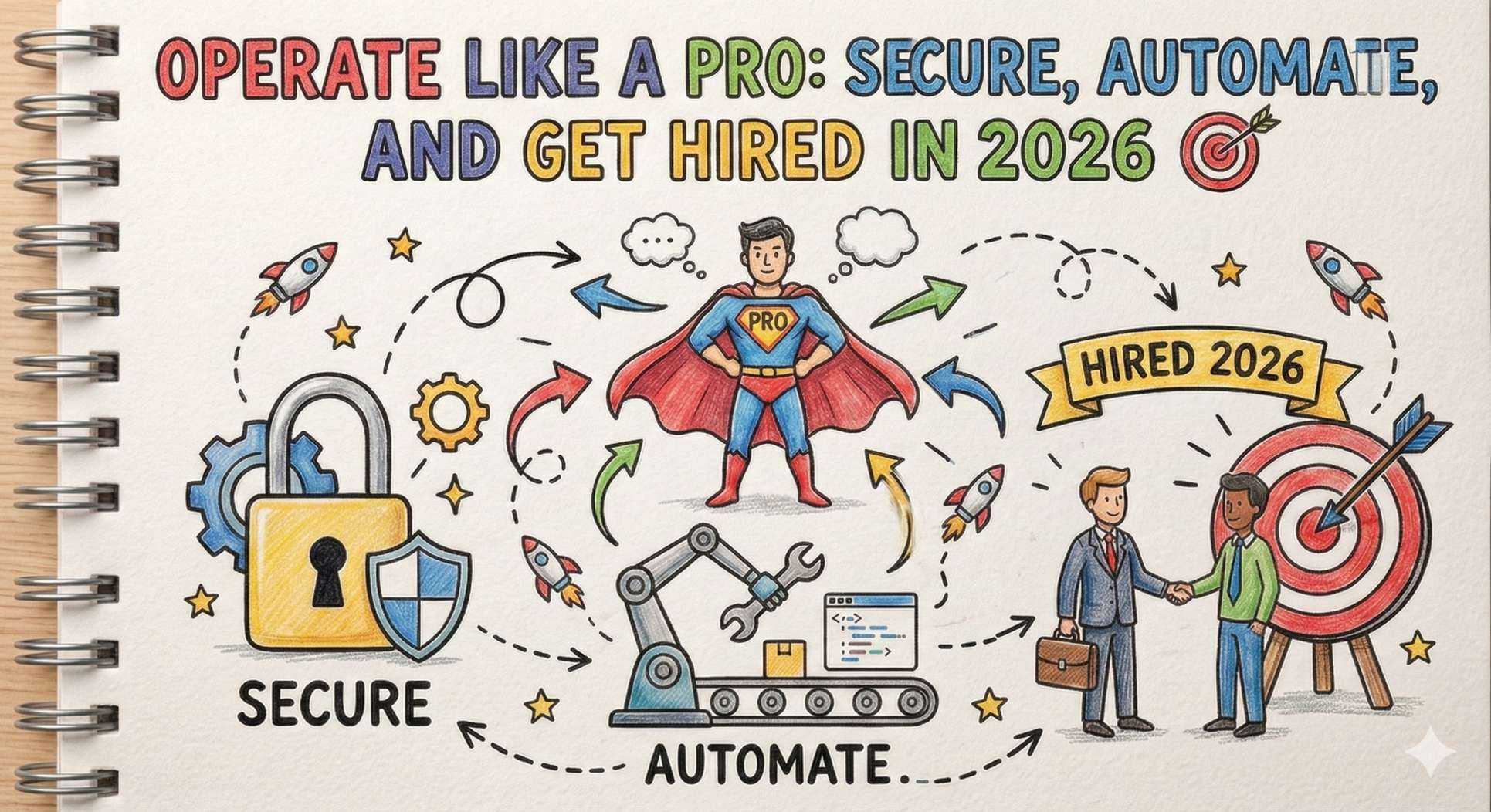
Operate Like a Pro: Secure, Automate, and Get Hired in 2026 🎯
The Professional Layer, Security, Coding, GitOps, Career Paths, Interviews, and the 2026 AI Shift
This is the layer that turns “I’m learning” into “I’m hireable.”
1) DevSecOps basics, security must be built in 🔐
Security is integrated across the lifecycle now. DevOps engineers should understand:
- Secret management mindset (never treat secrets casually)
- Access control basics (least privilege)
- Scanning and basic vulnerability awareness
- Secure pipelines and safe artifact handling
Example: Putting credentials inside a code repo is a common beginner mistake. Proper teams use secret managers and grant access only where needed.
2) Programming and scripting, “code is non-negotiable” 💻
Most DevOps roles expect scripting and automation ability. You’ll use code to:
- Glue systems together
- Automate repetitive work
- Validate configs
- Handle deployment tasks
- Build internal tooling
Common languages:
- Shell scripting
- Python
- Go (useful in many tooling and platform environments)
A strong strategy: build one small application end-to-end once. It teaches you what you’re deploying and how systems behave beyond theory.
3) Git, GitOps, and documentation 📚
Everything should be version-controlled (except secrets). Git is foundational.
GitOps is the idea that Git becomes the source of truth for deployments and infrastructure state.
Documentation matters:
- It reduces repeated questions
- It speeds onboarding
- It makes troubleshooting faster
- It becomes proof of learning
Try this (15 minutes)
Create a tiny automation pipeline:
- Push code to Git
- Trigger a simple build/test script
- Document the process
You’ve just simulated the delivery lifecycle.
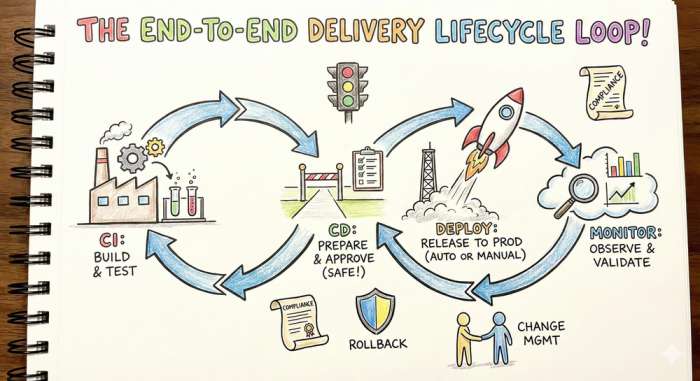
4) End-to-end delivery lifecycle (how software really ships)🚦
You should understand:
- Continuous integration: build/test early and often
- Continuous delivery: prepare releases safely
- Continuous deployment: release automatically where appropriate
Also, understand typical organization realities:
- Approvals and change management
- Compliance requirements
- Rollback strategies
- Post-deploy validation
5) MLOps and LLMOps, the emerging expectation🤖
DevOps is expanding. Many teams now operate AI workloads too.
DevOps-adjacent AI operations include:
- Deploying model workloads
- Versioning and rollout strategies
- Monitoring drift and performance
- Securing data and model artifacts
- Scaling inference on Kubernetes
6) Agents, MCP, and AI productivity workflows 🧠
Treat AI agents like productivity teammates:
- Draft configs
- Summarize incidents
- Review deployment templates
- Extract patterns from logs
Rule stays the same: you validate.
🔹 AI as career multiplier
AI can also accelerate career growth beyond daily engineering work. Many learners now use AI to simulate interview scenarios, generate portfolio project ideas, review architecture decisions, and even critique documentation clarity. Used thoughtfully, AI becomes a rehearsal space where you can experiment safely before doing things in production or interviews.
Think of AI here as a co-pilot for learning; helpful for direction, but you still hold the controls.
7) DevOps vs SRE + types of DevOps teams 🧭
SRE focuses heavily on reliability and operations. DevOps focuses heavily on delivery collaboration. They overlap.
You could land in:
- Platform engineering
- App operations
- SRE
- Support escalation teams
8) Roles, responsibilities, interviews🎤
Different companies test different things, but patterns repeat:
- Linux and networking fundamentals
- Troubleshooting thinking
- CI/CD reasoning
- Scripting basics
- Infrastructure automation thinking
- Sometimes system design questions
Quick question: If you had to pick one portfolio project to prove your DevOps skill, what would you build: a CI/CD pipeline, an infrastructure-as-code setup, or a Kubernetes deployment with monitoring, and why?
🔹 Beginner misconception
“Learning tools are enough to become hireable.”
Reality: Hiring signals include troubleshooting thinking, automation ability, documentation, and delivery understanding.
“Automate the boring. Own the critical. That’s DevOps.”