Layer by Layer Into DevOps: The Roadmap Most Beginners Need (PART 3)
In this part, you’ll learn how modern production systems are actually built: cloud, automation, containers, Kubernetes, and observability; the "real world" toolchain.
Quick continuation before we dive in
So far, you’ve built two layers:
Part 1 → DevOps mindset + culture + collaboration
Part 2 → Linux + networking + infrastructure basics
If you’re jumping in here, read those first; they explain why these tools work the way they do.
👉 Part 1: https://devopsinside.com/layer-by-layer-into-devops-the-roadmap-most-beginners-need-part-1/
👉 Part 2: https://devopsinside.com/layer-by-layer-into-devops-the-roadmap-most-beginners-need-part-2/
In this part, you’ll learn how modern production systems are actually built: cloud, automation, containers, Kubernetes, and observability; the "real world" toolchain. 🛠️
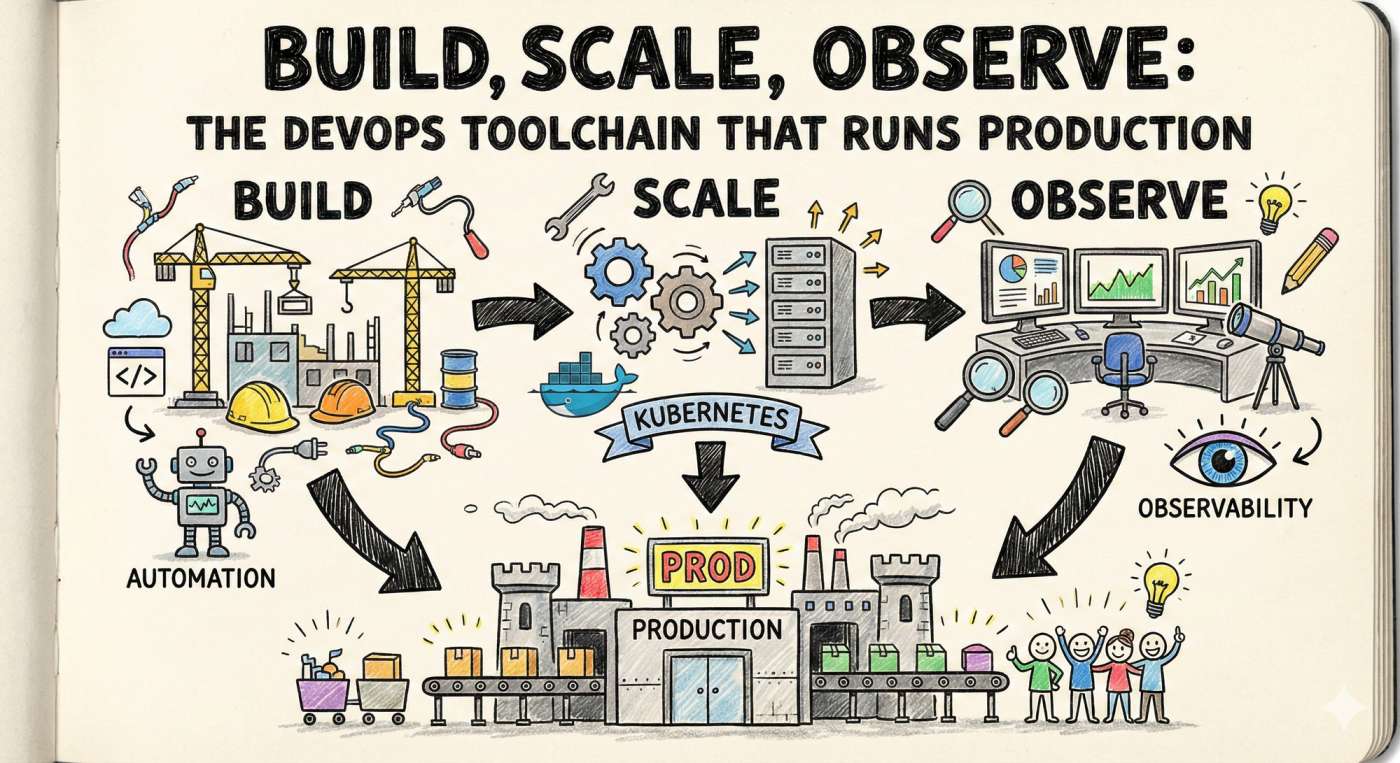
Build, Scale, Observe: The DevOps Toolchain That Runs Production
The Build Layer, Cloud + Automation + Containers + Kubernetes + Observability
Now the story becomes real. This is where you stop collecting concepts and start building systems that resemble production.
Concepts explain systems.
Tools build systems.
1) Cloud and virtualization, your execution playground ☁️
Cloud and virtualization are foundations for modern DevOps. You don’t need to learn every cloud. Pick one (often AWS) and understand the core services.
Focus on:
- Compute: running workloads reliably
- Networking: isolation and connectivity
- Storage: durability and access control
- Identity: permissions and roles
Example: Your app needs a server (compute), needs to talk to the internet (network), needs to store files (storage), and needs safe access (identity). Cloud is just these building blocks packaged. 🧩
Goal: Understand how a real app is hosted, secured, scaled, and monitored.
🔹 Beginner misconception
“Using cloud and containers automatically makes systems reliable.”
Reality: Reliability comes from automation, observability, and operational practices around those tools.
2) Infrastructure automation, because manual work does not scale ⚙️
In modern infrastructure, manual changes are a liability. If you create servers by clicking around, you’ll create inconsistency. If you define infrastructure in code, you can review it, version it, and reproduce it.
This is where automation fits:
- Repeatability
- Auditability
- Predictable changes
- Less human error
🔹AI as config scaffolding + architecture reasoning
At this layer, AI becomes especially useful for scaffolding configurations. You can ask it to draft a Terraform snippet, a Dockerfile, or a Kubernetes manifest, then study and refine what it produces. This approach turns blank-page anxiety into guided iteration while still ensuring you understand the system you’re building.
Think of AI here as a co-pilot for learning; helpful for direction, but you still hold the controls.
3) Containers, the packaging step that stops “works on my laptop” problems 🐳
Containers give you repeatability.
As a beginner, learn:
- Images and containers concept
- How apps talk to each other
- Basics of running app + database together
- Debugging container crashes
Containers are shipping boxes; what matters is not the box, but that every box arrives identical.
Try this (10 minutes)
Run any simple application in a container locally.
Observe:
- How logs appear
- How ports expose services
- What happens when the container stops
This is your first production-like packaging experience.
4) Kubernetes, the orchestrator (and why it feels hard) ☸️
Kubernetes is used because systems are distributed: multiple services, multiple replicas, updates, scaling, and failures.
Beginner Kubernetes focus:
- Scheduling concept
- Pods/deployments/services concept
- Updates and rollbacks concept
- Configuration and secrets concept
- Why clusters behave differently from single machines
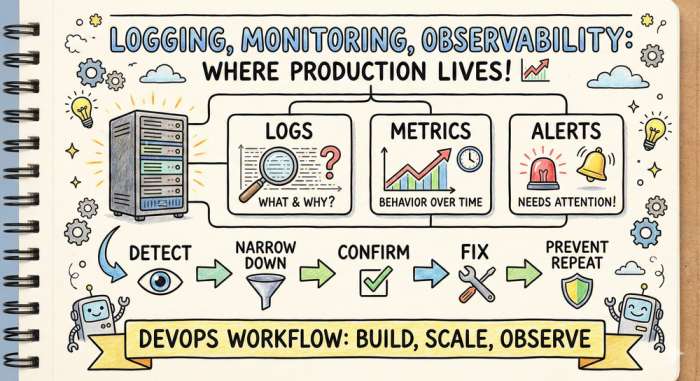
5) Logging, monitoring, observability (this is where production lives) 📈
This is how you detect, diagnose, and recover.
You should understand:
- Logs: what happened and why
- Metrics: how the system behaves over time
- Alerts: when something needs attention
- Dashboards: a quick picture of health
Takeaway: Modern DevOps is the combination of building systems, scaling systems, and observing systems.
Think in workflow:
detect → narrow down → confirm → fix → prevent repeat.
6) Distributed systems mindset🧠
In distributed systems:
- Failures happen
- Networks are unreliable
- Latency exists
- Retries can cause an extra load
- One small issue can cascade
DevOps engineers learn to operate with these realities.
Quick question: Your service is slow. Would you check metrics first or logs first, and what exactly are you looking for?
If production breaks at 2 a.m., can you debug it, secure it, patch it, version it, and ship a fix confidently? That’s what separates learners from engineers.
Let’s build that layer next.
Jump to Part 4 → Security, GitOps, coding, and real-world readiness
👉 https://devopsinside.com/layer-by-layer-into-devops-the-roadmap-most-beginners-need-part-4/