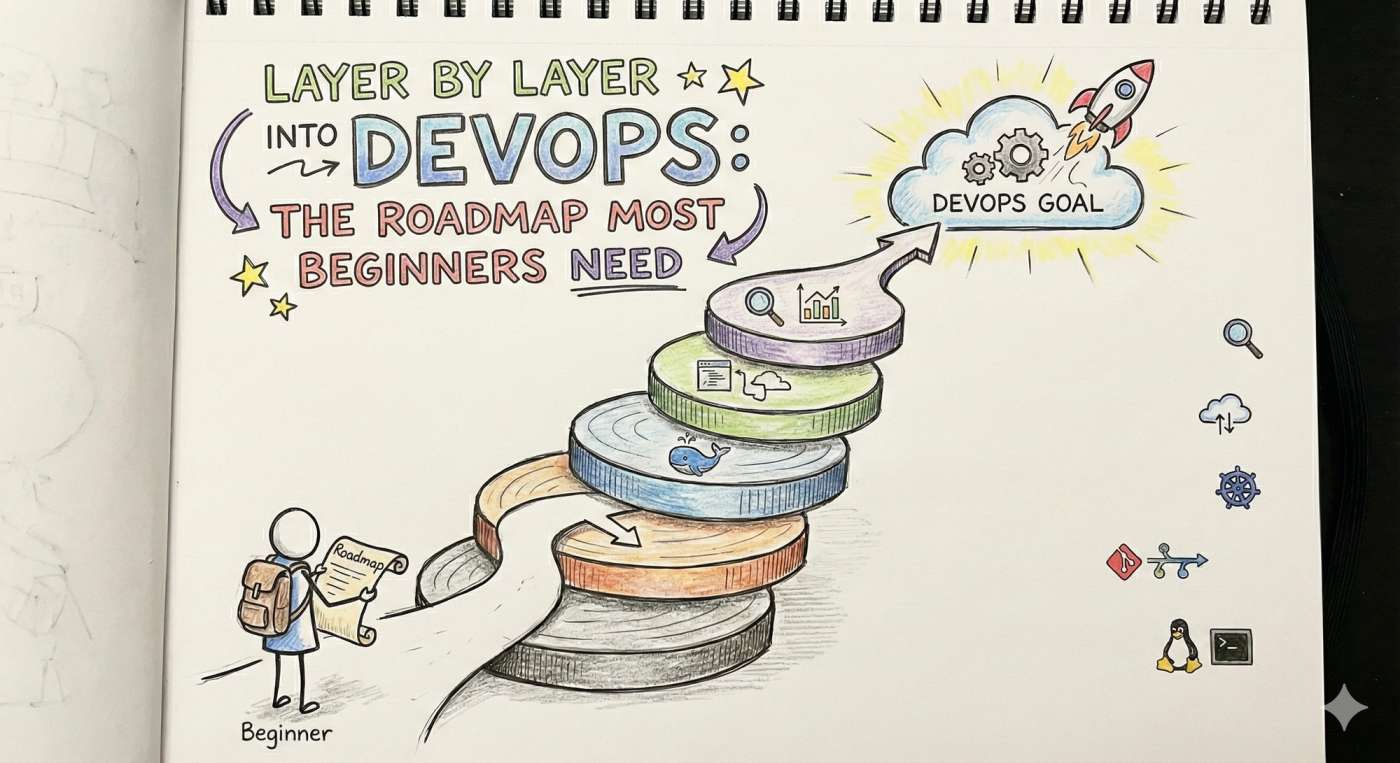
Layer by Layer Into DevOps: The Roadmap Most Beginners Need (PART 1)
DevOps is not a tool collection. Tools are only the "how." DevOps is the “why.” It’s a way of working where building and running software stops being a relay race and becomes a shared mission.
Beginner misconception
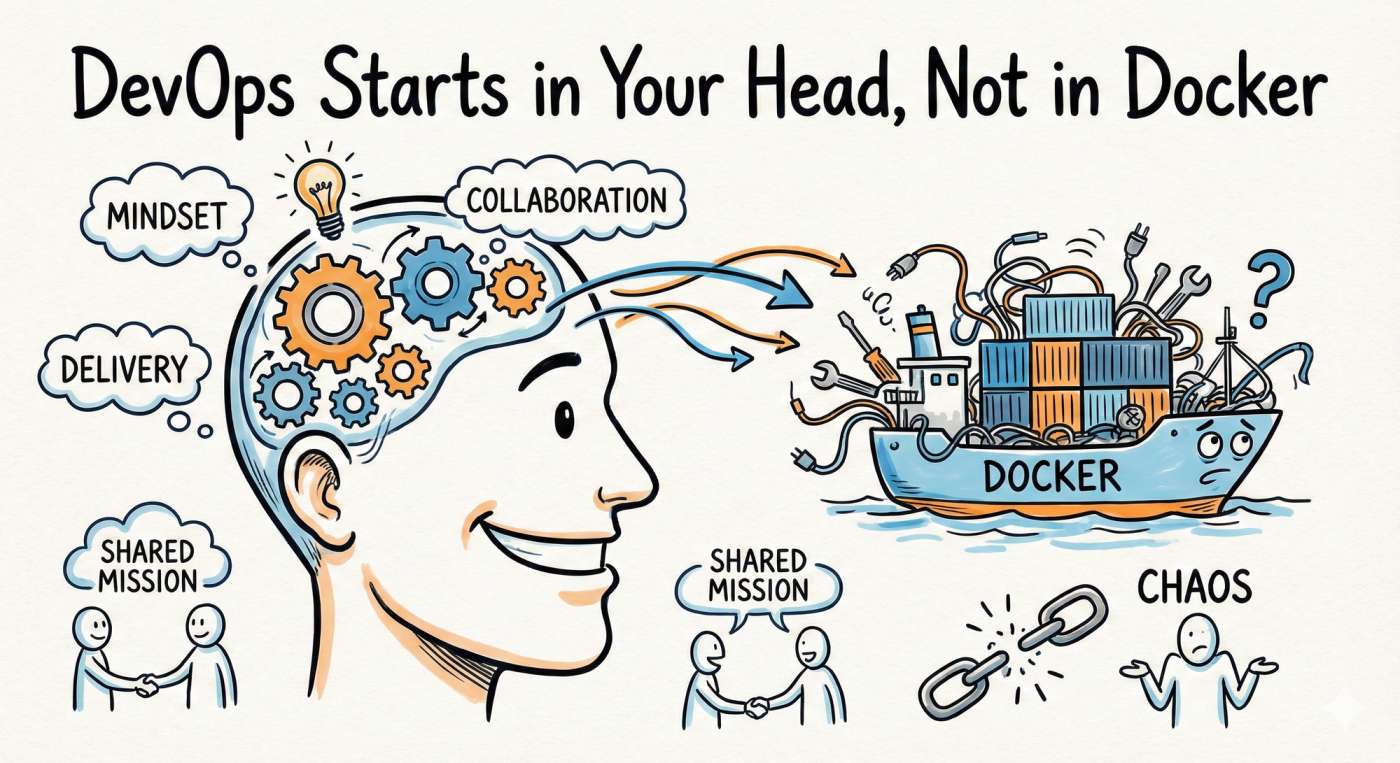
“DevOps is mainly learning tools like Docker and Kubernetes.”
Reality: DevOps starts with mindset, collaboration, and delivery thinking. Tools only implement those principles.
So… What Even Is DevOps?” (And Why Tools Alone Won’t Save You)
Imagine you join a team where releases are scary. People delay deployments, bugs reach production, and whenever something breaks, everyone looks for someone to blame. DevOps exists to reduce that chaos.😬
DevOps is not a tool collection. Tools are only the "how." DevOps is the “why.” It’s a way of working where building and running software stops being a relay race and becomes a shared mission. The mission is simple: ship changes faster, break fewer things, and recover quickly when something does break.
If you’ve heard people say “automation is DevOps,” that’s a half-truth that causes full confusion. Automation is important, but DevOps is more than automation. A team can automate everything and still be toxic, slow, and blame-driven.
DevOps is not about deploying faster.
DevOps is about deploying safely, repeatedly, and confidently.
1) The real definition
DevOps is a way of building and running software where:
- Teams share responsibility for delivery and production outcomes
- Releases happen frequently, in smaller changes
- Feedback loops are short (issues are detected quickly)
- Improvement is continuous, not occasional
It’s less like passing a baton and more like rowing the same boat together.
Reality check: If a release fails and the first reaction is “whose fault is this?”, DevOps culture is missing.🚫
2) Who is a DevOps Engineer (in 2026 terms)?
A DevOps engineer is someone who reduces friction between code and production. They help teams:
- Build reliable CI/CD pipelines
- Automate infrastructure setup and changes
- Improve observability so systems are debuggable 🔍
- Implement safer practices around security and delivery🔐
- Reduce repetitive manual work (toil)
Example: If your team is manually doing the same deployment steps every Friday, a DevOps engineer automates that flow so releases become boring (in a good way). 😄
You’ll see companies use different labels: DevOps, SRE, Platform Engineer, Cloud Engineer. Titles vary, responsibilities overlap.
3) DevOps culture (the part most beginners underestimate)
Tools are easy to list. Culture is what makes those tools actually useful.
Healthy DevOps culture looks like:
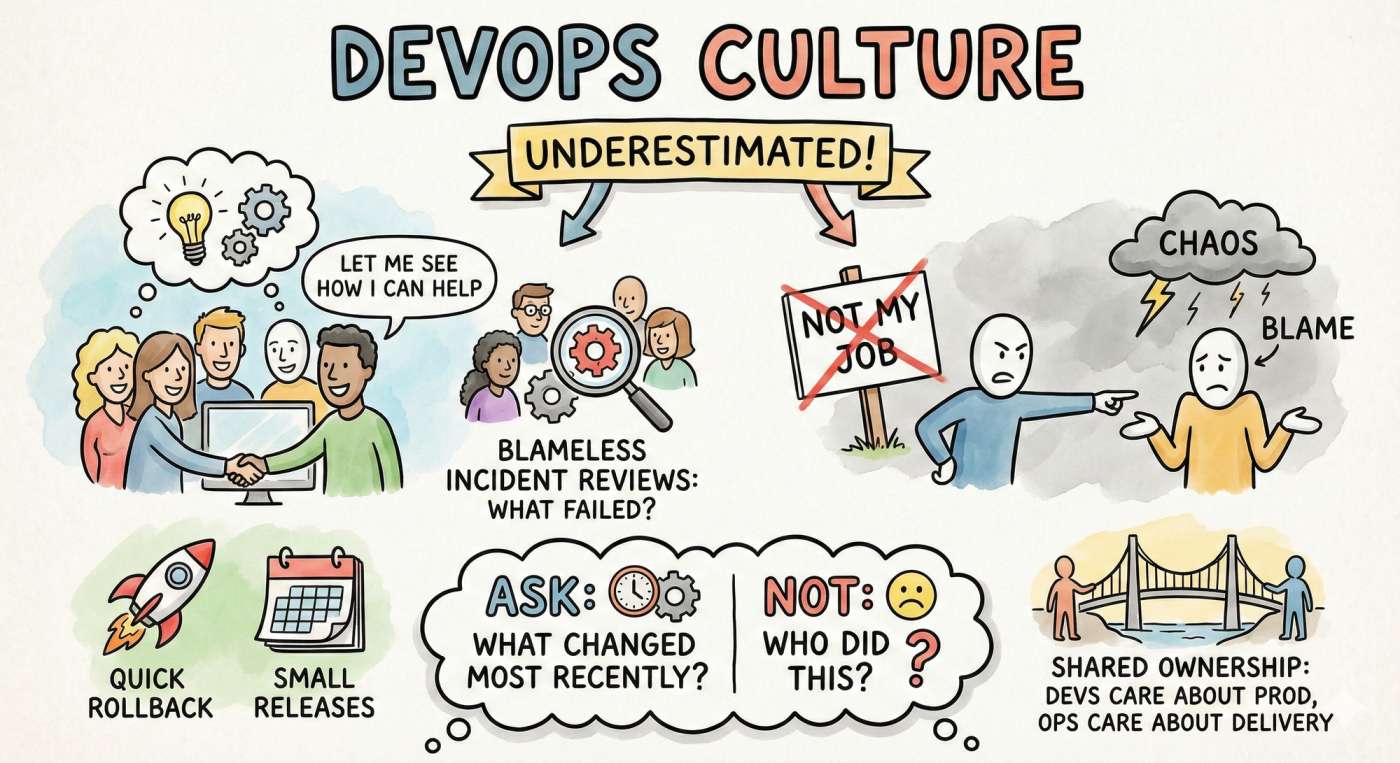
- “Let me see how I can help” instead of “not my job”🤝
- Blameless incident reviews (what failed in the system, not who failed)
- Transparency, small releases, quick rollback habits
- Shared ownership: devs care about production, ops cares about delivery quality
A simple habit to adopt early: When something breaks, ask “What changed most recently?” Not “Who did this?”
🔹 Try this (5 minutes)
Think about a time something failed in software you used (a website crash, payment error, login issue).
Write down:
- What users experienced
- What might have changed before the failure
- What signals would help diagnose it
This is your first blameless incident analysis.
Takeaway: DevOps starts with shared responsibility and feedback, not automation tools.
4) Learn to use AI tools (without becoming dependent) 🤖
DevOps in 2026 is AI-augmented. The goal isn’t to stop learning. It’s to learn faster and work smarter.
Use AI tools for:
- Explaining unfamiliar concepts in simple language
- Summarizing long error logs and suggesting likely causes
- Drafting config templates (then you verify)
- Generating checklists, runbooks, and troubleshooting steps
The rule: AI can draft, you validate. In production, guessing is expensive. 💸
You can also use AI as a curiosity amplifier. When you encounter a term like “CI/CD pipeline” or “observability,” instead of bookmarking it for later, ask AI to explain it with a real-world analogy and a small example. This turns passive reading into active learning and helps concepts stick faster.
Think of AI here as a co-pilot for learning; helpful for direction, but you still hold the controls.
5) The roadmap, what comes next
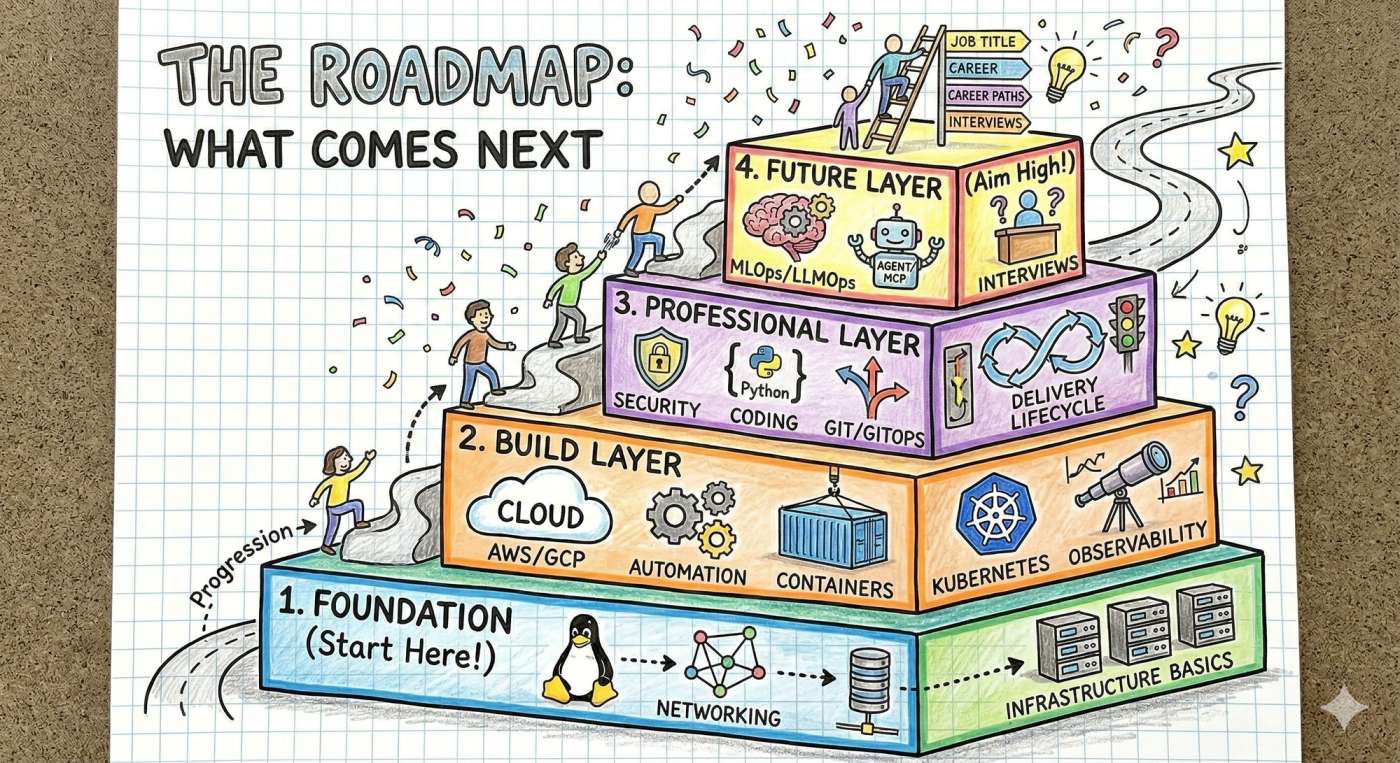
You’re going to build this in layers:
- Foundation: Linux + networking + infrastructure basics
- Build layer: cloud + automation + containers + Kubernetes + observability
- Professional layer: security + coding + Git/GitOps + delivery lifecycle
- Future layer: MLOps/LLMOps + agents/MCP + career paths + interviews
Quick question: If someone says “DevOps = Docker + Kubernetes,” what would you reply in one sentence?
Quick reality check: If production breaks tonight, would you debug Docker first… or the server underneath it?
Exactly.
That’s why we start with the basics.
Jump to Part 2 → Linux, networking, and infrastructure fundamentals
👉 https://devopsinside.com/layer-by-layer-into-devops-the-roadmap-most-beginners-need-part-2/