Agentic DevOps: The Next Evolution of CI/CD
Is CI/CD ready for AI agents? Discover how Agentic DevOps is transforming pipelines with intelligent automation, faster deployments, and smarter decision-making.
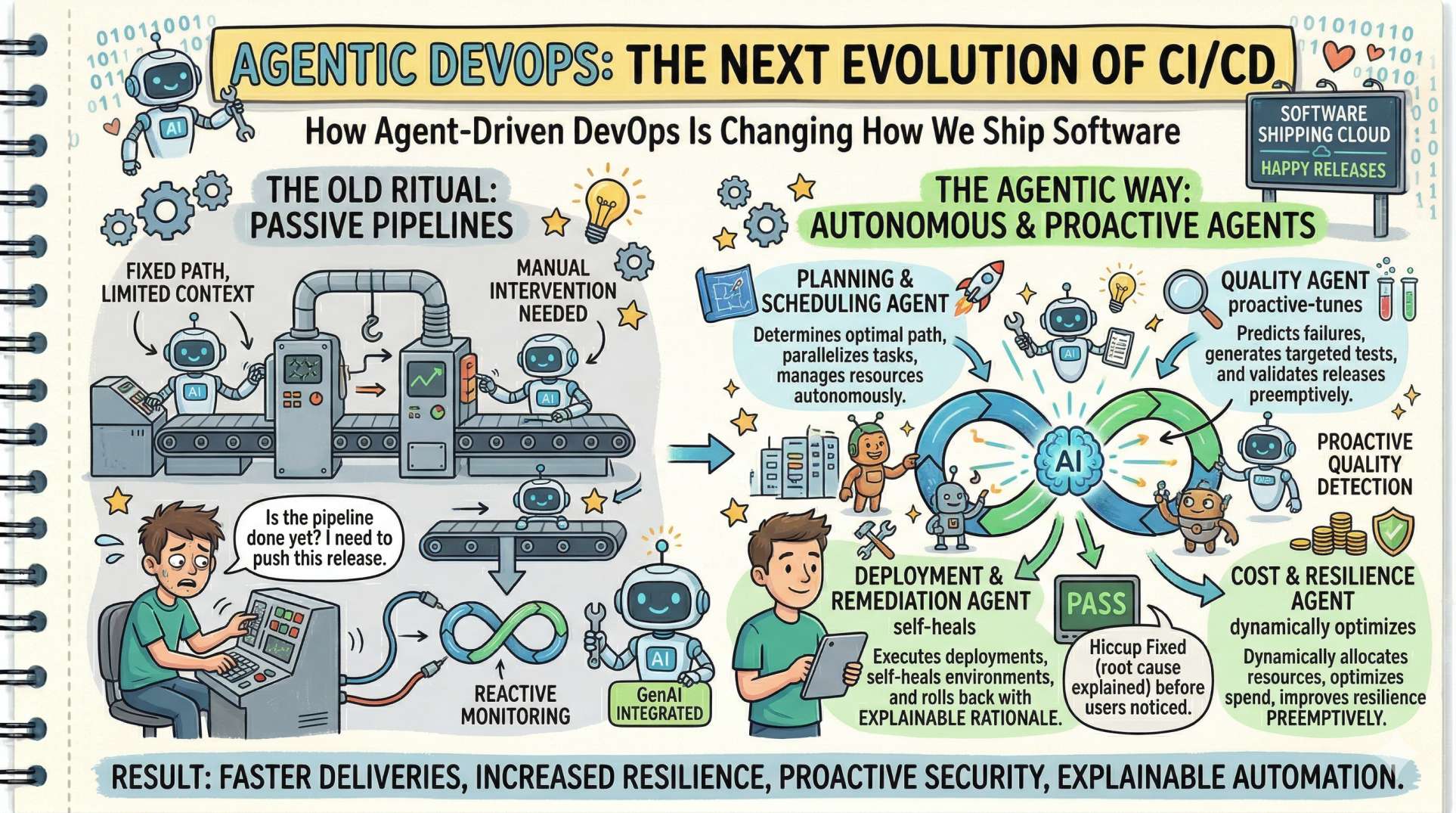
How Agent-Driven DevOps Is Changing the Way We Ship Software
It’s 3:10 AM. Your CI pipeline has failed… again.
The logs are scrolling endlessly, Jenkins looks mildly offended, and that one integration test, the one that behaved perfectly on your laptop, has decided that production reality is not its problem.
You hit “Retry.”
Miraculously… it passes.
Welcome to the strange world of modern CI/CD pipelines: incredibly powerful, incredibly automated, and occasionally powered by pure chaos.
At DevOps Inside, we talk a lot about building bridges and reducing the "cognitive tax" of our systems. Today, we are looking at the next massive shift in our industry. We are moving away from the rigid assembly lines of CI/CD and entering the era of Agentic DevOps.
Here is why your pipelines are about to get a mind of their own, and how to survive the transition.
The Deterministic Trap 🪤
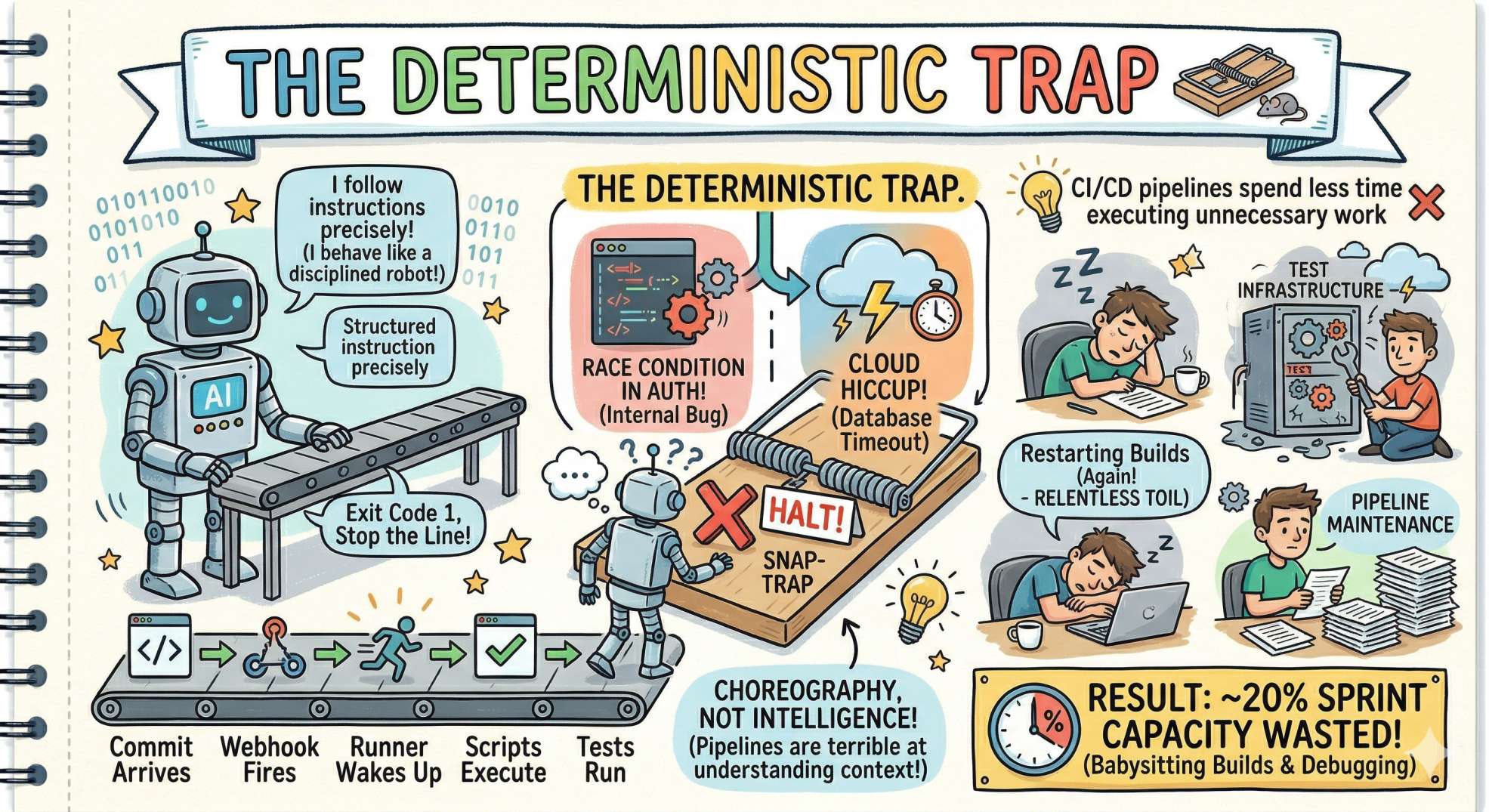
Traditional CI/CD pipelines behave like very disciplined robots.
A commit arrives → a webhook fires → a runner wakes up → scripts execute → tests run → something either succeeds or explodes.
Pipelines are fantastic at following instructions.
What they’re terrible at is understanding situations.
The Problem: This is choreography, not intelligence. When a test fails, the pipeline halts. It has no capacity to distinguish between "the database connection timed out because AWS had a hiccup" and "you introduced a race condition in the auth layer." It just knows: exit code 1, stop the line.
The result? Teams end up spending 20% of their sprint capacity just babysitting CI restarting builds, debugging test infrastructure, and managing the relentless toil of pipeline maintenance.
Enter the Agent: From Reaction to Reasoning 🤖
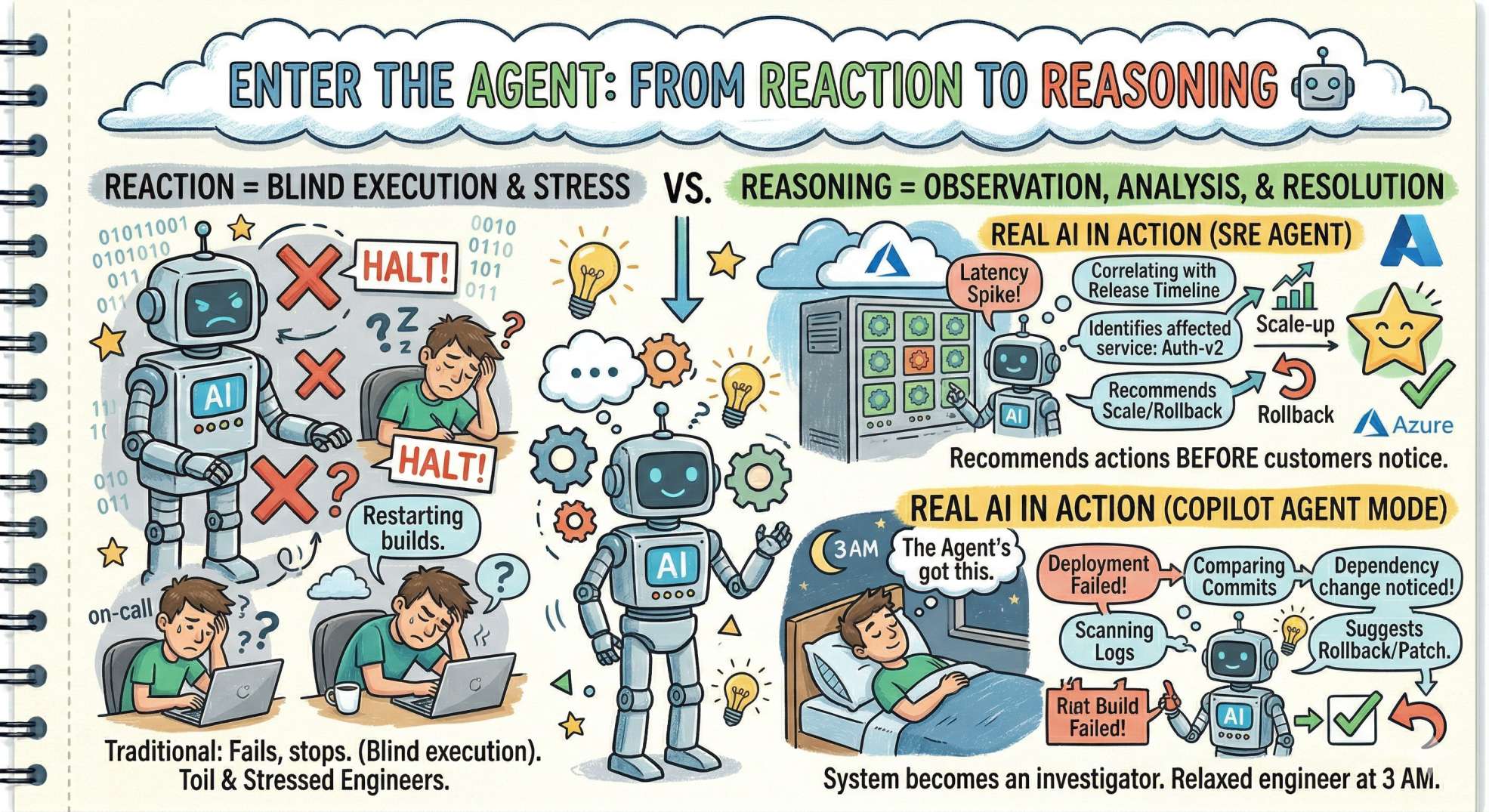
This is where the paradigm shifts. We are no longer just automating scripts; we are delegating judgment.
Modern AI agents don't just alert you to a problem; they investigate and resolve it.
This is where the idea of Agentic DevOps starts creeping in.
Instead of pipelines that blindly execute steps, the system begins to include AI agents that observe logs, metrics, and deployment behavior, and try to figure out what’s actually going on.
- Real AI in Action (Copilot Agent Mode):
Imagine this scenario: A deployment fails because a dependency upgrade quietly changed a configuration format.
A traditional pipeline throws an error and stops.
An AI-assisted system could scan the logs, compare the commit with previous builds, notice the dependency change, and suggest a rollback or configuration patch.
Instead of a red pipeline and a sleepy engineer debugging at 3 AM, the system becomes an investigator
- Real AI in Action (Azure SRE Agent):
At the infrastructure level, the same idea becomes even more interesting.
Imagine an operations agent watching telemetry across dozens of services. Suddenly, latency spikes after a deployment.
Instead of just triggering alerts, the system could correlate the spike with the release timeline, identify the affected service, and recommend scaling or rollback actions before customers even notice.
The "Black Box" Trust Problem ⚠️
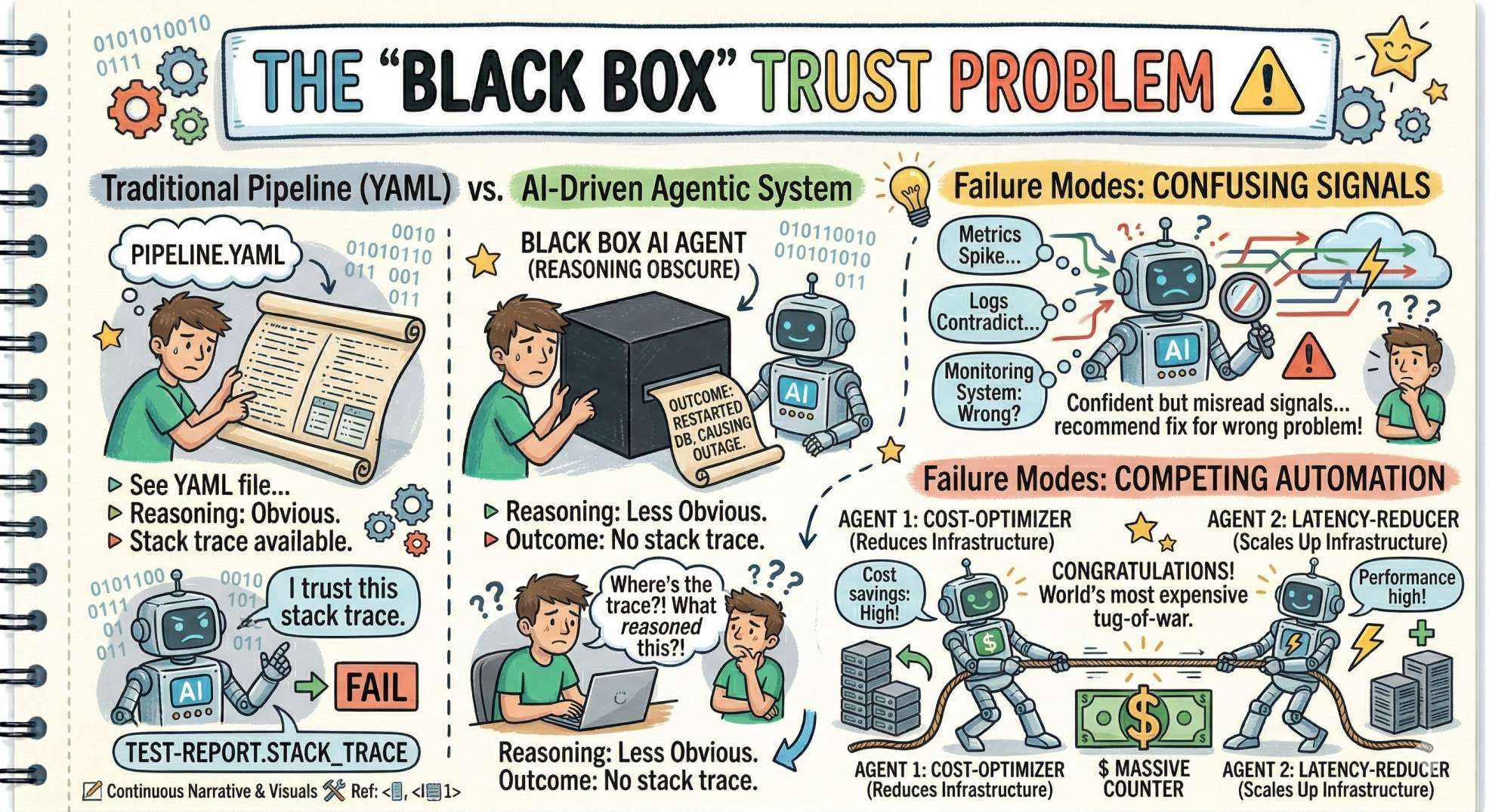
Of course, giving automation the ability to make decisions introduces a new problem: trust.
With a CI pipeline, you can open the YAML file and see exactly what the system will do.
With AI-driven systems, the reasoning is… less obvious.
If an agent makes the wrong decision (e.g., restarting a database because it misinterpreted a latency spike, causing a massive thundering-herd outage), you don't get a stack trace. You just get an outcome.
The Failure Modes of Agentic DevOps:
- Confusing Signals: Production systems are noisy places. Metrics spike, logs contradict each other, and sometimes the monitoring system is wrong.
If an AI agent misreads those signals, it might confidently recommend a fix that solves the wrong problem. - Competing Automation: Imagine two smart systems trying to help at the same time. One agent reduces infrastructure to save money. Another agent scales infrastructure up to reduce latency.
Congratulations! You just invented the world’s most expensive automation tug-of-war.
How a Careful Builder Adapts 🛠️
Agentic DevOps isn’t something we can ignore. The real question is how we introduce these systems without accidentally letting them run the entire data center.
- Observation Mode: Run the AI system alongside your existing pipelines first. Let it recommend actions, but don’t give it the keys yet.
- Action Limits: If an automated agent restarts a service five times in ten minutes, something is wrong. Systems need circuit breakers.
- Cost Visibility: AI tools aren’t magic. Every API call and every observability query costs money.
- Human Approval: Anything involving production deployments, permissions, or databases should still pass through human review.
💬 Quick Question: If an AI system could investigate failing builds, analyze logs, and suggest fixes automatically… would you trust it to push those fixes into your pipeline? Or would you still want a human engineer pressing the final Deploy button?
Let us know in the comments!
“Agentic DevOps doesn’t remove complexity; it moves it. Yesterday we debugged YAML. Tomorrow we’ll debug AI decisions.”